Narrative Historian | Author | Journalist
When Eagles Fall: The 1939 Campaign That Changed the World
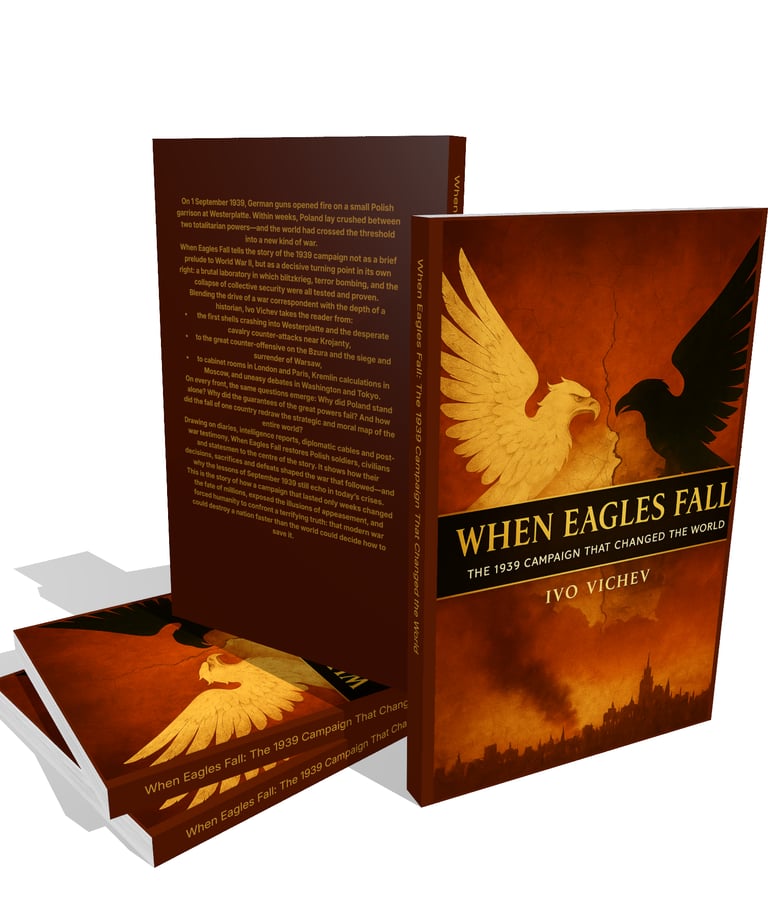
On 1 September 1939, German guns opened fire on a small Polish garrison at Westerplatte. Within weeks, Poland lay crushed between two totalitarian powers — and the world had crossed the threshold into a new kind of war.
When Eagles Fall: The 1939 Campaign That Changed the World does not treat September 1939 as a mere prelude. It treats it as what it was: a decisive turning point in its own right — a brutal laboratory in which blitzkrieg, terror bombing, and the collapse of collective security were tested, proven, and unleashed upon the modern world.
From the first shells crashing into Westerplatte and the desperate cavalry counter-attacks near Krojanty, through the Bzura counter-offensive and the siege of Warsaw, to the cabinet rooms of London and Paris, the Kremlin in Moscow, and the uneasy debates in Washington and Tokyo — this book moves across battlefields, command posts, and corridors of power with equal precision.
On every front, the same questions emerge: Why did Poland stand so largely alone? Why did the guarantees of the great powers fail when they were needed most? How did the fall of one country redraw the strategic and moral map of the entire world?
Drawing on diaries, intelligence reports, diplomatic correspondence, and post-war testimony, When Eagles Fall restores Polish soldiers, civilians, and statesmen to the centre of the narrative. It shows how their decisions, sacrifices, and defeats shaped the war that followed — and why the lessons of 1939 still matter in an age of renewed aggression, territorial revisionism, and open contempt for international law.
This is military and diplomatic history woven into a single narrative — deep yet accessible, built around people rather than abstractions, driven by the choices real men and women made under impossible pressure. It is written for readers who want World War II history told through people, not just dates — who value rigorous analysis delivered without academic jargon — and who believe that understanding how wars begin is just as important as understanding how they end.
In a campaign that lasted only weeks, the world learned how quickly a modern state could be destroyed — and how slowly democracies responded when faced with ruthless, well-prepared aggression.
When Eagles Fall is a powerful reminder that the first campaign of the Second World War was also one of its most important — and that its warnings have never been more relevant.