Narrative Historian | Author | Journalist
Iran: Empire, Faith, and Revolution
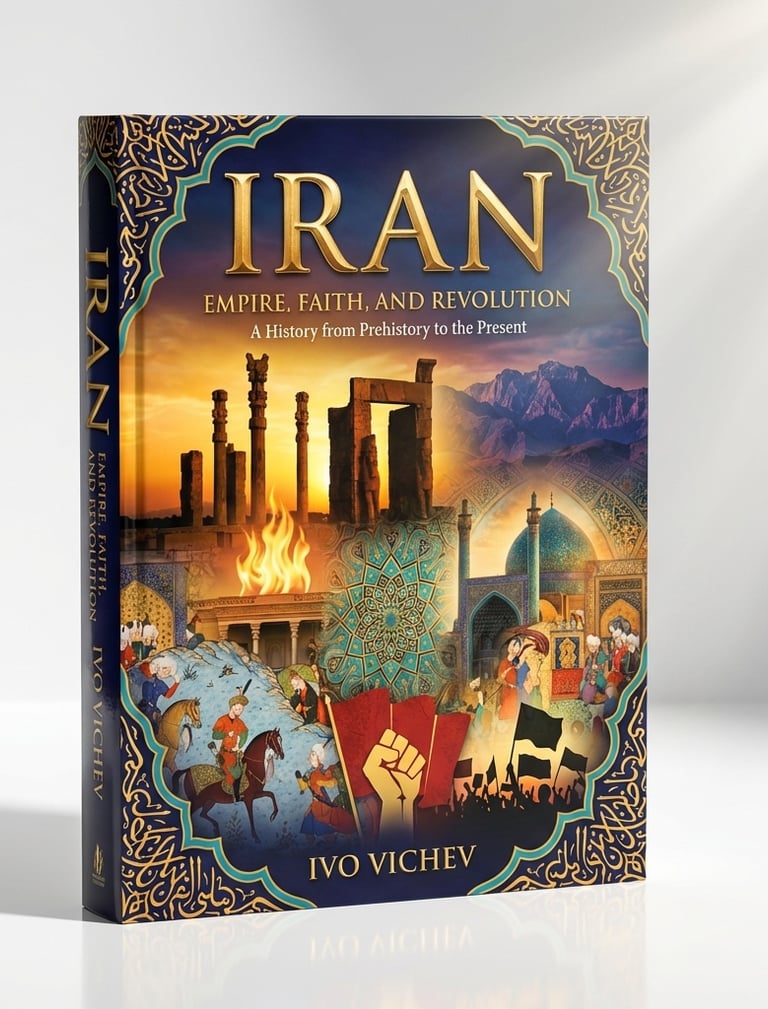
Here's the thing about Iran. This is not a country. It's a civilisation wearing a country's clothes. Ten thousand years of continuous reinvention — absorbing every conqueror, retooling every religion, outlasting every empire including its own. Everyone who invaded Iran became Iranian. That's not a footnote. That's the entire story.
Iran: Empire, Faith, and Revolution tells it all.
It begins where civilisation itself begins — the Zagros Mountains, Elam, the earliest farmers. Then Cyrus the Great builds the Achaemenid Empire and invents something the world hadn't seen: a multi-ethnic state held together by law, tolerance, and infrastructure rather than pure terror. Darius I scales it further. The Greeks show up, burn Persepolis, and Alexander thinks he's conquered Persia. Persia digests Alexander instead.
That pattern never stops. The Parthians absorb Hellenism. The Sasanians build a rival to Rome and fuse Zoroastrianism with imperial power. The Arab conquest brings Islam — and within two centuries, Iranians have reshaped Islamic civilisation so fundamentally that Persian becomes the language of poetry, philosophy, and administration from Anatolia to India. The Mongols flatten everything. Iran rebuilds. The Timurids rise and fall. Iran rebuilds again.
The Safavids change the game permanently. They make Shi'a Islam the state religion, forge a new national identity, and draw a line that still defines Iran today. From there the book follows the Qajar decline, the Constitutional Revolution, Reza Shah's forced modernisation, the British-American coup against Mossadegh in 1953 — the wound that never healed — and the Pahlavi dynasty's attempt to drag Iran into the twentieth century while crushing everyone who disagreed.
Then 1979. The Islamic Revolution wasn't just a political event. It was a civilisational earthquake. Khomeini built something genuinely new — a theocratic republic — and then the Iran-Iraq War cemented it in blood for eight years. The book tracks what came after with the same honesty: the post-Khomeini power struggles, the reform movement, Ahmadinejad's populism, the Green Movement crushed in 2009, sanctions, the nuclear crisis, Rouhani's attempted opening.
The final chapters hit the present directly. Mahsa Amini. Generation Z in the streets. "Woman, Life, Freedom" as a slogan that shook the regime harder than anything since 1979. Iran caught between Russia, China, and the West. A civilisation ten millennia old asking the same question it has always asked: what comes next?
If you want to understand Iran beyond the headlines — beyond "axis of evil" and nuclear talks and cable news shorthand — this is where you start.