Narrative Historian | Author | Journalist
The Venona Decrypts: What Soviet Cables Revealed About Espionage, McCarthyism, and the Cold War
A serious historical analysis of the Venona decrypts, Soviet espionage in America, the Rosenberg case, Alger Hiss, Elizabeth Bentley, Whittaker Chambers, and why the evidence still does not vindicate McCarthyism.
COLD WAR
Ivo Vichev
5/20/202626 min read
The cables arrived after the verdicts had hardened.
After the trials. After the executions. After the congressional performances and the party-line denials, after men had been made symbols and files had been locked away and memory had chosen sides and defended them for decades.
By July 1995, when the National Security Agency released the first Venona translations to the public, Joseph McCarthy had been dead for nearly forty years. Julius and Ethel Rosenberg had been executed at Sing Sing Correctional Facility on 19 June 1953. Alger Hiss had ceased to be merely a defendant and had become a battlefield. Whittaker Chambers had written his memoir. Elizabeth Bentley had been dismissed by some as unstable and regarded by others as a woman who had seen the machinery from inside. The Cold War was over. The Soviet Union had dissolved on 25 December 1991.
Then the messages began to speak.
Not cleanly. Venona came in fragments: cover names, partial decrypts, message numbers, broken sentences, analyst notes, tentative identifications, cables written in the 1940s and read by a later age with too much appetite for final answers. Some messages were recovered in full. Many were not. A recovered message with a cover name was not a conviction. It was a thread. Threads still had to be pulled.
The evidence was serious.
Soviet espionage in the United States had been real, organised, and far-reaching. It had penetrated atomic research, the Treasury, the State Department, the OSS, wartime agencies, and networks connected to the Communist Party USA. Some people defended for decades as victims of hysteria had, in fact, been tied to Soviet intelligence. Some accusations that once sounded like paranoia were not paranoia at all.
But Venona did not vindicate McCarthyism. That distinction has to hold.
Soviet espionage was real. McCarthy was still wrong. He was wrong not because there were no spies. He was wrong because he treated suspicion as evidence, publicity as proof, association as guilt, and political theatre as counterintelligence. Venona exposed a hidden world of signals, couriers, cryptonyms, sources, case officers, and years of slow verification. McCarthy offered lists whose numbers changed under pressure.
The gap was not small. It was the distance between intelligence and accusation.
Venona proved the disease existed. McCarthy poisoned the treatment.
The Secret Work
Venona began on 1 February 1943, when the U.S. Army's Signal Intelligence Service — based at Arlington Hall, Virginia — started examining encrypted Soviet diplomatic traffic that had been accumulating in intercept files since 1939.
At first the work was small, cautious, and almost completely secret. The United States and the Soviet Union were wartime allies. Intercepting and attempting to break the communications of an ally was diplomatically explosive and operationally sensitive. The project's meaning widened later, as the messages began to reveal espionage as well as diplomacy. The first public release did not come until July 1995, beginning with messages concerning Soviet attempts to gather information on the Manhattan Project. Across later releases, roughly 2,900 translations or partial translations entered the public record.
The technical fact matters because it explains both Venona's force and its limits.
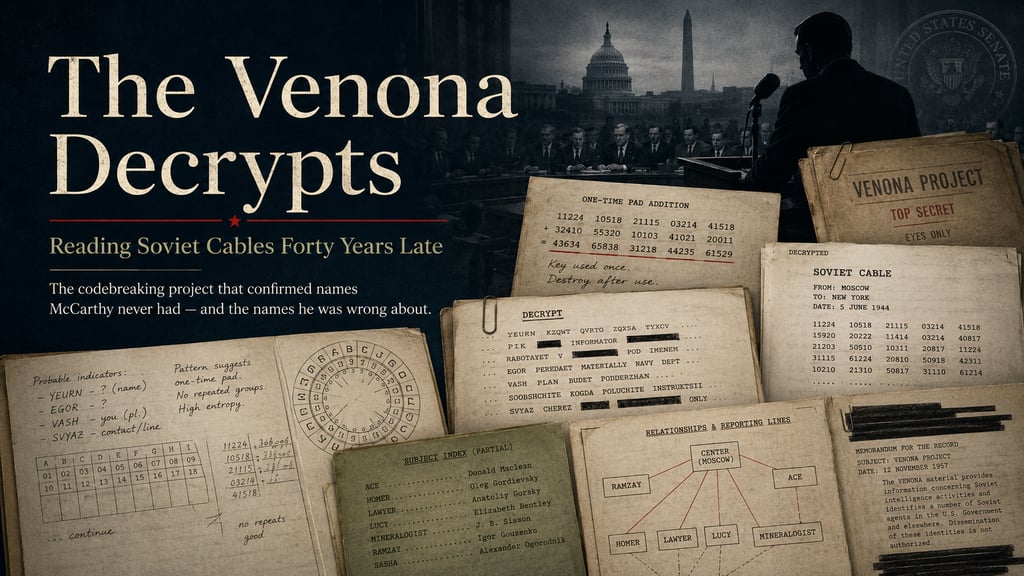
Soviet messages were protected by one-time pads — a system in which a message is encrypted using a random key that is used once and then destroyed. Used correctly, the system is unbreakable. There is no repeating pattern for a cryptanalyst to exploit. The weakness came from Soviet error. In 1942, under pressure from wartime material shortages, Soviet code clerks duplicated some key pages across two separate pad productions. That mistake gave Meredith Gardner and his colleagues at Arlington Hall a narrow, precarious opening into traffic that should have remained permanently closed.
Gardner was a linguist who had taught himself Russian. He made the first significant break into Venona traffic in December 1946, recovering portions of a 1944 message that would eventually point toward atomic espionage. His progress was slow. Each partial decryption was a negotiation between mathematics, linguistic knowledge, and the damaged record itself. Some messages yielded to years of work. Others never gave up their contents at all.
The opening was narrow.
Venona was never a clean list of names. It was a slow recovery of damaged evidence. A cable might reveal a cover name without a real identity. Another might show a contact without proving the contact's function. A third might indicate that Soviet intelligence regarded someone as an asset while leaving unclear whether that person was an agent, a courier, a source, a party contact, or a possible recruit under cultivation.
That is the first defence against bad history. Venona was not magic. It was evidence. Evidence has to be handled.
The programme changed American counterintelligence because it gave investigators a view from inside Soviet communications. It did not give them freedom to speak. If the decrypts were exposed too soon, the Soviets would learn which systems had failed and which channels were compromised. Investigators could know more than they could prove in public. They could follow leads without revealing why.
There was a worse problem. By 1949, Soviet intelligence already knew Venona existed.
William Weisband was a Soviet agent working as a signals intelligence officer inside the U.S. Army Security Agency. He had watched Gardner work and understood what the American cryptanalysts had found. He told his handlers. The KGB changed procedures and tightened communications, though the material already intercepted remained in American hands. Simultaneously, Kim Philby — the British intelligence officer and Soviet spy who served as liaison between British intelligence and the CIA in Washington from 1949 — also became aware of Venona and reported to Moscow. Two separate channels of betrayal reached Soviet intelligence before the American public knew anything at all.
That fact matters for a reason the Cold War's public arguments almost entirely missed. The Soviets knew their communications had been partially broken. American investigators knew the Soviets probably knew. And the public knew nothing. The secrecy that hid Venona from ordinary political debate was not merely bureaucratic caution. It was a response to a compromised security environment whose full shape would not be publicly understood for decades.
Venona gave counterintelligence the shape of the network. Secrecy kept that shape behind a locked door.
What the Cables Revealed
Atomic espionage is the clearest entry point into Venona because the stakes require little explanation.
The Manhattan Project was not an ordinary government programme. It was the largest secret weapons research effort in American history, employing an estimated 130,000 people at its peak and spread across sites in New Mexico, Tennessee, Washington State, and a network of laboratories and facilities that stretched across the country. The Soviet Union wanted to know what the Americans and British were building. Soviet intelligence called the atomic project "Enormous." The name was crude and accurate. By the time the first American bomb was tested at Trinity, New Mexico on 16 July 1945, Soviet intelligence had been receiving information from inside the project for approximately two years.
The atomic cases showed penetration at several levels.
Klaus Fuchs was the professional scientist. Born in Germany in 1911, a committed communist from his student years, he had fled Nazism to Britain in 1933 and eventually became a naturalised British subject. His theoretical physics work earned him a place in the British delegation to the Manhattan Project. He worked at Los Alamos under J. Robert Oppenheimer and had direct access to the implosion design of the plutonium bomb. He passed information to his Soviet handler from 1943 onward, meeting contacts in New York, Santa Fe, and Boston. His courier for much of this period was Harry Gold, a Philadelphia chemist who served as an intermediary between Fuchs and his Soviet controllers.
Fuchs's case showed that Soviet intelligence had reached not merely sympathisers on the margins but scientists with direct knowledge of bomb design. The information he provided was later assessed by Soviet physicists as having materially accelerated the Soviet nuclear programme. The Soviet Union tested its first atomic device on 29 August 1949 — roughly four years after the American test. Western intelligence had estimated the Soviets would not achieve a bomb until at least the mid-1950s. Fuchs's contribution was part of the reason that estimate was wrong.
He was arrested in January 1950, confessed, was tried at the Old Bailey in London, and was sentenced to fourteen years. His confession gave the FBI Harry Gold's name.
Gold was arrested in May 1950. His interrogation led to David Greenglass — a machinist who had worked at Los Alamos and was Ethel Rosenberg's younger brother. Greenglass named Julius Rosenberg as the organiser who had recruited him.
Julius Rosenberg was different from Fuchs in almost every important way. He was not the great physicist in the laboratory. He had studied electrical engineering at City College of New York, joined the Communist Party, worked briefly as a civilian employee of the U.S. Army Signal Corps, and been dismissed in 1945 when his party membership was discovered. He was an organiser. His talent was not theoretical physics. It was people. Venona and later material made his old defence — that he was simply a leftist falsely accused — far harder to sustain. He appeared under Soviet code names, first "Antenna" and later "Liberal," in cables sent between Soviet intelligence officers and their Moscow controllers. He was treated in those cables as a productive recruiting agent.
His network was larger than the public largely understood during the trial. It included Morton Sobell, an engineer and college friend who was sentenced to thirty years; Joel Barr and Alfred Sarant, both engineers who fled the United States before arrest and eventually surfaced in the Soviet Union, where they made significant contributions to Soviet military electronics; and William Perl, another engineer who had passed aeronautical research to Soviet intelligence during the war. The network was not a single leak. It was a structured collection operation built around technical professionals with access to classified material.
Theodore Hall was more unsettling than any of them because his public life never carried the same infamy.
Hall was nineteen years old when he arrived at Los Alamos in 1944 — the youngest scientist at the site, a Harvard-trained physicist of exceptional ability. On his own initiative, without being recruited, he approached Soviet intelligence and offered his services. He later described his reasoning as ideological: he believed a monopoly on nuclear weapons by any single power was dangerous, and that sharing atomic knowledge with the Soviets would create a balance. He passed information through a courier named Saville Sax, a college friend.
Hall was identified through Venona-linked material in the late 1940s. The FBI interviewed him twice. He denied everything. He was never prosecuted. The reason was not innocence. The reason was that prosecution would have required disclosing the Venona programme, revealing to Soviet intelligence exactly how much American codebreakers had recovered, and potentially burning the entire intelligence operation. The state chose secrecy over justice. Hall lived freely in the United States for years, eventually moved to Britain, and died in Cambridge in 1999. He acknowledged his espionage late in life.
His case demonstrates something Venona made unavoidable to understand: the border between intelligence and public justice is not clean. Sometimes the state knows what it cannot say. Sometimes the architecture of a secret intelligence success requires that certain truths remain officially unspoken.
Ethel Rosenberg sits at the hardest point of that problem.
Venona and related evidence make it difficult to maintain the old claim that the Rosenberg case was entirely invented. Julius was a Soviet agent. That much the record supports clearly. Ethel's role was not Julius's role. That distinction should never have been blurred, and later evidence has made the blur look worse.
A declassified memorandum by Meredith Gardner concluded that Ethel knew about Julius's espionage but did not engage in operational work herself. She had no code name in the Venona traffic. Julius did. The key testimony against Ethel at trial came from her brother David Greenglass, who told the court that Ethel had typed notes he had written about Los Alamos. Decades later, in a 2001 interview, Greenglass recanted. He had lied, he said, to protect his own wife Ruth, who had also been involved.
The prosecution used Ethel Rosenberg as leverage against her husband in the hope that the threat of her execution would compel Julius to confess and name additional members of his network. Julius did not confess. Both were executed. A 2015 release of grand jury testimony largely reinforced the existing picture: Julius was central, Ethel was peripheral, and what peripheral involvement she had was known to her rather than operational.
Venona made Julius Rosenberg harder to defend. It made Ethel Rosenberg harder to execute.
That is not a slogan. It is the moral shape of the evidence.
Beyond the Bomb
The cables reached far beyond atomic espionage. They pointed toward Soviet access inside government, policy, and diplomatic machinery — a penetration whose depth had long been disputed and whose implications the American government found genuinely alarming.
Harry Dexter White was perhaps the most consequential non-atomic figure in the Venona record.
White was a senior official in the U.S. Treasury, eventually serving as Assistant Secretary. He was an architect of the Bretton Woods agreements of 1944, which created the International Monetary Fund and the World Bank and established the postwar international financial order. He appeared in Venona cables under the cover name "JURIST" and was described by Soviet intelligence as a source of significant value. Elizabeth Bentley had already named him. So had Whittaker Chambers, though with less precision about his specific role.
What White passed and how consciously he understood his relationship with Soviet intelligence remain contested. The Venona cables do not settle every question about his intent, his awareness of how his information was being used, or whether he understood himself as an agent in the operational sense. What they show, combined with other evidence, is that Soviet intelligence regarded him as an asset and had access through him or networks around him to Treasury deliberations at the highest level.
White was called before the House Un-American Activities Committee in August 1948. He denied being a Soviet agent, delivered a confident and well-received public statement, and died of a heart attack three days after his testimony. He was fifty-five years old.
His death permanently foreclosed the possibility of prosecution. It also permanently complicated the historical record. A man who died three days after testifying, who never faced cross-examination over time, and whose private correspondence and relationships left a mixed and contested picture, became one of those Cold War figures who resists the clean verdict later generations often want to assign.
The Silvermaster network illustrated how Soviet intelligence built collection infrastructure inside the American government.
Nathan Gregory Silvermaster was an economist working in the Farm Security Administration and later other wartime agencies. He ran a network of contacts and sources that included, according to Bentley's testimony and Venona corroboration, officials in the War Production Board, the Foreign Economic Administration, and the Treasury. His home in Washington became a centre for photographing documents, which were then passed to Bentley for delivery to her Soviet handler Jacob Golos. Golos died in 1943, after which Bentley continued working directly with Soviet intelligence until her November 1945 defection.
The Perlo group was another network operating in parallel, with members inside the War Production Board and other agencies.
These were not isolated individuals acting on personal conscience. They were interconnected structures — loose, imperfect, sometimes disorganised, but real — through which information about American policy, production, economic planning, and diplomatic intentions moved toward Soviet handlers and then toward Moscow.
Alger Hiss occupied different ground because his case had become symbolic before Venona became public.
Hiss was not a minor official. He had attended the Yalta Conference in February 1945 as part of the American delegation. He had been the secretary-general of the San Francisco Conference that produced the United Nations Charter in June 1945. He had served in the State Department, had worked on postwar planning, and had been present at several of the most consequential diplomatic moments of the final war years and the immediate postwar period.
Whittaker Chambers accused him in 1948 before HUAC of having been a member of the same underground communist cell in Washington in the 1930s. Hiss denied it, sued Chambers for libel, and the case escalated into one of the defining confrontations of the early Cold War. Chambers produced documents — the so-called Pumpkin Papers, microfilm he had hidden inside a hollowed pumpkin on his Maryland farm — that he claimed Hiss had provided. Hiss was tried twice for perjury, convicted on the second trial in January 1950, and sentenced to five years in prison. He served forty-four months and spent the rest of his life, until his death in 1996, insisting on his innocence.
The key Venona question was the cover name ALES. A 1945 cable described an agent with that designation as a State Department official who had attended the Yalta Conference and had met with a Soviet military intelligence officer in Moscow shortly afterward. The profile matched what was publicly known about Hiss closely enough to make the identification compelling, though serious historians treated it as strong rather than mathematically certain. The identification was not made in a formal, authoritative Venona translation note. It was an analyst annotation. That distinction matters for the precision of the claim.
Venona did not end the Hiss argument. It moved the argument onto much harder ground. The people most invested in his innocence had less evidentiary ground to stand on after 1995. They did not concede. They shifted to arguing the identification of ALES as Hiss was itself uncertain. That is a legitimate argument about the quality of evidence. It is not the same as the older argument that the entire case was a fabrication.
The Party and the Networks
One of the most contested questions Venona raised was the relationship between the Communist Party USA and Soviet intelligence.
The CPUSA was not a small organisation. At its peak in the mid-1940s it had approximately 75,000 members. Many were labour organisers, trade union officials, writers, artists, academics, teachers, lawyers, government workers, and political activists with no connection to espionage of any kind. For most of its membership the party was exactly what it appeared to be: a political organisation with a distinct ideology, a particular culture, and affiliations that became embarrassing or dangerous as Soviet behaviour became harder to ignore.
Soviet intelligence did not recruit universally from party membership. It recruited selectively.
The party provided something more valuable than a list of potential spies. It provided a community of trust, a system of vetting, a shared set of loyalties and disciplines, and a network of social relationships inside which contact between a Soviet handler and a potential American source could occur without immediately appearing suspicious. A party connection was not evidence of espionage. But a party connection was one of the mechanisms Soviet intelligence used to identify, approach, test, and cultivate people who might become useful.
Venona showed that the distinction between party member and intelligence source was real and operational. Soviet cables distinguished between full agents, developmental contacts, party sources, unwitting sources, and people under consideration. That taxonomy meant that a person could be inside the party's world without being inside the intelligence network — and that a person could be inside the intelligence network without having formally joined the party.
The honest position is that Venona proved Soviet intelligence used the CPUSA as a recruitment environment while leaving intact the fact that most CPUSA members had nothing to do with espionage. McCarthy erased that distinction. He treated party membership, or proximity to party members, or sympathy with any position the party had ever held, as evidence of loyalty to a foreign power. That move was intellectually dishonest and politically convenient.
The Witnesses Before the Cables
Venona also changed the standing of the earlier witnesses whose testimony had defined the public argument about Soviet espionage before any decrypt became available.
Elizabeth Bentley walked into the FBI's New York office on 7 November 1945 and described her work as a courier for Soviet espionage rings. She named more than eighty people, including senior government officials, wartime agency employees, and members of the two main networks she had served as a courier — the Silvermaster group and the Perlo group. She described Jacob Golos, her handler and lover, who had died in 1943. She described how documents were photographed and passed. She described routes, contacts, tradecraft, and the operational texture of Soviet intelligence work inside the American government.
Much of what she said fitted information the FBI already possessed, but she brought knowledge rather than courtroom-ready proof. That made her vulnerable. She was a defector, a former insider, a damaged witness carrying memory and motive together. She had been a communist. She had loved Golos. She had operated under a system of compartmentalisation that meant her knowledge was real but partial. Human testimony always needs testing. Bentley was not a document.
When she testified publicly before HUAC in July 1948, the reaction split sharply along political lines. Critics called her unstable, self-promoting, and unreliable. Supporters called her courageous. Nobody on either side had access to the Venona cables, which were confirming parts of her account in real time inside sealed intelligence channels.
Venona did not make every word she spoke true. It showed that she had not invented the world she described.
Whittaker Chambers had a different relationship to the public argument. He had been a party member and, by his own account, a courier for Soviet underground networks in the 1930s. He had left the party in 1938 and eventually become a senior editor at Time magazine. His testimony against Hiss before HUAC in August 1948 produced one of the most dramatic confrontations of the period. He was a complicated witness: deeply intelligent, prone to grandiosity, writing from memory about events more than a decade in the past, with a convert's zeal about the communist threat that coloured everything he said. His memoir, Witness, published in 1952, was an extraordinary document — part confession, part polemic, part religious autobiography — that shaped how a generation understood the Cold War.
Chambers and Bentley had spoken about Soviet networks before Venona could speak publicly. His testimony belonged to the open political war. Venona belonged to the sealed intelligence war. When the two worlds later touched, the older arguments changed. Neither Chambers nor Bentley had simply conjured a Red Scare fantasy. They had each seen part of a real apparatus.
That does not make testimony sacred. It means documents can rescue testimony from both credulity and contempt.
Why the Public Could Not Know
Venona created one of the most difficult conditions a democracy can face. The state possessed evidence that could have disciplined public argument, but the evidence itself had to remain secret.
The reason was not trivial. If the decrypts had been exposed too early, Soviet intelligence would have learned which communications had been broken, which systems had failed, and which methods required protection. The intelligence value could have collapsed. The Soviets already suspected the worst, after Weisband's and Philby's reports, but suspicion and confirmed knowledge are operationally different. Keeping Venona secret preserved some residual uncertainty in Moscow.
Secrecy still had a cost.
President Truman was apparently never given a full, direct briefing on Venona by his intelligence and security services. Whether this was bureaucratic failure, institutional caution about the programme's fragility, or some more deliberate calculation is not fully resolved. The consequence was that the president was making public judgements about the severity of Soviet penetration — calling the Hiss case a "red herring" in 1948, dismissing some spy charges as politically motivated — without the same information his own counterintelligence services possessed. The political damage was compounded by this asymmetry. Defenders of accused spies could argue with greater conviction that the cases were fabricated, because the evidence that would have undermined that argument was locked inside a programme almost nobody in public life knew existed.
Investigators received fragmentary decrypts. They opened files. They followed leads. They found corroboration. They also hit dead ends, faced witnesses who refused to confess, and handled cases where the evidence was real but unusable in open court without destroying the intelligence methods that had produced it. The result was a system in which counterintelligence officers sometimes knew the answer and could not say it, prosecutors sometimes brought cases on thinner evidence than they possessed, and targets sometimes walked free not because of innocence but because the strongest proof could not be shown.
This is where Venona becomes more than a spy story. It becomes a story about knowledge trapped inside institutions.
A democracy cannot judge what it cannot see. An intelligence service cannot reveal everything it knows without destroying the work it exists to do. Between those truths, the early Cold War built a space where fear, denial, evidence, and opportunism lived together.
McCarthy walked straight into that space.
McCarthy's Microphone
Joseph McCarthy did not rise because he discovered Venona.
He did not have the decrypts. He did not break Soviet communications. He did not compare cover names with travel records, test cryptonyms against personnel files, or build cases through years of quiet verification. He rose because he understood the political force of accusation in an environment where the government had created an information vacuum by classifying the most important evidence it possessed.
On 9 February 1950, at a Republican Women's Club dinner in Wheeling, West Virginia, he claimed to be holding a list of 205 known communists employed in the State Department. Within days the number became 57 "card-carrying members." Later it became 81. The movement of the numbers matters because it reveals the method. When pressed on specific names, he pivoted, attacked the questioner, changed the figure, or buried the procedural challenge under a new accusation. The list was never subjected to the kind of scrutiny that would have exposed how thin the evidentiary basis actually was.
Venona worked from fragments toward identification. McCarthy worked from assertion toward attention. Venona narrowed. McCarthy widened. Venona distinguished between an agent, a contact, a party member, a spouse, a source, and a person mentioned in passing. McCarthy blurred those categories until suspicion itself became a weapon.
His defenders later tried to use Venona as a shield. The argument is simple: Soviet espionage was real; McCarthy warned of Soviet penetration; Venona proved Soviet penetration; therefore McCarthy was vindicated.
That argument collapses under evidence.
M. Stanton Evans, the conservative journalist who made the most sustained case for McCarthy's rehabilitation in his 2007 book Blacklisted by History, argued that Venona demonstrated the reality of the threat McCarthy had been warning about. John Earl Haynes and Harvey Klehr, the historians who did more than anyone else to document Soviet espionage in America through Venona and Soviet archive material, reached a different conclusion. They accepted the full seriousness of Soviet penetration. They rejected the claim that their findings vindicated McCarthy. He was right only in the broadest sense that Soviet infiltration existed. Where he repeated earlier and better-grounded warnings made by the FBI, HUAC, and others, he added little. Where he was original, he was often wrong. His errors were not harmless. They damaged the anti-communist cause by making precision look like weakness and recklessness look like courage.
That is the centre of the matter.
McCarthy was not wrong because there were no Soviet agents. He was wrong because real espionage made evidence more necessary, not less. A man accused of espionage is not being accused of a policy error. He is being accused of betrayal — of an act that in wartime carried the death penalty and in any era involves the deliberate transfer of the country's secrets to a hostile foreign power. That burden requires discipline. McCarthy used the language of treason while refusing the discipline that language demands.
The Names He Never Had
The strongest Venona cases were not McCarthy's trophies.
Klaus Fuchs was exposed through British-American counterintelligence work that had nothing to do with McCarthy's genius. MI5's investigation of Fuchs began when Venona-linked material identified his Soviet contact and worked backward. His confession was produced through patient interrogation by MI5 officer William Skardon over multiple interviews across January 1950. The investigation that led from Fuchs to Gold to Greenglass to Julius Rosenberg was built by the FBI's New York field office, drawing on confessions and corroborating evidence gathered through investigative work that preceded any McCarthy intervention.
Theodore Hall was identified through Venona-linked material in the late 1940s. He was interviewed by the FBI. He did not confess. He was not prosecuted. He does not appear as a centrepiece of McCarthy's public crusade because he was a case the government handled through secrecy rather than theatre. He proved both the depth of Soviet atomic espionage and the gap between what the government knew and what it could say.
Harry Dexter White had already been named by Bentley and Chambers before McCarthy rose to national prominence. His case was in the hands of the FBI and HUAC before McCarthy ever held a microphone at Wheeling.
Alger Hiss had already become the defining Cold War espionage case before February 1950. Richard Nixon, then a young California congressman, had been the central figure pursuing Hiss through HUAC since 1948. Venona strengthened the historical case against Hiss — but that strengthening came decades after the conviction, in the privacy of later scholarship, not through anything McCarthy provided.
Bentley and Chambers had spoken before the decrypts could be used publicly. McCarthy entered after much of the hard material already existed in other hands, built by other people through methods he did not employ and did not understand.
This is why the phrase "McCarthy was right" is lazy history.
Right about what? That Soviet espionage existed? Yes, at the broadest level — the same level at which J. Edgar Hoover, HUAC investigators, Bentley, Chambers, and the Venona analysts had already been right, years before McCarthy's Wheeling speech. Right about his shifting lists? No. Right about George Marshall? No. Right that accusation could substitute for proof? No. Right that ideological sympathy with labour causes constituted evidence of espionage? No.
He saw smoke in a country where some fires were real. Then he set fire to the courthouse.
The Names He Was Wrong About
The damage of McCarthyism did not lie only in tone. It lay in method and in scale.
George Marshall is the clearest example of how far suspicion could travel once detached from evidence.
Marshall had been Army Chief of Staff throughout the Second World War. He had coordinated the largest military mobilisation in American history, managed relationships between Roosevelt, Churchill, and the Allied command structure, and was regarded by virtually every serious military and political observer as one of the essential architects of Allied victory. As Secretary of State under Truman, he gave his name to the European Recovery Programme — the Marshall Plan — that transferred approximately thirteen billion dollars to Western European economies between 1948 and 1952 and is widely credited with stabilising democratic governments across the continent. He became Secretary of Defence in 1950 and was awarded the Nobel Peace Prize in 1953.
McCarthy, in a Senate speech in June 1951, accused Marshall of being part of "a conspiracy so immense and an infamy so black as to dwarf any previous venture in the history of man." The speech ran to approximately sixty thousand words. It was read into the Congressional Record. It was based on nothing that would survive scrutiny as evidence.
Owen Lattimore was presented by McCarthy in March 1950 as "the top Russian espionage agent" in the United States. Lattimore was a scholar of Central Asian affairs who had served as an adviser to Chiang Kai-shek during the war and had been involved in postwar policy debates about China. His politics were clearly left-leaning. Whether his advice and influence had been damaging, misguided, or simply wrong were questions that could be debated. None of those debates added up to being a Soviet espionage agent in the operational sense. A State Department loyalty board cleared him. The FBI, which had been watching him for years, never brought an espionage charge.
John Service, John Carter Vincent, and John Paton Davies were foreign service officers who had served in China during and after the war and had sent reports back to Washington arguing that Chiang Kai-shek's government was corrupt, incompetent, and likely to lose to Mao Zedong's forces. Their assessments were accurate. Their reward was years of loyalty hearings, career destruction, and the implication that they had "lost China" through treachery rather than observed its fall through clear reporting.
Philip Jessup, the U.S. Ambassador-at-Large, was accused by McCarthy of having "an unusual affinity for communist causes." Eisenhower, Truman, and Marshall all personally vouched for Jessup. McCarthy's attack prevented his appointment to a diplomatic post regardless.
These cases show the mechanism of the damage. It did not require a guilty verdict. It required only the accusation, the hearing, the headline, and the institutional machinery of loyalty investigations that the early Cold War had built and that McCarthy knew how to weaponise.
The Institutional Machine
McCarthy did not operate alone or in a vacuum.
The Federal Employees Loyalty Program, established by Truman in March 1947, created the bureaucratic structure within which McCarthyism operated. Executive Order 9835 required loyalty investigations of all federal employees. The standard was initially whether "reasonable grounds" existed to doubt loyalty. In April 1951 Truman tightened it to a "reasonable doubt" standard — meaning the burden shifted from the government to prove disloyalty, to the employee to prove loyalty.
The change was significant. Under the revised standard, an employee could be dismissed not because evidence showed they had done anything wrong, but because the investigation had produced doubt that they had not. Membership in organisations that the Attorney General had listed as subversive was enough to trigger investigation. Membership was sometimes historical, sometimes nominal, sometimes a matter of having attended a single meeting a decade before. None of that mattered in the loyalty-board calculus.
Thousands of federal employees resigned, were dismissed, or had careers effectively ended through this machinery between 1947 and the mid-1950s. The State Department, the most politically exposed agency, lost experienced officers through a combination of loyalty proceedings and self-protective caution from managers who preferred dismissal to the administrative burden of defending a target.
The entertainment industry operated through its own version of the same mechanism. HUAC began investigating Hollywood in 1947. The Hollywood Ten — directors and screenwriters who refused to testify before the committee and cited First Amendment protections — were cited for contempt of Congress, convicted, and imprisoned. The blacklist that followed operated informally but effectively. A name on a list circulated by Red Channels, a pamphlet published in 1950 that named 151 actors, writers, and directors as communist sympathisers, was enough to end a career at any of the major studios or broadcast networks. No charges. No trial. No verdict. Just a name.
McCarthy entered this environment and intensified it. He did not create it. That is worth remembering. The machinery preceded him. He understood how to make it serve his political ambitions.
The Army-McCarthy Hearings
McCarthy's method collapsed publicly during a thirty-six-day series of televised hearings beginning on 22 April 1954.
The immediate trigger was his investigation of alleged communist influence in the U.S. Army — specifically, a dispute arising from the Army's refusal to give preferential treatment to a former aide of McCarthy's named G. David Schine, who had been drafted. McCarthy, in retaliation, had accused the Army of harbouring communists and covering up subversive activity.
The hearings were televised. An estimated twenty million Americans watched. What they saw was not the crusading patriot McCarthy had constructed in his public image. They saw a bully — interrupting, threatening, shouting objections, badgering witnesses, and deploying innuendo as a substitute for evidence.
The decisive moment came on 9 June 1954. McCarthy introduced, in an apparent attempt to smear a young lawyer in the Army's counsel's office, a reference to the man's brief youthful membership in a leftist legal organisation. Joseph Welch, the Army's chief counsel — a sixty-three-year-old Boston attorney from the firm of Hale and Dorr — turned to McCarthy and said: "Have you no sense of decency, sir? At long last, have you left no sense of decency?"
The room erupted in applause.
The United States Senate censured McCarthy on 2 December 1954 by a vote of 67 to 22 — condemning him for conduct "contrary to senatorial traditions." He remained in the Senate but lost his committee chairmanship and ceased to be a force in American politics. He died on 2 May 1957 at Bethesda Naval Hospital. He was forty-eight years old. The official cause was acute hepatitis. It was widely understood to be related to long-term alcoholism.
He was gone. The machinery he had accelerated did not disappear with him.
What Venona Proved
Venona proved that Soviet espionage in wartime and postwar America was not a paranoid invention.
It showed penetration of atomic research by multiple people at multiple levels. It strengthened cases involving Julius Rosenberg, Klaus Fuchs, Theodore Hall, and others in the atomic programme. It corroborated substantial parts of Elizabeth Bentley's account of government networks. It reinforced the evidentiary case against Alger Hiss. It showed that Harry Dexter White was regarded by Soviet intelligence as a high-value source in a position of significant institutional access. It revealed that some people defended for decades as victims of pure hysteria were not innocent in the way their defenders had claimed.
It also showed that the Communist Party USA was not merely a domestic political organisation in every case. For most of its members it was exactly that: a political home, a labour structure, an ideological community — sometimes a foolish allegiance, sometimes a social world, sometimes a moral disaster when the full record of Soviet behaviour was admitted. For Soviet intelligence, party circles provided recruitment pools, contact environments, trust networks, and mechanisms of access. That fact cannot be wished away because McCarthy abused it.
Venona also proved that American counterintelligence often worked with one hand tied. It knew things it could not say. It watched people it could not expose. It built cases around evidence it could not reveal. Some guilty people were defended as martyrs. Some innocent people were damaged by proximity to genuine espionage. Some prosecutors overreached. Some defenders lied to protect a political faith they could no longer honestly sustain.
Venona did not make the early Cold War clean. It made it dirtier, more specific, and harder to use.
What Venona Did Not Prove
Venona did not prove that every person accused during the Red Scare was guilty.
It did not prove that McCarthy's lists were accurate. It did not prove that he personally uncovered the major Soviet networks. It did not prove that every communist, socialist, liberal, labour organiser, academic, artist, New Deal official, or foreign service officer under suspicion was a Soviet agent. It did not prove that Soviet espionage controlled American policy. It did not convert recklessness into courage after the fact.
The archive does not work that way.
A document can vindicate one claim and destroy the method of the person who shouted it. Venona confirmed espionage while exposing the need for restraint. It showed the difference between knowing and suspecting, between evidence and atmosphere, between a cover name in a decrypted cable and a name waved from a podium to a crowd that did not know the difference.
The lesson is uncomfortable on both sides of the old argument.
For those who spent decades insisting that Soviet espionage was a right-wing fabrication — that the Rosenbergs were martyrs, that Hiss was framed, that Chambers was a fantasist, that Bentley was a troubled woman inventing a world to give herself importance — Venona is devastating. The networks were real. Some of the martyrs were not martyrs. Some of the accusations that sounded like paranoia were built on evidence.
For those who want to rehabilitate McCarthy — who want to read Venona as a vindication of everything he said and did — Venona is equally devastating. It shows what serious counterintelligence work looked like: quiet, technical, slow, cross-checked, often uncertain, often unable to speak publicly. It shows investigators making painstaking recoveries from damaged cryptographic material, building identifications over years, naming uncertainty precisely where the record required it. McCarthy's method looks smaller beside that work, not larger.
The real spies were there. That did not make every accusation true.
The Final Measure
Venona changed the history of the early Cold War because it forced two truths to stand together, and because one of those truths had been denied on the left for decades while the other had been used dishonestly on the right.
The first: Soviet espionage in the United States was real, organised, and sometimes dangerously successful. Atomic information moved from Los Alamos to Moscow. Government information moved from Treasury offices and wartime agencies to Soviet handlers. Technical and military material moved through networks of engineers, scientists, and officials who had decided, for their own reasons — ideological conviction, misplaced loyalty, idealism about Soviet communism, simple careerism in some cases — that passing secrets served a larger good.
The second: McCarthyism was still a disgrace. Not because anti-communism was automatically hysteria. Not because communist espionage was imaginary. Not because every accused person was innocent. McCarthyism was a disgrace because it broke the discipline truth required. It collapsed categories. It punished suspicion. It destroyed careers on the strength of association, proximity, and accusation alone. It made political theatre out of what should have been careful counterintelligence work. It called the performance patriotism. And it caused real damage to real people — dismissed employees, blacklisted writers, ruined careers, frightened witnesses, and a generation of public servants who learned that honesty in their reporting about the Soviet world could make them targets of the senator with the microphone.
Venona did not absolve McCarthy. It made him smaller.
The codebreakers worked in fragments, number groups, duplicate key material, cover names, partial decrypts, linguistic patience, and years of silence. Meredith Gardner made his first significant break in December 1946 and spent years afterward pressing further. Investigators worked through defectors' testimonies, surveillance, personnel files, travel records, contradictions between what people claimed and what the cables showed. They made mistakes. They overreached. But they also did the work — slow, precise, unglamorous, constrained by the very secrecy that made the work possible.
McCarthy had a microphone.
That was enough to damage lives. It was not enough to find the truth.