Narrative Historian | Author | Journalist
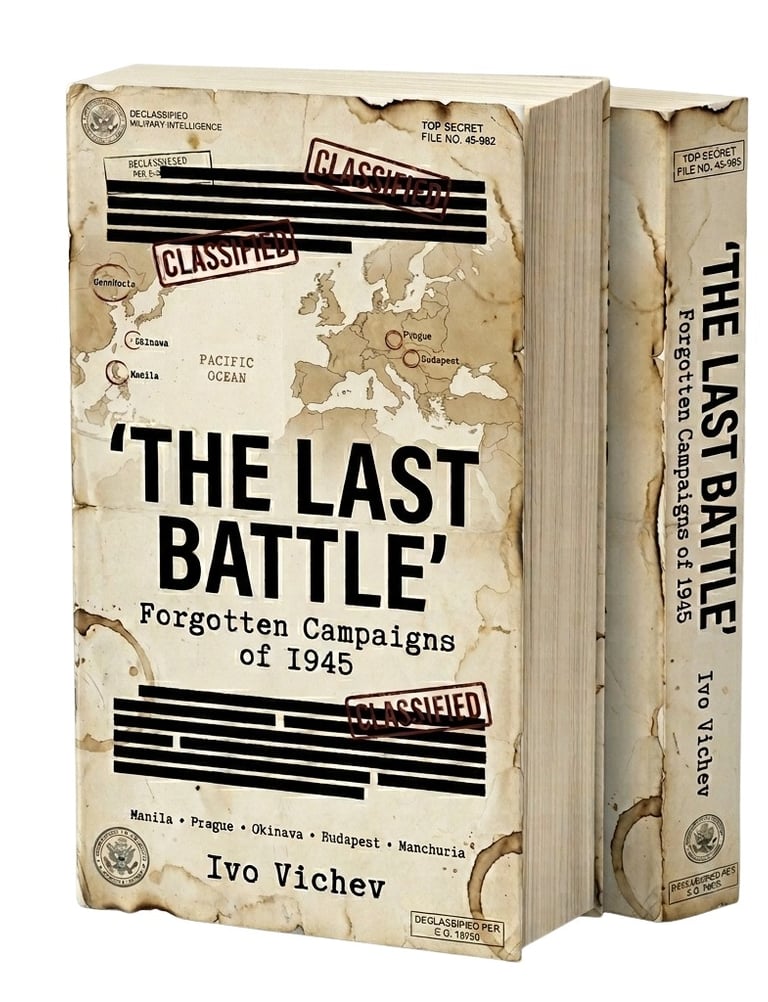
The Last Battle – Forgotten Campaigns of 1945
The war didn’t end with a signature. It ended with a scream. On the day Germany surrendered, nineteen-year-old Gerda Weissmann lay in a barn in Czechoslovakia weighing sixty-eight pounds, the sole survivor of a death march that swallowed thousands of women whole. In Manila, 100,000 civilians were dead in a single month, crushed under the rubble of their own liberation. In Okinawa, entire families leapt from cliffs rather than face what was coming. 1945 was the bloodiest year of the bloodiest war in human history. And nobody talks about it. Until now.
The Last Battle rips open the final chapters of World War II that mainstream history sealed shut. This is not another generals-and-glory retelling. This is history from the cellars where civilians hid while their cities burned, from the refugee columns stretching across shattered continents, from the resistance fighters who won their freedom only to be betrayed by the peace they bled for. Drawing on survivor testimonies, declassified military archives, and frontline accounts, Ivo Vichev reconstructs five forgotten campaigns that shaped the modern world—campaigns where liberation looked exactly like destruction.
The Battle of Manila remains one of the deadliest urban battles in modern warfare. American artillery and Japanese atrocities combined to kill over 100,000 Filipino civilians in February and March 1945, a death toll that rivals Hiroshima. The Pearl of the Orient was reduced to the second-most-destroyed Allied capital after Warsaw. Schools became execution chambers. Churches became crematoriums. And the world called it freedom. Between April and June 1945, Okinawa became a preview of what invading mainland Japan would cost. Over 12,000 American soldiers, 100,000 Japanese troops, and as many as 150,000 Okinawan civilians died in eighty-two days of fighting. Japanese propaganda convinced thousands of civilians that surrender meant torture and mass suicides swept the island. Entire families held grenades between them. American war planners watched the casualty reports and concluded that only something unprecedented could end this war without a million more deaths. Okinawa didn’t just end a battle. It started the atomic age.
On May 5, 1945, three days before Germany’s official surrender, Prague exploded into open revolt. Czech resistance fighters seized radio stations, built barricades, and begged the approaching American Third Army for help. General Patton’s forces were kilometers away. They never came. An agreement with the Soviets kept American troops west of a line drawn on a map in a room far from the fighting. Prague’s resisters held out for four days, fighting and dying for a liberation that would arrive under a Soviet flag and carry a very different meaning. While the world fixated on Hiroshima and Nagasaki, 1.5 million Soviet troops smashed into Japanese-occupied Manchuria on August 9, 1945, in one of the largest and fastest military operations in history. In just two weeks the Soviets destroyed Japan’s Kwantung Army, seized territory the size of Western Europe, and redrew the map of East Asia. This invasion, not the atomic bombs alone, may have been what finally forced Japan’s surrender. It also planted the seeds for the Korean War, Mao’s victory in China, and the Cold War in Asia. The most consequential campaign of 1945, and most Westerners have never heard of it.
In Budapest one of the war’s longest and most savage sieges ground on through the winter of 1944 and 1945, killing tens of thousands of civilians trapped between Soviet and German forces in a city neither side was willing to surrender. In the Philippines Japanese holdouts and mopping up operations continued killing soldiers and civilians months after the world declared peace. For the people caught in these forgotten battles the war’s official end date was meaningless. The dying continued on its own schedule.
We live in an era where wars are watched in real time on phone screens, where liberation and destruction blur into the same footage, where civilians die in campaigns the world has already moved on from. The Last Battle isn’t just about 1945. It’s about every war that ends on paper while the killing continues on the ground. Ivo Vichev has written the World War II book for readers who are done with the sanitized version, readers who understand that history’s most important lessons live in the chapters we’ve been taught to skip. If you’ve read The Second World War by Antony Beevor, Inferno by Max Hastings, Bloodlands by Timothy Snyder, or The Rape of Nanking by Iris Chang and you still felt like something was missing from the story of how the war actually ended, this is the book that fills the gap. The Second World War ended in 1945. For millions caught in its final campaigns, liberation looked exactly like destruction. It’s time you knew the whole story.