Narrative Historian | Author | Journalist
The Penkovsky Papers: A Source That Probably Saved the Cuban Missile Crisis
The warning did not begin in the Cabinet Room. It began earlier, in Moscow, with a Soviet officer carrying secrets out of the system that had trained him to keep them. Oleg Penkovsky was a colonel in Soviet military intelligence, the GRU. He knew enough to be useful and enough to be killed. He moved through a city built around suspicion, where foreign diplomats were watched, phones were unsafe, meetings had shadows, and any contact with the wrong person could become a sentence before a judge had spoken.
INTELLIGENCE & ESPIONAGE HISTORY
Ivo Vichev
5/15/202611 min read
It began earlier, in Moscow, with a Soviet officer carrying secrets out of the system that had trained him to keep them. Oleg Penkovsky was a colonel in Soviet military intelligence, the GRU. He knew enough to be useful and enough to be killed. He moved through a city built around suspicion, where foreign diplomats were watched, phones were unsafe, meetings had shadows, and any contact with the wrong person could become a sentence before a judge had spoken.
By October 1962, his work had already entered the bloodstream of Western intelligence. Documents, photographs, debriefings, technical descriptions, missile manuals, estimates of Soviet strength and weakness — the material moved from Moscow into British and American hands before the world knew how close it was moving towards nuclear war. Penkovsky did not stop the Soviet decision to put missiles in Cuba. He did not discover the sites from the air. He did not sit beside John F. Kennedy when the photographs arrived.
His value was more exact than that.
He helped the West understand what it was looking at when the photographs came in.
That difference mattered. The Cuban Missile Crisis is usually remembered as thirteen days in October: U-2 photographs, Kennedy’s advisers around a table, naval quarantine, Khrushchev’s messages, American aircraft over Cuba, Soviet ships approaching the line, and the final retreat from nuclear war. The shape is familiar because it is dramatic and contained. Thirteen days can be held in the mind. They have a beginning, a middle and an ending.
The nuclear danger was not that neat.
Soviet nuclear warheads had reached Cuba before Kennedy spoke to the American public. The wider deployment lasted far longer than the famous thirteen days. The crisis did not begin only when Washington realised what was happening, and it did not end cleanly when the public version of the bargain was announced. American intelligence did not know everything it needed to know. It did not see every weapon. It did not control every trigger. It did not understand every Soviet command arrangement on the island.
This is why Penkovsky mattered without becoming a saviour myth.
He gave Kennedy’s government a head start in one part of the crisis where time could still be used. The missiles in Cuba had to be identified. Their range had to be understood. Their support equipment had to be read. Their readiness had to be estimated. A launch site under construction was not the same thing as a missile ready to fire. A convoy in a photograph was not useful unless someone could say what it belonged to. A trailer, an erector, a canvas-covered shape, a pattern of cleared ground — each detail needed to be translated into military meaning before it could become political judgment.
Penkovsky helped supply that translation.
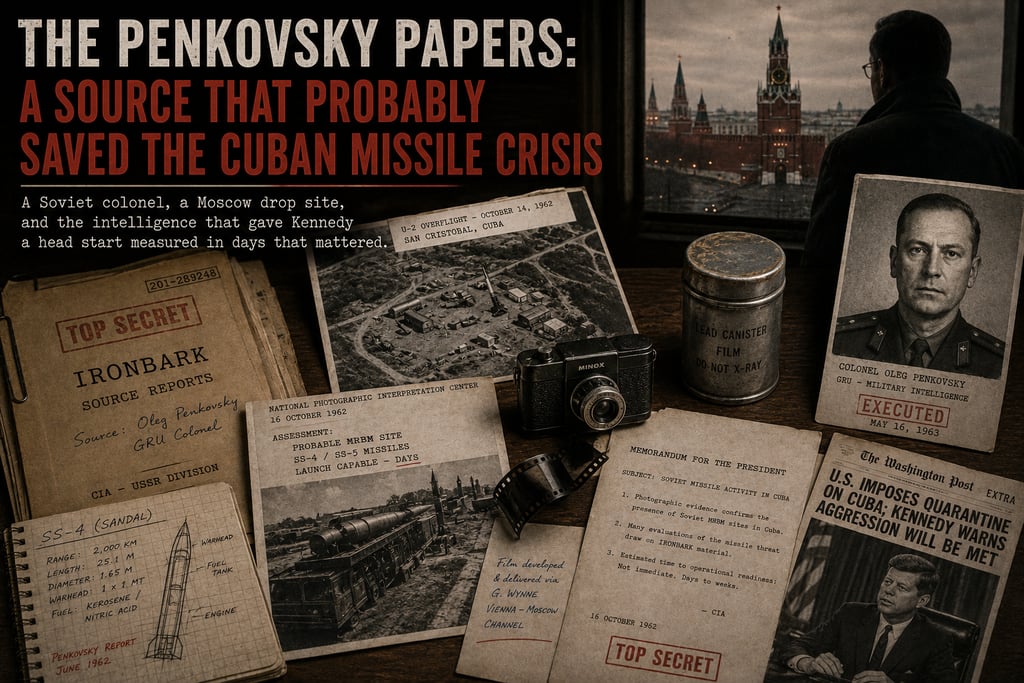
The CIA’s later documentary collection on the crisis states that many evaluations of the missile threat drew on IRONBARK material, whose source was Penkovsky. That sentence is the hard centre of the case. His intelligence was not a footnote to the crisis. It entered the assessments being used while the crisis unfolded. His material helped analysts understand Soviet missile systems, their technical capacities, their weaknesses, and the difference between Soviet boasting and Soviet readiness.
He did not give Kennedy certainty. No one could. He gave the American intelligence machine better ground beneath its uncertainty.
The road to that moment was dangerous from the start. Penkovsky had tried to offer himself to the West before he became a fully handled source. He was not approaching an easy adversary. The Soviet state was built for internal suspicion. The security services watched foreign embassies, diplomats, journalists, businessmen and Soviet citizens whose paths crossed theirs. Moscow was not Vienna, not London, not Washington. Contact itself was evidence if the state wished to make it so.
The men and women who handled Penkovsky had to work inside that pressure. The British businessman Greville Wynne became part of the courier chain because his commercial travel gave him a surface reason to move. British and American intelligence also used diplomatic channels and covert contact arrangements. Film had to be moved. Documents had to be photographed. Debriefings had to be held. Every success created the next risk. Every delivery increased the value of the source and the danger around him.
The physical tools were small because the stakes were too large to move openly. Penkovsky used miniature cameras. Film was concealed in containers. Packages had to defeat Soviet inspection. The International Spy Museum holds a lead film canister connected to his work and notes that he copied classified military documents with a Minox camera. The lead container was designed to protect film from Soviet attempts to expose hidden contents by irradiation. That object carries more pressure than any broad phrase about espionage. A strip of film inside a small container was moving through a state that would kill the man who had filled it.
This is where intelligence leaves the world of abstraction. A source is not a line in a report. A source is a person whose body has to pass through the city after the report has been written.
Penkovsky’s access was not ordinary. He was a Soviet military intelligence officer with knowledge of missile systems and the institutions around them. He understood the equipment, but he also understood the culture that produced the equipment: the claims made for it, the weaknesses hidden beneath them, the bureaucracy that moved it, and the military habits surrounding deployment. A stolen manual matters. A stolen manual explained by someone who knows the system matters more.
He supplied volume, but volume alone is not value. Accounts of the case often cite the scale of what he gave: hours of debriefing, exposed rolls of film, thousands of pages of reports. Such numbers can impress without proving anything. Intelligence agencies can drown in material that adds little. Penkovsky’s material mattered because it could be used. It helped narrow technical uncertainty. It helped Western analysts read Soviet missile behaviour with greater confidence. It helped separate Khrushchev’s performance of strength from the Soviet Union’s true strategic position.
That separation was central to the crisis.
For years, Soviet missile power had been wrapped in political theatre. Khrushchev had spoken in a language of rockets, pressure and strategic inevitability. The “missile gap” fear had already haunted American politics, feeding the belief that the Soviet Union might be racing ahead in long-range nuclear capability. Penkovsky’s reporting helped show that Soviet intercontinental missile strength was weaker than the language around it suggested. The danger was still grave. But it was not the same danger as the one Soviet propaganda wanted Washington to imagine.
A bounded danger can be faced differently from an undefined one.
That is not a small point. Presidents do not decide under perfect information. They decide inside pressure, fear, political humiliation, military advice, intelligence gaps and the knowledge that delay may be read as weakness. In October 1962, Kennedy faced Soviet nuclear missiles in Cuba, a hostile revolutionary government ninety miles from Florida, military advisers discussing strikes and invasion, and a public position that could not allow Soviet offensive missiles to remain. A wrong move could leave American cities exposed. A rushed move could start a war.
The U-2 flight on 14 October brought the visible evidence. The aircraft photographed missile installations in Cuba. The photographs went to the National Photographic Interpretation Center. Analysts worked through the images and identified probable Soviet medium-range ballistic missile sites. On 16 October, Kennedy was briefed. The National Security Archive’s page on the first CIA missile-site memo describes that morning as the first White House meeting of the crisis and notes that the evidence came from the 14 October U-2 overflight. The photographs were the moment the crisis became undeniable.
But photographs do not speak alone.
A photograph has to be read. A missile site has geometry. A support area has a logic. Equipment has scale, shadow, proportion and arrangement. Some details prove more than others. The National Security Archive’s description of the 16 October memo notes the role of visible evidence such as missile trailers and erectors in identifying Soviet systems. That did not mean every element of the analysis came from Penkovsky. It did not. Some identification depended on other photographic intelligence, including images of Soviet missiles in public display. The honest claim is sharper: Penkovsky’s material was part of the intelligence base that allowed American analysts to move faster and with more confidence once the U-2 images arrived.
That speed mattered because the clock was already moving.
On the first day of the secret crisis, the choices were violent. Air strikes were discussed. Invasion was discussed. The military problem was plain: if missiles were becoming operational, waiting carried risk. The political problem was equally plain: a surprise attack on Cuba could kill Soviet personnel, leave missiles undiscovered, provoke retaliation, and push the crisis towards Berlin or nuclear escalation. Kennedy needed to know not only that missiles were present, but how close they were to use.
This is where days mattered.
If the missiles were already ready, the president’s room for manoeuvre narrowed. If they were approaching readiness but not yet fully prepared, the United States could use pressure before fire. A naval quarantine could slow additional Soviet shipments. Diplomacy could be forced into motion. Public warning could be combined with military readiness. Delay could become an instrument rather than a surrender.
Penkovsky helped give meaning to that delay.
He did not make the quarantine safe. Nothing made it safe. Soviet submarines were at sea. American forces were alert. Cuba was armed. Anti-aircraft batteries were active. Messages between Washington and Moscow did not move with the calm speed later memory gives them. Men at sea and in the air were making decisions under pressure. On 27 October, an American U-2 was shot down over Cuba and Major Rudolf Anderson was killed. That day became one of the most dangerous of the crisis. Intelligence had narrowed some dangers but had not tamed the event.
That is the right way to measure Penkovsky. He reduced ignorance in a crisis that remained unstable.
He did not resolve it.
His material gave the West technical and strategic confidence. It helped show that Soviet capabilities were serious but not magical. It helped analysts estimate readiness. It helped the president resist the immediate pull of attack long enough for a political outcome to remain possible. That is not the same as saying he saved the world by himself. It is better. It is more exact. He helped preserve time before war could close the space.
The crisis also revealed where American intelligence had failed. Before the U-2 photographs, the Intelligence Community had judged that Soviet leaders were unlikely to deploy offensive missiles in Cuba. That judgment was wrong. The political estimate failed. Khrushchev had taken a larger risk than Washington expected. Once evidence appeared, analysis improved quickly. Penkovsky’s material belonged to that recovery. He could not stop the surprise. He helped make the surprise intelligible.
That sequence should stay intact. It prevents mythology.
Intelligence agencies do not succeed or fail as single units. They can miss intent and read hardware well. They can underestimate a decision and then interpret the evidence of that decision with speed. They can be blind in one register and precise in another. Penkovsky’s value sits in the second register. He helped the West read Soviet missile power once Soviet intent had already broken through American expectation.
His own position was closing as the crisis opened.
Penkovsky was arrested in Moscow on 22 October 1962, the same day Kennedy publicly announced the presence of Soviet missiles in Cuba and declared the quarantine. The timing has the cruel symmetry that history sometimes produces without needing invention. As Kennedy spoke to the world, one of the sources who had helped the West understand Soviet missile systems was already in Soviet hands. The man whose material had moved into the crisis room was removed from the field as the crisis became public.
By then his main work had already travelled. That is the nature of intelligence once it has crossed the line. A source can be arrested. The documents already delivered remain in the files. The film already processed remains in the analysis. The knowledge already absorbed continues to shape decisions after the person who carried it has disappeared.
Penkovsky’s arrest did not immediately explain itself to the public. Soviet secrecy did what it usually did. The state controlled the exposure, the trial, the language of treason. Greville Wynne was arrested as well. In 1963, Penkovsky was tried and executed. Wynne received a prison sentence and was later exchanged. The Soviet state could punish the men. It could stage the moral theatre of betrayal. It could not recover the time the West had already gained from Penkovsky’s material.
The human cost should not be softened. Penkovsky chose betrayal of the Soviet state, but the state he betrayed was not an abstraction to him. It had prisons, interrogators, courts and executioners. Wynne entered a world for which he was not built and paid heavily for it. The story has often been polished into heroic espionage drama. The real texture is harsher: fear, contact, film, courier work, surveillance, arrest, interrogation, trial, execution.
That roughness matters because the Cuban Missile Crisis is too often told from the top down. Kennedy and Khrushchev dominate the frame. They should. They held the political levers. But beneath them were pilots, analysts, sailors, Soviet officers in Cuba, Cuban anti-aircraft crews, embassy staff, code clerks, intelligence couriers and sources like Penkovsky. The crisis was not only a duel between leaders. It was a system under strain.
Penkovsky’s role was to make one part of that system visible.
He gave the West knowledge about Soviet missile forces before the crisis reached its open phase. He helped American and British intelligence read Soviet capabilities with more confidence than they would otherwise have had. His material fed into evaluations of the missile threat. The CIA’s documentary collection makes that link clear with the IRONBARK reference. That link does not prove he alone decided the crisis. It proves his intelligence was inside the chain of assessment at the moment assessment mattered.
The title “The Penkovsky Papers” carries its own danger. It suggests a clean archive, as if the source’s value exists in one neat pile of truth. The published book associated with that name has a tangled history and should not be treated as a direct transparent record of everything Penkovsky said. The safer ground is the intelligence material itself: IRONBARK reports, missile evaluations, photographic interpretation, later CIA assessments, and the way technical intelligence fed decision-making in October 1962.
This is where Ivo’s rule matters: the document before the legend.
The legend says Penkovsky saved the world. The document says his material helped shape missile-threat evaluations. The history sits between them. His intelligence probably gave Kennedy and his advisers a crucial advantage in understanding the Soviet deployment before the crisis ran out of time. That is a strong claim. It does not need to be made stronger than the record allows.
The crisis did not turn only on missile identification. It turned on political exit. Kennedy needed to force withdrawal without starting a war. Khrushchev needed to retreat without appearing destroyed. The final settlement included Soviet removal of missiles from Cuba, an American non-invasion assurance, and the quiet later removal of American Jupiter missiles from Turkey. That bargain was not made by Penkovsky. It was made by leaders under pressure, using public statements and private understandings to create a way back from disaster.
But bargains require time. Time requires confidence that waiting will not make defeat inevitable.
That is where Penkovsky’s intelligence presses closest to the centre. By helping analysts understand Soviet missile systems and readiness, he helped strengthen the case that Kennedy had space to use pressure before attack. The quarantine option required belief that the missiles were not all instantly beyond reach. It required enough confidence to reject the most violent immediate response. Penkovsky did not create that confidence alone, but he contributed to it.
The difference between one day and three days can be invisible in ordinary politics. In a nuclear crisis, it can decide whether aircraft launch before diplomacy has found language.
The physical image remains small. A Minox camera. A roll of film. A canister. A Moscow contact. A courier’s route. These things sit far from the spectacle of nuclear confrontation, but they belong to it. The great crisis was not only made of missiles, ships and presidential speeches. It was made of material that had to arrive before the decision did.
That is why Penkovsky’s story belongs in any serious history of the Cuban Missile Crisis. Not as ornament. Not as spy romance. As mechanism.
He was one of the reasons the West could read the danger faster than it otherwise might have. Faster reading did not guarantee wiser action. It made wiser action possible.
The last act belongs to the source, not the president.
Penkovsky was tried, condemned and killed. The Soviet state closed its account with him in the only language such a state could use. His name survived in the files of the adversary he had served, in the reports his material shaped, in the memoirs and disputes that followed, and in the history of a crisis that came close enough to nuclear war for every extra hour of judgment to matter.
The missiles in Cuba were real.
The gaps in American knowledge were real.
The photographs were real.
The danger was real.
So was the man in Moscow who had sent out enough knowledge to make the photographs speak faster.
Penkovsky did not save the world alone.
He gave the world a little more time before men with power over nuclear weapons had to decide what they were willing to do.