Narrative Historian | Author | Journalist
The Mitrokhin Archive: The KGB Defector Who Exposed Soviet Espionage
Discover how Vasili Mitrokhin, a KGB archivist, smuggled Soviet intelligence secrets to the West and exposed decades of espionage, active measures, and Cold War operations.
Ivo Vichev
5/24/202621 min read
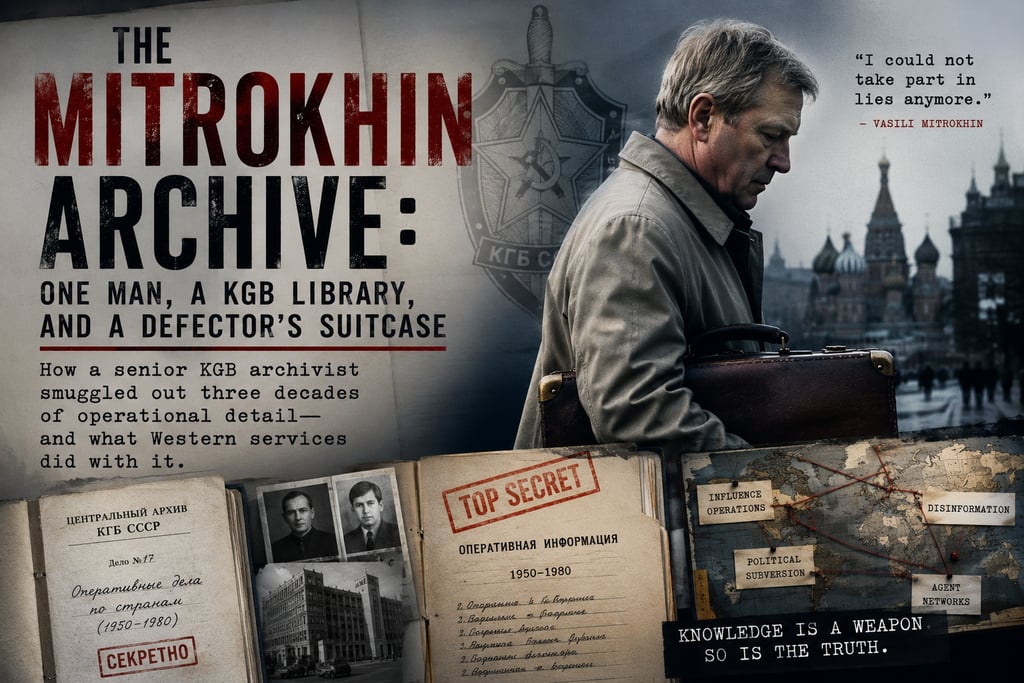
The archive left Moscow in pieces.
Not as a lorry of seized files. Not as a formal transfer after the Soviet collapse. Not as a state opening its records to the people it had lied to for seventy years. It left in handwritten notes, scraps of paper hidden inside clothing, typescripts assembled by a single man in a dacha outside the city, and six large metal trunks that a British intelligence service eventually carried out of Russia.
It left because one KGB archivist spent more than a decade copying the secret life of an empire by hand, hiding the notes beneath the floorboards of his dacha in the village of Tarchino, and waiting for the state that owned those files to weaken enough for him to run.
His name was Vasili Nikitich Mitrokhin. He was born on 3 March 1922. He spent much of his adult working life inside the institution he would eventually betray. He died on 23 January 2004, in Britain, having outlived the Soviet Union, the KGB, and almost every principal of the world he had decided to expose.
He was not a field legend. He was not one of the glamorous illegals who crossed borders under false names, lived double lives in foreign cities, or turned up years later as the subject of a documentary. He was not Philby, Blake, Penkovsky, or Gordievsky — not one of the men whose lives became shorthand for betrayal or courage. Mitrokhin's power came from something less theatrical and more dangerous. He had access to the archive.
The Archive and the Move
From 1972 to 1984, Mitrokhin worked as a senior archivist in the KGB's foreign intelligence branch — the First Chief Directorate — at a moment of unusual administrative upheaval. The FCD was being relocated from its old headquarters inside the Lubyanka, the infamous Moscow building that had served as the nerve centre of Soviet security since the Cheka, to a large new complex at Yasenevo, on the southern outskirts of the city. The move required the physical relocation of tens of thousands of files covering decades of Soviet foreign intelligence operations.
Mitrokhin was at the centre of that process.
Churchill Archives Centre describes him as having had unlimited access to hundreds of thousands of files from the KGB's global intelligence operations during this period. The files documented Soviet espionage in the United States, Britain, Western Europe, the Middle East, Africa, Asia, and Latin America. They covered agents, contacts, cover names, courier systems, recruitment approaches, active measures, technical collection, sabotage planning, penetration of governments, penetration of intelligence services, and the internal bureaucratic life of an organisation that had been running foreign operations since 1917.
Mitrokhin took notes.
The mechanics of what he did across twelve years were brutal in their patience. He read files during working hours and carried handwritten notes out of the building in his clothing and shoes. He returned home, transferred the notes to a fuller record, and eventually organised the material into typescripts covering different countries and subject areas. The final cache, hidden at the dacha in Tarchino, grew until it filled six large metal trunks. He was not stealing loose documents. He was copying the institutional memory of an empire — one file, one day, one page at a time — inside a building whose purpose was to prevent exactly that.
Discovery would have meant death. Possibly a slower death than execution.
The Man Before the Defection
Mitrokhin had not always been a dissident. He had joined Soviet foreign intelligence after the Second World War and spent years inside the system before disillusionment accumulated into action.
Later accounts identify several stages. Nikita Khrushchev's Secret Speech to the Twentieth Party Congress in February 1956, which publicly acknowledged Stalin's crimes against the Soviet state and its people, shook many Soviet insiders who had sustained their loyalty through the fiction of the leader's infallibility. The crushing of the Prague Spring in August 1968 — when Warsaw Pact tanks ended the Czechoslovak experiment in liberalised socialism — stripped away another layer of the ideological scaffolding. The visible moral courage of Soviet dissidents, including Andrei Sakharov and Alexander Solzhenitsyn, who paid personally for saying in public what Mitrokhin could only record in private, appears to have provided a further pressure.
Chris Taylor, writing for the Australian Strategic Policy Institute, notes that Mitrokhin's motivation grew from outrage at Soviet repression and the visible decay of late Soviet institutional life.
He did not act immediately on that outrage. He built an archive.
The logic was cold. A defector who arrived at a Western service with only his memory and testimony was a valuable but incomplete asset. A defector who arrived with twelve years of copied KGB files was something categorically different. Mitrokhin understood this. He spent more than a decade creating the thing he intended to defect with.
The Offer Nobody Wanted
The Soviet collapse gave him his opening.
In 1992, Mitrokhin approached Western intelligence with samples of his material. The sequence of what happened next became a source of professional embarrassment for one of the world's most capable intelligence services.
The CIA rejected him.
Later reporting, including a Guardian account from 2025 drawing on new documentary evidence, described Mitrokhin as having approached the Americans multiple times before turning to the British. The CIA apparently treated his approach with suspicion, failing to grasp what was on offer. Whether this was institutional scepticism about walk-ins, a specific officer's misjudgement, or a structural failure of assessment is not fully resolved in the public record. What is resolved is the outcome. The CIA passed. MI6 did not.
Mitrokhin's approach to the British Embassy in Riga, Latvia, brought a different response. MI6 assessed the sample material, recognised its scope, and moved to receive the full archive. The operation that followed removed Mitrokhin, his family, and the six trunks from Russia. He settled in Britain under a new identity and spent the remainder of his life working with Cambridge historian Christopher Andrew to translate the archive into published history.
The FBI later described the material as the most complete and extensive intelligence ever received from any source. The CIA described it, according to the UK Intelligence and Security Committee's Mitrokhin Inquiry Report of June 2000, as the biggest counterintelligence bonanza of the post-war period.
The phrase is almost too large. A bonanza sounds like wealth. The better word is wound. Mitrokhin had opened a wound in the KGB's memory. Western services then had the long, unglamorous task of deciding what to do with everything that came out of it.
The Archivist in the Machine
Mitrokhin's placement at the centre of the archive transfer matters because it explains both the scale of what he obtained and the nature of what it was.
Intelligence services live in two directions at once. The forward life is operations: recruitments, meetings, dead drops, encrypted communications, courier runs, handlers, and the constant human business of turning foreign nationals into sources. The backward life is files. The archive remembers what officers forget, what retired agents deny, what departmental politics revise, and what later propaganda rewrites. In a secret police state, the archive is not a passive storehouse. It is the institution's hidden autobiography.
Mitrokhin was placed inside that autobiography at its most exposed moment — during the physical move of its contents from one building to another, across a period when the archive was more accessible than it had ever been or would be again.
The KGB's First Chief Directorate handled foreign intelligence. The Second Chief Directorate handled domestic security and counterintelligence. The archive Mitrokhin accessed concentrated the memory of Soviet foreign operations across decades and continents. A file might document a recruitment in 1949. Another might cover a running operation in 1971. Another might describe a sabotage plan for Western Europe with specific targets named. Another might show the internal correspondence about a disinformation campaign, including the forged documents produced to support it.
He copied all of it that he could reach.
What the Archive Contained
The Mitrokhin material exposed the KGB not as a single thing but as several interlocking systems operating simultaneously: espionage, active measures, technical collection, political warfare, and organised violence.
The first major public account came in 1999 when Christopher Andrew and Vasili Mitrokhin published The Mitrokhin Archive: The KGB in Europe and the West, released in the United States as The Sword and the Shield. A second volume, The World Was Going Our Way, followed in 2005. Between them, the two volumes used Mitrokhin's archive to describe Soviet foreign intelligence operations across more than half a century and across most of the world.
The contents were not a list. They were a landscape.
Espionage Inside the West
The archive documented Soviet penetration of Western governments, intelligence services, academic institutions, trade unions, and defence industries across the Cold War.
In Britain, the most publicly visible case involved Melita Norwood.
Norwood had worked as a secretary at the British Non-Ferrous Metals Research Association, an organisation involved in atomic energy-related metallurgy. The Mitrokhin archive identified her under the codename HOLA as a long-running KGB source who had passed classified material for decades. She had been recruited in the late 1930s and continued cooperating with Soviet intelligence into the 1970s.
The British public learned of her in September 1999, when The Mitrokhin Archive was published. She was eighty-seven years old. She emerged briefly to speak to waiting journalists outside her suburban home, expressed no regret for her beliefs, and returned inside. She was never prosecuted. The Crown Prosecution Service determined that a prosecution would not be in the public interest given her age and health. She died in 2005.
Her case showed both the power and the frustration of the archive. It could identify. It could expose. It could shame. What it could not always do, when the material concerned events decades in the past and the principals were elderly or dead, was produce a criminal conviction.
The UK Intelligence and Security Committee's Mitrokhin Inquiry examined precisely this problem — why some identified individuals were not prosecuted, and whether the proper legal and prosecutorial authorities had been adequately consulted in those decisions. The inquiry's conclusions were not entirely comfortable for the intelligence agencies involved.
In the United States, one of the clearest prosecutorial outcomes involved Robert Lipka.
Lipka had been a clerk at the National Security Agency in the 1960s. He had sold the NSA's secrets to the KGB for cash, passing signals intelligence material of significant value at a period when American communications intercept work was central to the Cold War. By the 1990s the case was cold. Mitrokhin's archive revived it. The FBI used the material to build a sting operation. Lipka was arrested in 1996, pleaded guilty, and was sentenced to eighteen years in federal prison.
That was one of the archive's most direct practical outputs: not history, but handcuffs.
Active Measures and the Architecture of Lies
The KGB did not only steal secrets. It manufactured falsehoods and distributed them inside functioning democracies with a patience and institutional discipline that most Western publics could not imagine.
The archive opened that world in detail.
Active measures — the Russian term is aktivnyye meropriyatiya — included forgery, disinformation, front organisations, black propaganda, manipulation of foreign media, covert financing of political movements, and operations designed to damage the credibility of Western governments, intelligence services, and public figures. These were not occasional gambits. They were a standing function of the KGB's Service A, the dedicated active measures department that ran operations across the Cold War.
One of the most consequential was Operation DENVER, also known in the West as Operation INFEKTION.
Beginning in 1983, Soviet intelligence planted stories in foreign press outlets — starting with an Indian newspaper, then moving through African and European media — claiming that the AIDS virus had been deliberately created by the United States military at the biological warfare research laboratory at Fort Detrick, Maryland. The claim was medically false and entirely fabricated. The KGB produced supporting documentation, planted corroborating voices, and built a disinformation infrastructure around a story designed to damage American credibility in the developing world at a period when the AIDS crisis was creating widespread fear and distrust.
The operation proved more durable than the KGB might have expected. The story circulated through media in dozens of countries. American officials were forced to issue repeated public denials. The Fort Detrick conspiracy theory did not die with the Soviet Union. It mutated. Versions of it persisted in online and print media for decades after the intelligence operation that produced it had been dismantled and documented.
A fabricated story is not destroyed by being exposed. It can be immunised into a permanent part of the information ecosystem.
The archive documented other active measures with a similar structure. Forged documents attributed to the FBI were produced to inflame racial tensions in the United States. Forged letters designed to suggest that the United States was planning a nuclear first strike against the Soviet Union were seeded through Western European media during the early 1980s, a period when the deployment of Pershing II missiles was generating genuine public anxiety across West Germany, Britain, and the Netherlands. KGB connections to the Campaign for Nuclear Disarmament in Britain, and to other peace movement organisations, were described in terms that suggested not control but cultivation — the maintenance of useful sympathies in organisations whose public position happened to coincide with Soviet strategic interests.
Not every active measure required a direct lie. Some required only the maintenance of a useful fog.
Operation RYAN and the Nuclear Fear
The archive also revealed the machinery behind one of the Cold War's least understood episodes.
Operation RYAN — Raketno Yadernoye Napadenie, meaning nuclear missile attack — was a KGB programme launched in 1981 by KGB chairman Yuri Andropov, who had become genuinely convinced, or chose to act as if convinced, that the United States was preparing a nuclear first strike against the Soviet Union. RYAN directed KGB residencies across Western Europe and North America to monitor indicators of imminent American nuclear attack: unusual activity at military bases, changes in diplomatic communications, lights on in government buildings during unusual hours, the movement of blood supplies, preparations in civil defence organisations.
The programme was a mirror of Soviet fear, but it was also a mirror of Soviet institutional logic. The KGB had to produce reports. Residencies were asked to find signs of preparations for war. They found them, or produced them, because the system rewarded production. RYAN showed how intelligence services can amplify the paranoia they are supposed to diagnose.
It also showed how close the early 1980s came to genuine misunderstanding. NATO's ABLE ARCHER 83 exercise in November 1983 — a command-post simulation of nuclear release procedures — was monitored by Soviet intelligence and apparently interpreted by some Soviet analysts as a potential prelude to actual first strike. Mitrokhin's archive and later released KGB material both contributed to the scholarly reconstruction of how serious Soviet alarm had been.
That part of the Cold War's history is still not fully understood. The archive helped open it.
Weapons Caches and Planned Violence
The archive also documented a category of KGB activity that went beyond information and into organised preparation for physical violence on European soil.
In Western Europe, Soviet intelligence had, over decades, buried weapons caches — arms, explosives, communication equipment, and operational material — at pre-positioned locations to be used by KGB illegals or activated assets in the event of war or for use in covert operations short of war. The caches were real. After the Mitrokhin material was processed and shared with friendly services, several were physically located and recovered.
Swiss authorities acted on information from the archive and found an actual cache of KGB equipment on Swiss territory — a confirmation that the archive was not merely documentary but operationally accurate in its specifics. Similar actions occurred in other European countries.
The caches showed a service that did not merely plan for intelligence competition. It planned for a physical campaign on Western European territory using pre-positioned material. The Cold War had a logistics dimension that operated beneath the level of public knowledge and official diplomatic exchange.
The archive documented KGB connections to violent non-state actors as well. Soviet support, in the form of money, weapons, and training connections, reached the Red Brigades in Italy, the Baader-Meinhof Group in West Germany, and other far-left organisations that were conducting campaigns of political violence across Western Europe in the 1970s and early 1980s. The degree of direct operational control versus ideological sympathy and financial support varied by group and by period. The archive showed a service willing to provide material support to organisations conducting murders, kidnappings, and bombings in allied Western democratic states.
The Shadrin Case
The archive also shed light on cases that had sat as unresolved intelligence mysteries for years.
Nicholas Shadrin — whose real name was Nikolai Artamonov — had been a Soviet naval officer who defected to the United States in 1959. He subsequently worked as a naval intelligence analyst for the Americans and was eventually recruited by the CIA to operate as a double agent, feeding controlled information back to Soviet intelligence contacts in Vienna. In December 1975, during a meeting with his Soviet handlers in the Austrian capital, he disappeared. His wife, waiting in their hotel, was told he had been arrested. The reality took years to assemble.
Mitrokhin's archive helped confirm what had happened. Soviet intelligence had decided to act against Shadrin directly. During the Vienna meeting, he was apparently drugged and either died from the dose or from a struggle during the attempt to move him. His body was never recovered. The Soviet side never formally acknowledged what had occurred. His wife spent years trying to learn the truth from American intelligence services that had used her husband and then lost him in a failed covert operation on foreign soil.
The archive did not give her a body. It gave her a version of the machinery.
Nureyev and the Use of Physical Harm
Not every KGB operation aimed at death. Some aimed at diminishment.
Rudolf Nureyev had defected to the West at Le Bourget Airport in Paris in June 1961 — one of the most public defections of the Cold War, conducted in front of journalists, security officials, and a watching international press. He became the most celebrated male ballet dancer in the world. The KGB did not accept the loss quietly.
The archive documented a proposal to injure Nureyev — not to kill him, but to damage his legs specifically, ending the career that had made his defection internationally visible and his continued freedom a standing advertisement for the West's openness. The proposal was to, in the operational language, "cut his legs."
The plot was not carried out. The archive does not fully explain why, whether because the operation was cancelled at a senior level or because it was considered and rejected as diplomatically unacceptable. What the documentation shows is that a state security service spent operational resources discussing how to physically destroy the working body of a dancer because he had chosen to leave.
That is the level at which the KGB's institutional logic operated. Defection was not only a security problem. It was an ideological insult. The response was bureaucratic, patient, and occasionally monstrous.
The Developing World
The second Andrew-Mitrokhin volume, The World Was Going Our Way, opened a part of Cold War history that Western writing had left largely in shadow.
The KGB's operations in the developing world were not supplementary to the main Cold War competition. They were a primary theatre. Soviet foreign intelligence worked across Africa, Asia, Latin America, and the Middle East to cultivate governments, support client movements, undermine Western influence, collect technical intelligence, and place assets inside institutions that might eventually reach positions of power.
The archive's revelations about India were among the most striking.
KGB operations in India over several decades had included the payment of Indian journalists and newspaper editors to publish pro-Soviet material, the cultivation of political figures across the spectrum, and the use of Indian media as a channel for active measures aimed at third countries. ASPI notes that the Mitrokhin material helped correct a lopsided Cold War record in which CIA activity in the developing world had received detailed scrutiny while Soviet operations were treated as rhetorical background. India, in this picture, was neither an innocent nor a passive player but a country whose information environment had been substantially penetrated and shaped by Soviet intelligence over a long period.
The same pattern, at different scales and with different methods, applied to Japan, where KGB collection focused on scientific and technical intelligence; to a range of African states where Moscow supported aligned governments and movements; and to parts of the Middle East where ideological alignment and anti-Western politics created exploitable openings.
This does not make Soviet covert operations the moral equivalent of every criticism the archive's revelations received. It makes Cold War history more honest. Both empires interfered. Both lied. Both cultivated clients. Both used intelligence services to shape the politics of countries that had not invited them in.
The archive's value is that it gives form to one side of that mutual record.
The French Material
Western Europe was not only Britain and America.
Le Monde reported in January 2025, drawing on research into the archive's later releases, that the French material in Mitrokhin's notes covered KGB operations in politics, media, science, and intelligence. Britain's Five Eyes partners — the United States, Canada, Australia, and New Zealand — received relevant files by the summer of 1992, while France received its share of the material later and through different channels.
The French cases raised the same evidentiary issues that applied across the archive. A name in a KGB file is not a conviction. The KGB's files described a world in which assets, contacts, unwitting sources, proposed recruits, and occasional chance encounters could appear in the same bureaucratic category without the distinctions being immediately clear to a later reader. French intelligence and prosecutorial authorities faced the same dilemmas British and American institutions had faced: aged cases, dead witnesses, classified material, and a public that wanted clean verdicts from evidence that rarely provided them.
The Le Monde reporting specifically noted that researchers and intelligence services alike had been cautioned about reading names in the archive as proof of active collaboration, since mention in a KGB document could indicate a range of relationships, not all of them voluntary or even understood by the person named.
That caution belongs in every discussion of the archive.
Australia and the Medium-High Target
Mitrokhin's archive also reached Australia, though the published volumes of 1999 and 2005 contained limited Australian material. ASPI notes that notebooks released in 2014 included references to Australian operations, covering the effect of the 1963 expulsion of Soviet diplomat Ivan Skripov — who had been operating as a KGB intelligence officer under diplomatic cover — on the residency's subsequent work, KGB interest directed through and at Australian universities, approaches to Armenian Church figures, and contacts involving Australian political circles.
ASIO's own official history, cited by ASPI, described Australia as a medium-high target for the KGB.
That phrase explains the archive's relevance to a country that was not among the Cold War's primary adversaries. Australia was targeted not as an end in itself but as an access point. Alliance membership and intelligence-sharing arrangements made Australian institutions a potential route into American and British secrets. Pine Gap — the joint facility in the Northern Territory that supported American satellite and signals intelligence — made Australian territory operationally significant in a way that created permanent KGB interest in the people and institutions around it.
A weaker security culture at a particular institution, a university department with defence connections, a political contact with access to American briefings, a diplomatic relationship carrying classified traffic — each of these was potentially more accessible through Australia than through the primary Western powers directly. The KGB understood that alliance systems create pathways. Pathways create vulnerabilities. The medium-high target was targeted because of what it led to.
The Value of a Copied Archive
Mitrokhin's archive had an unusual strength that distinguished it from most defector material.
Most defectors bring depth. They know a station, a network, a period, a set of officers. They can describe operations they personally handled and people they personally recruited. Their knowledge is local and specific. Mitrokhin brought range. He had copied from files across decades and regions, across departments and case categories, across the full span of the FCD's record in the years the archive was being moved. The result was not one operation but a map of institutional behaviour.
That map could do several kinds of work simultaneously.
It identified agents and former agents — including Norwood in Britain and Lipka in the United States — and gave friendly services the material to reopen cold cases with new evidentiary force. It corroborated or complicated earlier intelligence, allowing counterintelligence analysts to cross-check names that had appeared in one source against KGB records as copied by Mitrokhin. It helped allied services reassess their own past penetrations and current vulnerabilities. It gave historians a record against which the testimony of earlier defectors — Bentley, Chambers, Gordievsky himself — could be checked and corrected.
The deeper value was institutional. Intelligence services learn from enemy records when they can obtain them. Mitrokhin's material revealed not only who the KGB recruited but how it thought, what it valued, where it exaggerated, which Western weaknesses it returned to repeatedly, and which of its own operations it considered failures.
A list of spies is useful. A record of enemy institutional habits is more useful and far rarer.
What Christopher Andrew Did With It
The decision to work with Christopher Andrew — a Cambridge historian with deep expertise in intelligence history — to produce published books from the archive was significant and not without controversy.
The collaboration produced two works of major historical importance. It also raised questions about selection, editorial framing, the handling of named individuals, and the relationship between public history and intelligence use of the same material. When the archive serves simultaneously as a counterintelligence tool and as the basis for published history, the interests of those two uses do not always align.
Andrew had access to Mitrokhin and to the archive's typescripts. He did not have access to the original manuscript notes, which remain classified. Churchill Archives Centre — where Mitrokhin's papers are now held — states plainly that it is not in a position to establish the veracity of information that was selected, transcribed, collated, edited, and typed by Mitrokhin before it was deposited.
That is a precisely correct statement of the archive's evidentiary status. Mitrokhin's typescripts are not the original KGB files. They are one man's handwritten extraction from those files, subsequently organised and typed. Each step — selection, transcription, organisation, typing — adds distance from the original document. A serious reader should hold that distance in mind, not as a reason to dismiss the material, but as a reason to handle it with the same discipline any source requires.
Where the archive is corroborated — by prosecution, by other defectors, by independent archives, by later confirmations from Soviet or Russian sources — it stands on firmer ground. Where it stands alone on a contested identification or an uncorroborated claim of influence, it should be treated with proportionate caution.
The Limits of the Archive
The Mitrokhin Archive should not be treated as scripture.
KGB files themselves were not always innocent records. Officers exaggerated operational success to satisfy Moscow's demand for results. A proposed recruitment could be described in the file as an accomplished penetration. A contact who had once passed useful information might be listed as an active agent years after the relationship had lapsed. A claim of influence over a foreign political figure might reflect the handler's ambition as much as the subject's actual cooperation. The bureaucratic incentives of a police state do not produce uniquely reliable paperwork.
This is not a reason to dismiss what Mitrokhin copied. It is a reason to read it correctly.
An intelligence archive can identify guilt. It can also generate misreadings. A person named in a file may be an agent, a target, a contact, an unwitting source, a proposed recruit, a false claim by an officer seeking promotion, or a name that appears in a context the extracted document does not preserve. A name is not a conviction. A KGB file is not a court. The archive is powerful because it opens the record of an intelligence service that operated in darkness for decades. It is dangerous if that power is treated as synonymous with certainty.
The archive is strongest where it is corroborated. It is weaker where it stands alone.
That is the difference between serious history and intelligence gossip.
The Man Who Wanted the Truth Told
The UK Intelligence and Security Committee concluded that Mitrokhin was a man of remarkable commitment and courage who risked imprisonment or death because he wanted the truth about the KGB and its activities to be known.
The judgement is deserved. It should not flatten him into a statue.
Mitrokhin was a Soviet insider who spent years inside the system before disillusionment became action. He did not defect at once. He built an archive over twelve years, hiding it beneath a dacha floor in a country where discovery meant not merely professional ruin but likely disappearance. His courage was archival before it was operational. He fought the KGB with the thing the KGB trusted most: its own files.
There is a particular logic in that.
The security service had spent decades collecting the secrets of others. Mitrokhin collected its secrets. It had built an archive to preserve institutional power across generations, to remember what officers forgot and what states officially denied. He turned that preservation against it. The institution that had recorded betrayals, recruitments, kompromat, sabotage, and lies found that one of its own archivists had been recording the recorders.
This is why his story has force beyond the operational. It shows that authoritarian systems are vulnerable not only to external pressure but to the moral exhaustion of people inside the machinery who have seen too much. The archivist, the file clerk, the translator, the analyst who reads a little too carefully — these figures are not always harmless. Sometimes they are the only witnesses who know where the evidence is buried and willing to carry it out.
The Afterlife of the Archive
The KGB's successor services — the SVR, which inherited the First Chief Directorate's foreign intelligence function, and the FSB, which took on domestic security — did not inherit the archive's exposure along with the archive itself. They inherited the habits.
The active measures that Mitrokhin documented did not end with the Soviet collapse. The logic survived the institution. Disinformation campaigns, front organisations, influence operations, the seeding of conspiracy theories through foreign media, the cultivation of useful voices in Western political life — these are recognisable features of Russian intelligence operations in the decades after the archive was published.
The difference is speed and platform. Soviet active measures of the 1970s and 1980s moved through newspapers, radio stations, and physical forgeries that required weeks or months to circulate. Modern equivalents move through social media, amplified by algorithmic distribution, and can reach tens of millions of people before a government has decided how to respond.
The underlying logic is the same. Exploit existing divisions. Launder claims through apparently independent voices. Blur authenticity. Force the target to spend time and credibility disproving fabrications. Make uncertainty itself into a tool.
Mitrokhin copied the earlier machinery. The machinery did not die with the KGB.
The Final Measure
The Mitrokhin Archive did not end the history of the KGB. It reopened it.
It gave Western intelligence services names, leads, cold cases, and operational histories that had otherwise been permanently inaccessible. It gave historians an imperfect but indispensable record of how Soviet foreign intelligence had actually functioned across half a century. It gave governments the uncomfortable task of deciding what to prosecute, what to publish, what to share with allies, and what to bury again under the weight of age, secrecy, and political inconvenience. It gave the public a view of the Cold War in which Soviet intelligence was not a rhetorical phrase or a cartoon villain, but a working bureaucracy with files, plans, agents, institutional habits, and a memory it tried very hard to protect.
The archive's greatness lies in its scale. The danger lies there too. A small file can be checked line by line. A vast archive seduce the reader into treating volume as certainty. Mitrokhin's material deserves neither credulity nor the sceptical dismissal of people made uncomfortable by what it reveals.
The KGB was real. Its operations across the Cold War were extensive, often successful, and often genuinely damaging to the countries and individuals they targeted. Its active measures had a structure. Its agents had names. Its sabotage plans had coordinates. Its failures were filed alongside its successes. Its secrets sat in the archive at Yasenevo until one quiet man began copying them, hiding the copies under his dacha floor, and waiting for the state that owned them to finally become too weak to hunt him.
Mitrokhin did not bring out the KGB archive itself. He brought out something almost as dangerous: the KGB's memory, filtered through the hand of a man who had stopped believing in the state that owned it.
For twelve years, he carried that memory home in pieces.
In 1992, he packed it into six metal trunks and offered it to the West.
The Americans said no.
The British said yes.