Narrative Historian | Author | Journalist

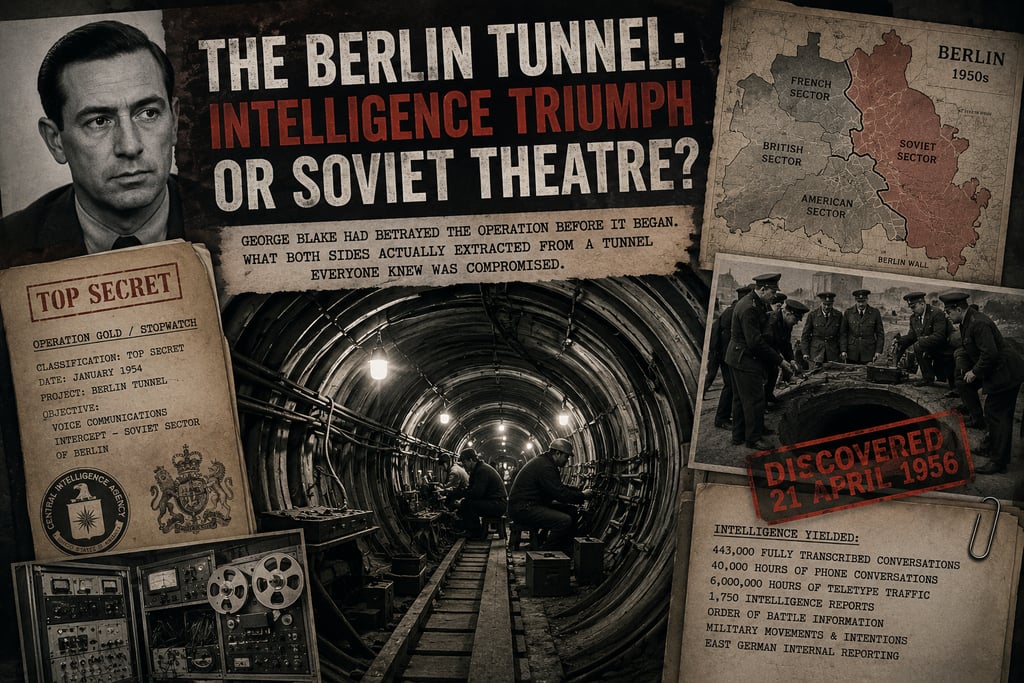
George Blake betrayed the Berlin Tunnel before it began. The real question is what CIA, MI6 and the Soviets each gained from a compromised operation.
The Berlin Tunnel: Intelligence Triumph or Soviet Theatre?
The Berlin Tunnel was compromised before the first useful word passed through it. That should have killed the operation. It did not. It made the operation harder to understand. George Blake, a Soviet agent inside Britain’s Secret Intelligence Service, knew about the plan from its early stages and told Moscow. The KGB therefore understood that the CIA and MI6 were preparing to tunnel from West Berlin into the Soviet sector and tap communications lines carrying Soviet and East German traffic. The secret was broken before the tunnel became useful. The wall had ears before the West built the room.
INTELLIGENCE & ESPIONAGE HISTORY
Ivo Vichev
5/12/202613 min read
That fact produces the easy version of the story: the tunnel was a failure, a vast underground monument to Western self-deception. The Americans and British dug, wired, recorded and translated while Moscow watched the performance from the other side. The Soviets let the operation run, then exposed it when it suited them. The West got theatre. Moscow got Blake.
That version is too clean.
The opposite version is also too clean. In that telling, the Berlin Tunnel was one of the great intelligence triumphs of the Cold War: 1,476 feet of engineering under one of the most dangerous frontiers in Europe, built under cover of a warehouse and radar site, tapping Soviet communications for nearly a year, producing a flood of transcripts, reports and military detail before the Soviets staged their discovery in April 1956. The CIA later described the operation as yielding 50,000 reels of tape, 443,000 fully transcribed conversations, 40,000 hours of phone conversations, 6,000,000 hours of teletype traffic, and 1,750 intelligence reports.
That version is also incomplete.
The Berlin Tunnel was both things at once: an intelligence success inside an intelligence defeat. It produced real material while already compromised. It gave the West access to Soviet and East German communications while giving the KGB a reason to sacrifice some traffic in order to protect something more valuable. It was an engineering triumph, a collection success, a counter-intelligence embarrassment, a propaganda gamble, and a study in how intelligence services choose what to lose.
The question is not whether the tunnel was a triumph or theatre. The question is what each side extracted from a tunnel one side built and the other side already knew about.
Berlin made the operation tempting because Berlin was not only a city. It was a communications knot, an occupied capital, a listening post, a symbol, a wound and a border before the Wall made the division concrete. In the early 1950s, before reconnaissance satellites and before the full maturity of high-altitude aerial intelligence, communications intelligence mattered with a harder urgency. The Soviets had shifted much of their military traffic from radio to landline telephone systems. That move reduced Western access to radio intercepts. It also created a target beneath the ground.
The CIA later described East Berlin as the centre of a Soviet communications network linking important European nodes and extending into Russia. Almost all communications between Moscow, Warsaw and Bucharest passed through Berlin, making the city an ideal target for landline interception. The problem was obvious. The cables lay in the Soviet sector. The West could not simply walk in and attach a listening device.
The solution was to dig.
The operation was known to the CIA as Operation GOLD and to the British as Operation STOPWATCH. It was an American-British project, drawing on British experience with earlier tunnel operations in Vienna and American money, engineering and ambition. CIA Director Allen Dulles approved the covert tunnelling and tapping operation in January 1954. The cover was an American Air Force radar site and warehouse in West Berlin. From there, the tunnel would run eastward beneath the border towards the Soviet cables.
It was a difficult plan because underground work is never abstract. Soil has weight. Water enters. Noise travels. Men need air, power, tools, food, cover stories and somewhere to put the earth they remove. The CIA account notes that more than 3,000 tons of soil had to be hidden and that the tunnel was lined with steel to prevent collapse in sandy ground. The finished tunnel ran 1,476 feet, roughly six feet in diameter, with British technicians installing the taps. Collection began on 11 May 1955.
The engineering mattered because it created confidence. A scheme that looks absurd in outline can become possible when reduced to measurements, plates, shafts, cables and routines. A warehouse deep enough to hide the spoil. A tunnel lined with steel. A tap chamber under enemy ground. Tape recorders running in the Western sector. Translators waiting for the voices to arrive.
This was the Cold War beneath its own surface. Above ground, Berlin was checkpoints, uniforms, flags, occupation zones and nervous diplomacy. Below ground, it was cable, mud, steel, microphones and men working in silence under the most politically charged soil in Europe.
Blake made that triumph unsafe before it began.
George Blake was not a minor leak at the edge of the operation. He was an SIS officer and a Soviet agent. He had been involved in discussions of the tunnel from the start. Years later, after his exposure, Western intelligence had to face the most damaging question in the whole affair: if the Soviets had known from the beginning, why had they allowed the tunnel to operate? The declassified NSA account puts the question plainly, then gives the essential answer. Blake knew about the tunnel and the telephone tapping, but he apparently had not been informed of the flaw in Soviet teleprinters that allowed analysts to exploit encrypted messages. The Soviets, acting on incomplete knowledge, improved telephone security but did not alter their teleprinter habits. Routine telephone traffic remained useful at times, while decrypted teleprinter traffic produced higher-value intelligence.
That detail changes the case.
The KGB knew enough to protect itself imperfectly. It did not know everything the West could do with what it collected. It also had its own internal problem. To expose the tunnel too early might expose Blake. A mole inside British intelligence was more valuable than a cable. Moscow therefore had to choose. It could shut down the tunnel at once and risk revealing the source of its knowledge, or it could let the operation continue and manage the damage.
The KGB chose Blake.
That choice tells us how intelligence services measure value. They do not protect secrets equally. They triage. A source inside the enemy’s intelligence service may be worth more than compromised communications, especially if the compromised communications can be partly controlled, partly sanitised or kept away from the most sensitive channels. The tunnel therefore became a theatre in the literal sense: not fake, but staged. Each side acted under partial knowledge. The West believed it had built a secret ear. The KGB knew the ear existed. The Soviet military and East German users of the cables may not have understood the full picture, and that ignorance became part of the West’s advantage.
That is why the “Soviet theatre” argument must be handled carefully. The KGB knew. That does not mean every Soviet command circuit became a disinformation channel. It does not mean every intercepted message was planted. The CIA’s later public account states that later studies showed the Soviets had not attempted to feed false information over the tapped lines and that the intelligence collected was genuine as far as CIA could tell. The NSA account is more cautious but reaches a similar shape: Blake’s incomplete knowledge meant Soviet telephone security improved, but teleprinter habits did not change, allowing high-quality intelligence from teleprinter exploitation.
The tunnel was compromised, but not empty.
The West extracted volume first. The scale was enormous by the standards of the period: tapes, transcripts, teletype traffic, reports. A large intelligence operation often looks glamorous only at the point of collection. After that it becomes labour. Voices have to be recorded, sorted, transcribed, translated, indexed and interpreted. Teleprinter material has to be processed. Names, units, places, call signs, routines and anomalies have to be turned from noise into usable intelligence.
The CIA later listed several categories of intelligence drawn from the tunnel: order of battle information on Soviet and Warsaw Pact forces, evidence about Soviet lack of action towards a military invasion of Western Europe, identification of workers on Soviet atomic energy projects, early warning of the establishment of an East German army, the poor condition of East German railways, resentment between Soviets and East Germans, and growing tensions in Poland. These were not small matters in the early Cold War. They went to the heart of what Washington and London needed to know: what forces existed, how they moved, whether war was being prepared, where the Soviet bloc was brittle, and how Soviet control functioned in the countries behind the Iron Curtain.
The NSA account also records that the tunnel reports identified previously unknown Soviet military units in Germany and confirmed order of battle, training and equipment data that had previously been uncertain. Many reports dealt with day-to-day activities of Soviet and East German military and government units. Day-to-day information can sound dull until the absence of it is felt. In a nuclear age, with fear moving faster than evidence, routine military communications could tell policymakers whether panic was justified. The absence of attack preparations could be intelligence. The ordinary could calm the extraordinary.
That was one of the tunnel’s real values. It did not have to produce a single dramatic war plan to matter. It could produce texture. It could help Western analysts understand the working life of Soviet power in Germany: units, movements, repairs, tensions, shortages, administrative habits, command relationships and the distance between official confidence and practical strain.
The Soviets extracted something different. They protected Blake. They preserved a channel into British intelligence. They allowed themselves a later propaganda moment. When the tunnel was “discovered” in April 1956, Soviet and East German forces presented it to the world as proof of Western illegality and aggression. The CIA account says Soviet and East German soldiers began digging after rainy weather caused short circuits in Berlin’s telephone network, then found the wiretap and tunnel. The same account notes that the KGB had allowed the operation to continue until 21 April 1956, or 22 April in Berlin, and staged the discovery under the cover of repairing faulty cables.
The propaganda move did not fully work. The Soviets wanted outrage. Much of the press saw audacity. Photographs of the tunnel made it look less like a gangster act and more like a feat of Cold War engineering. Western intelligence had been caught, but not humiliated in the way Moscow expected. The tunnel’s physical existence carried its own strange glamour. In a contest of systems, even an exposed tunnel could become evidence of technical nerve.
The discovery also came at an awkward diplomatic moment, during Nikita Khrushchev’s visit to Britain. A scandal designed to embarrass the West risked complicating Soviet diplomacy as well. Intelligence theatre rarely stays under the control of the side that opens the curtain.
The most important audience, however, was not the newspaper reader. It was the intelligence professional reading the damage after Blake was exposed in 1961. Only then did the Western services understand that the tunnel had been known to Moscow from the start. That discovery reached backwards and poisoned the memory of the operation. Everything collected had to be reconsidered. Every transcript carried a question. Was this genuine? Was it tolerated? Was it shaped? Was it allowed through because it was harmless? Was it valuable precisely because some parts of the Soviet system had not been told?
That is the real counter-intelligence residue of the Berlin Tunnel. The operation did not end when the tap chamber was entered. It continued as doubt.
Doubt is one of the most expensive things in intelligence. It consumes time after the event. It forces review, reprocessing, second-guessing and institutional argument. It damages not only the material collected but the confidence with which that material can be used. A compromised operation may still produce good intelligence. The trouble is proving which parts were good, why they were good, and whether the enemy wanted them to be seen.
The Berlin Tunnel forced that problem into the open.
It also exposed rivalry inside the American intelligence system. The NSA account says the CIA did not inform NSA about the tunnel at first, rationalising that the activity was wiretapping rather than communications intelligence. CIA security regulations restricted access to the material, and NSA was not informed until a month after the tunnel became operational. This detail matters because intelligence failures rarely come only from the enemy. They often come from institutional borders at home: who owns a source, who controls a stream of information, who receives credit, who is allowed into the compartment.
The tunnel was built against the Soviet bloc, but it also ran through American bureaucratic pride.
The CIA had reason to protect the operation tightly. Too many people inside a secret can kill it. But over-control creates its own cost. If the best communications-intelligence expertise is kept outside because the lead agency wants ownership, the collection may be exploited less well than it could have been. The NSA account later describes rivalry between CIA and NSA over control of American communications intelligence, with relations affected for years. The tunnel therefore revealed another Cold War pattern: the enemy was not the only obstacle to intelligence. Washington was also full of borders.
The British role was no less important. British experience from Vienna and British technical skill helped make the Berlin tunnel possible. But British penetration by Blake made the same partnership dangerous. This is the paradox of allied intelligence work. Allies bring capability. They also bring their own risks. The Americans needed British experience. The British brought a Soviet mole into the room.
None of this means the Americans were innocent victims of British failure. The operation was joint, and counter-intelligence is never morally simple. But Blake’s presence inside SIS turned British participation into both strength and vulnerability. The same partner who helped tap the cable unknowingly helped tell Moscow the cable would be tapped.
That is why the Berlin Tunnel belongs with the Cambridge Five, Aldrich Ames and other mole cases, though its shape is different. A mole does not always destroy an operation immediately. Sometimes he changes the terms under which it proceeds. Sometimes the enemy chooses not to shut the door because the open door is useful. Sometimes penetration converts success into something more ambiguous than failure.
Blake’s betrayal did not make the tunnel worthless. It made it unknowable in real time.
The operation’s defenders had strong evidence on their side. The material was abundant. Later review suggested that at least significant portions were genuine and valuable. The tunnel gave insight into Soviet military order of battle, East German structures, Warsaw Pact activity, railway weakness and political strain. In the pre-satellite period, that mattered. The tunnel also confirmed a Western capacity for bold technical collection under extreme conditions.
Its critics also had evidence. The operation was compromised before collection began. The KGB knowingly allowed it to run. Soviet telephone security appears to have improved. The West did not know it was operating inside an enemy-managed environment. The public exposure came with Soviet initiative. A valuable Soviet agent inside SIS remained protected until much later.
Both judgments are true because intelligence history often refuses clean verdicts.
The Berlin Tunnel was not like a battlefield where ground is taken and held on a map. It was closer to a ledger with entries in different columns. The West gained intelligence, technical prestige and operational experience. It lost secrecy, suffered retrospective embarrassment and discovered later that one of its own planning circles had been penetrated. The Soviets protected Blake, absorbed some loss, attempted propaganda and may have shielded their most sensitive communications. They also allowed genuine information to flow and failed to turn the public exposure into the moral victory they wanted.
A tunnel can be a triumph and a trap.
The operation also shows the danger of judging intelligence by exposure alone. Many successful operations are eventually discovered. Some are discovered because they have already produced what they needed to produce. Others are exposed because they were compromised from the start. Exposure itself does not decide value. Timing, collection, adversary response and after-action review decide value.
In Berlin, the timing favoured both sides in different ways. The West collected for nearly a year before the discovery. The Soviets delayed long enough to protect Blake and then chose their moment. The tunnel’s physical exposure ended the collection, but by then the collection had already filled archives. Processing continued for years. The operation did not vanish when the soldiers entered the tap chamber.
The public saw photographs. The intelligence services saw reels, transcripts, reports and a problem that would not settle.
The Soviet decision not to reveal the tunnel immediately has sometimes been described as sacrifice. That is true, but it should not be sentimentalised. States sacrifice other people’s information constantly. The KGB did not ask Soviet officers, East German officials or military users of the lines whether they wished to be exposed so Blake could remain safe. It made the decision from the centre. Protect the penetration. Manage the loss. Stage the discovery later.
That decision reveals the hierarchy of secrets inside Soviet intelligence. Human penetration of British intelligence was worth more than some compromised communications. The KGB may have believed it could limit the damage. It may have believed the information flowing through those lines was not fatal. It may have underestimated what Western analysts could do with teleprinter exploitation. It may have accepted the loss because Blake’s continued access promised future gains.
The West made its own hierarchy of secrecy. It built the tunnel without full openness inside the American intelligence community. It compartmented material. It prioritised operational security and agency control. It accepted the risk of digging under Soviet territory because the potential gain justified the danger.
Both sides were gambling with partial knowledge.
That is the heart of the Berlin Tunnel. It was not a clean contest between one side knowing and the other side not knowing. It was a layered contest of incomplete knowledge. The CIA and MI6 did not know Blake had betrayed the plan. The KGB did not know everything the West could extract, especially from teleprinter material. The Soviet and East German users of the lines may not have known the KGB was letting them speak into a compromised system. NSA did not initially know what CIA was doing. Journalists later did not know how far the story had been penetrated from the beginning. Public memory still tends to choose one side of the verdict and discard the other.
Real intelligence history lives in those gaps.
The tunnel itself had a physical clarity the case lacked. Steel rings. A shaft. A warehouse. Tape machines. Taps attached to cables beneath East Berlin. Men digging in mud after rain. Soviet and East German soldiers entering the chamber. Cameras recording the exposed equipment. These objects make the story feel tangible. But the meaning of the operation sits in decisions that were less visible: Blake’s betrayal, Moscow’s delay, CIA’s compartmentation, Soviet communications habits, Western analysis, propaganda calculation.
One object opened the system.
That is why the Berlin Tunnel remains useful to study. It shows intelligence as engineering, bureaucracy, betrayal, analysis and theatre all at once. The men who built it solved one problem brilliantly: how to reach the cables. They could not solve the problem sitting in a British office with access to the plan. The KGB solved one problem brilliantly: how to protect Blake. It could not prevent all useful intelligence from flowing through the system it allowed to remain compromised.
Each side succeeded inside its own blindness.
The tunnel was exposed on 21 April 1956. The Cold War did not change course that day. No government fell. No war began. No alliance collapsed. The photographs moved through the press, the cables were cut, and the public story became one of audacity and scandal. The deeper consequences remained in files.
Five years later, Blake’s exposure changed the tunnel’s meaning. Before 1961, it could be remembered mainly as bold collection and Soviet embarrassment. After Blake, it became something darker: proof that Western intelligence could build an extraordinary machine and still fail to protect the room in which the machine was planned.
That is the final measurement.
The Berlin Tunnel collected real intelligence. It produced reports, clarified military information, and gave Western analysts access they would not otherwise have had. It also exposed the vulnerability of allied intelligence to penetration, the danger of institutional compartmentation, and the limits of technical brilliance when human trust has already failed.
The CIA could dig under Berlin.
It could not see George Blake.
The Soviets could protect Blake.
They could not make the tunnel meaningless.
That is why the operation refuses a simple verdict. It was not pure triumph. It was not empty theatre. It was a tunnel through the Cold War’s central truth: intelligence services rarely win everything at once. They choose what to risk, what to hide, what to sacrifice, and what to believe after the evidence has already been contaminated.
The West built an ear beneath Berlin.
Moscow knew it was there.
For nearly a year, both sides listened to something.