Narrative Historian | Author | Journalist

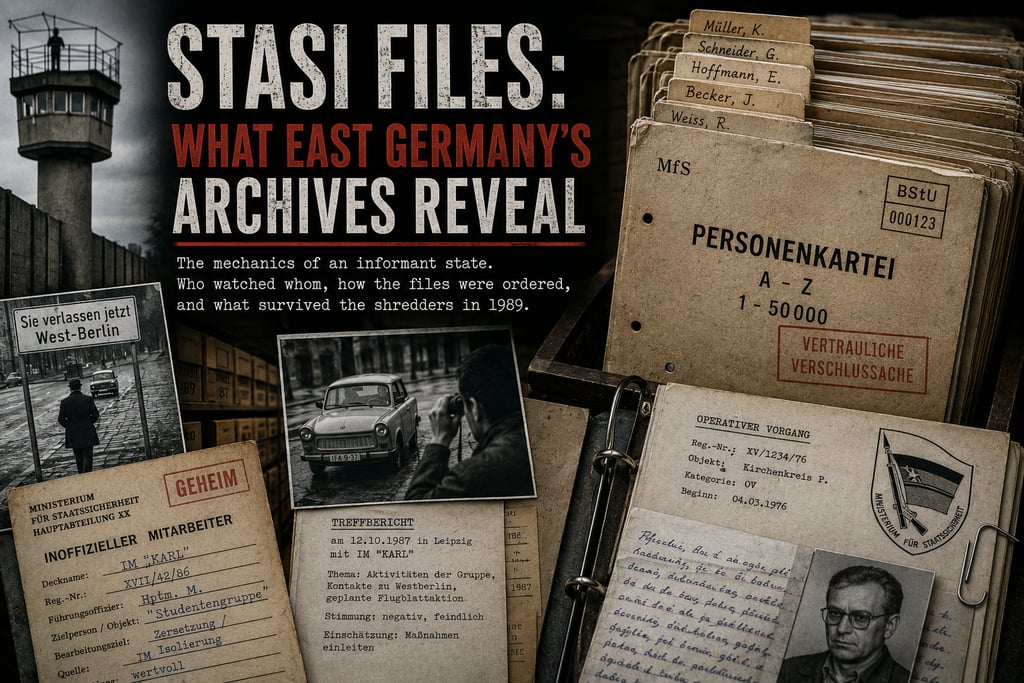
The Stasi files reveal the mechanics of East Germany’s informant state: surveillance, collaborators, ordered files, shredded records and what survived 1989.
Stasi Files: What East Germany’s Archives Reveal
The Stasi files reveal the mechanics of East Germany’s informant state: surveillance, collaborators, ordered files, shredded records and what survived 1989. That should have killed the operation. It did not. It made the operation harder to understand. George Blake, a Soviet agent inside Britain’s Secret Intelligence Service, knew about the plan from its early stages and told Moscow. The KGB therefore understood that the CIA and MI6 were preparing to tunnel from West Berlin into the Soviet sector and tap communications lines carrying Soviet and East German traffic. The secret was broken before the tunnel became useful. The wall had ears before the West built the room.
INTELLIGENCE & ESPIONAGE HISTORY
Ivo Vichev
5/13/202612 min read
The Stasi state did not only watch people. It organised them into paper.
That was its real machinery. Not the trench coat, not the hidden microphone, not the interrogation room alone, though all of those existed. The deeper instrument was the file: the report written after a conversation, the index card, the surveillance photograph, the informer’s note, the travel request, the intercepted letter, the workplace assessment, the church report, the neighbour’s observation, the operational plan, the codename placed over a human relationship.
East Germany’s Ministry for State Security, the Stasi, understood power as accumulation. A state could not control everything it did not know. It therefore tried to know too much. It listened, copied, filed, cross-referenced, recruited, classified and stored. It turned private life into administrative material. The result was not omniscience. No state is omniscient. The result was something colder: a bureaucracy of suspicion that made citizens legible to power before they were allowed to be legible to one another.
The Stasi files reveal this not as theory but as method. They show how an informant state actually worked. Who watched whom. How ordinary relationships were bent towards the state. How language turned mistrust into procedure. How careers, marriages, churches, universities, factories, theatres and dissident circles became fields of collection. How the regime tried to destroy the evidence when the ground began moving beneath it in 1989. How much survived anyway.
The archive is immense because the fear was immense. By the time the East German state began to collapse, the Stasi had built one of the most intrusive security apparatuses in modern Europe. The German Federal Archives, which now holds the Stasi Records Archive, states that the archive preserves the files of the Ministry for State Security and supports private access, research, media work and civic education. Its reconstruction project records that Stasi staff tore up documents by hand and stuffed the remnants into about 16,000 bags. Since the 1990s, archivists have manually reconstructed, indexed and archived about 1.7 million pages from 600 bags, with a pilot computer project reassembling around 91,000 pages from 23 bags.
Those numbers matter because they show two things at once. First, the Stasi created a state that documented its own violations with obsessive discipline. Second, when the state began to fall, its officers understood the danger of their own paperwork.
A dictatorship knows what its files are worth when it starts destroying them.
The Stasi was founded in 1950, one year after the creation of the German Democratic Republic. It became the shield and sword of the ruling Socialist Unity Party. That slogan was not decorative. The Stasi did not stand outside the political order as a neutral security body. It defended the party-state. Its task was not only to catch spies or prevent sabotage. Its task was to identify, penetrate, weaken, isolate, frighten and neutralise anything the regime defined as hostile.
Hostility was not limited to violence. It could mean political dissent, religious activity, cultural independence, contact with the West, plans to leave the country, criticism at work, jokes in the wrong room, unauthorised printing, independent peace activism, suspicion of insufficient loyalty, or merely the wrong pattern of association. An authoritarian state expands the meaning of threat because expansion feeds its own necessity. The wider the category of danger, the larger the machine required to manage it.
The files show that machine at work. They do not reveal only spectacular cruelty. They reveal routine. That is more disturbing. A spectacular crime can be treated as exception. Routine shows system.
A Stasi report might describe who attended a church meeting. Another might note who spoke critically about food shortages or travel restrictions. Another might record a conversation between friends. Another might analyse the psychological weaknesses of a target. Another might trace Western contacts. Another might recommend pressure at a workplace, problems in housing, interruption of study, disruption of publication, or the careful poisoning of trust around a person the state wanted isolated.
The GDR did not need every citizen arrested. Arrest is expensive, visible and sometimes politically costly. The Stasi perfected quieter forms of pressure. It could prevent, delay, frighten, compromise and disorganise. It could make a person’s life smaller without putting them on trial. It could turn a career brittle, a marriage uncertain, a friendship suspect, a dissident circle porous. It could make the citizen ask not only, “Is the state watching me?” but “Which person near me is carrying the state into the room?”
That second question was the weapon.
The informant network gave the Stasi reach that uniformed officers alone could never have achieved. Paid officers could enter workplaces and official institutions. They could summon, interrogate and investigate. But they could not naturally sit inside every kitchen, rehearsal room, parish group, student flat, literary circle, medical ward, sports club, family dispute or quiet friendship. Informants could. They gave the state social access.
The German term Inoffizieller Mitarbeiter, usually shortened to IM, carries the bureaucratic dullness of the system. “Unofficial collaborator” sounds almost harmless until the function becomes clear. These were people recruited to report secretly to the Stasi. Some were ideological believers. Some were pressured. Some wanted career protection. Some wanted privilege, travel, money, revenge or importance. Some convinced themselves they were helping preserve peace or socialism. Some reported little. Some reported with precision and malice. Each case needs individual care, because guilt, coercion and usefulness were not identical in every file.
But the aggregate was devastating. By 1989 the Stasi employed more than 90,000 full-time staff and relied on a vast network of unofficial collaborators. The Federal Archives’ Stasi education material records that the foreign intelligence arm alone, the HV A, had 4,600 full-time staff by 1989, plus 13,400 unofficial collaborators in the GDR and another 1,500 in West Germany. Other widely cited archival summaries put the domestic unofficial collaborator network in the high hundreds of thousands across the life of the GDR, with roughly 180,000 to 190,000 active around the end. The exact count depends on category and definition, which matters because Stasi language divided collaborators by type, access and function.
That classification was part of the system. The Stasi did not merely collect informants. It ordered them.
Some collaborators provided access to specific social or professional areas. Some offered apartments, addresses, rooms, telephones or logistical support. Some reported within workplaces. Some were tasked against churches, artistic circles, universities, youth groups, opposition networks, families or contacts in the West. Some were more valuable for their position than for the volume of what they wrote. The Stasi’s world was built from layers of usefulness.
The file transformed betrayal into form. A conversation became a report. A report became an assessment. An assessment became an operational decision. The person being watched became an object of procedure. Human trust entered the system as raw material and returned as control.
That is what the archive reveals most clearly. It shows not only that people informed. It shows how the state digested informing.
A citizen who opens a Stasi file does not encounter only the state. They encounter a distorted version of their own life, assembled by others. A meeting they remember one way appears in official language another way. A friend’s confidence becomes a paragraph. A workplace incident becomes evidence of political unreliability. A private joke becomes a sign. A disagreement becomes tendency. A refusal becomes hostility. The state did not simply record reality. It translated life into suspicion.
This is why the files are not neutral, even when they are invaluable. A Stasi file is evidence, but evidence produced by a hostile institution. It must be read closely. The report may show that surveillance happened. It may reveal who informed, what was said, what was invented, what was misunderstood, what the officer wanted his superior to believe. But the file is not the person. It is the person seen through the needs of a security bureaucracy.
The archive therefore requires moral and historical discipline. To read a Stasi file is to enter a room built by the perpetrator. The room contains truth, but not innocent truth. It contains observation, malice, fear, self-protection, careerism, ideological language, gossip, bureaucratic self-justification and occasional accuracy. The historian’s task is not to bow before the file because it is official. It is to understand the function the file performed.
The files also show how much labour surveillance required. Mass repression is often imagined as a single eye watching from above. The Stasi was closer to a system of thousands of hands. Officers recruited, met sources, wrote evaluations, assessed reliability, created operational plans, requested searches, recorded intercepted material, filed photographs, stored audio, classified targets and prepared reports. The state watched through labour.
That labour gave the Stasi state a physical form. Shelves. Cards. Folders. Bags. Indexes. Offices. Regional branches. Central repositories. Files moving through channels. Paper is not passive in such a system. Paper allows memory to outlive the moment. It allows suspicion to accumulate. It allows one officer’s report to shape another officer’s decision years later. It allows the state to remember what ordinary people might have forgotten or forgiven.
This was one of the brutal advantages of the archive while the regime lived. It gave the state a longer memory than the citizen.
A person might change. The file did not forget. A youthful comment, a family connection, an application to travel, a contact with a Western relative, a church meeting, a complaint, a failed recruitment, a poem, a signature on a petition: all could remain available to the state. The file made past behaviour permanently usable.
The Stasi files also reveal the poverty of a regime that claimed confidence while behaving as if it feared everything. States that are secure do not need to catalogue private life at such scale. The GDR presented itself as an anti-fascist workers’ and peasants’ state, historically justified and politically necessary. Its security apparatus shows how little it trusted its own citizens to believe that story without pressure.
The archive is therefore a record of weakness disguised as control.
By 1989, that weakness had become visible. East Germans were protesting. The Berlin Wall was opening. The authority of the party-state was collapsing with a speed its own files had not prevented. In the final months, Stasi officers tried to destroy records. They shredded, tore and bagged documents. The shredders could not keep up. Paper defeated panic by quantity. In many offices, documents were torn by hand and stuffed into sacks. The effort was large enough to show intent and incomplete enough to leave evidence.
The surviving 16,000 bags of torn material are among the most powerful images of the end of the GDR. They show a security state caught between two instincts: concealment and collapse. The officers knew the files could identify informants, operations, targets and crimes. They also knew that the system that had protected them was losing the power to protect its own memory.
Citizens understood it too. In December 1989 and January 1990, protesters occupied Stasi offices to stop destruction. That act mattered as much as any later law. The archive survived because citizens physically intervened between the state and its own shredders. The people who had been watched moved to seize the machinery of watching.
The post-1990 history of the files is therefore not only archival. It is democratic. The creation of access rights allowed former citizens of the GDR to request and read the files kept on them. That was a radical reversal of power. The state had once read the citizen in secret. Now the citizen could read the state.
The effect was not clean healing. Archives do not heal by themselves. They expose. They confirm old fears and create new wounds. A file could reveal that a colleague informed. Or a friend. Or a lover. Or a spouse. It could confirm that a career had been blocked, a trip denied, a manuscript monitored, a dissident group penetrated. It could show that someone trusted had been writing reports for years. It could also show exaggeration, nonsense, minor reporting, bureaucratic overinterpretation or mistaken suspicion. The file could answer one question and open ten more.
That is the human violence of an informant state after its fall. The regime dies. The relationships it damaged continue.
A dictatorship’s files are not inert after liberation. They enter families, courts, biographies, politics, journalism, scholarship and memory. They name names. They unsettle reputations. They complicate martyrdom. They expose collaboration and coercion. They force societies to decide what to do with compromised lives.
East Germany’s Stasi archive became one of the central instruments through which unified Germany confronted the GDR’s security past. The files were used for personal access, research, vetting, public accountability and historical education. That process has never been simple. Too much exposure can become spectacle. Too little exposure becomes protection for perpetrators. Every democratic use of a secret-police archive has to hold two obligations together: the right of victims to know and the need to read perpetrator records carefully enough not to reproduce their distortions.
The Stasi files reveal guilt. They also reveal grey zones. Some informants were willing servants. Some were compromised by pressure. Some were recruited young. Some reported trivialities. Some destroyed lives. Some lied to the Stasi. Some exaggerated to please handlers. Some gave the state exactly what it wanted. The archive does not absolve by being complicated. It only requires judgment precise enough to fit the case.
The state did not make all people equally guilty. It made many people useful.
That distinction matters because the Stasi’s power lay partly in making moral life unstable. It did not require everyone to be a convinced servant of repression. It needed enough people to cooperate, enough to fear, enough to keep quiet, enough to doubt, enough to wonder who was listening. It needed uncertainty to travel faster than proof.
Surveillance worked not only when a report was written, but when people changed what they said because a report might be written. This is the part no archive can fully measure. Files show recorded surveillance. They do not fully show the unwritten silence produced by the possibility of surveillance. A joke not told. A friendship not pursued. A meeting avoided. A manuscript softened. A pastor distrusted. A student deciding not to sign. A citizen lowering his voice at home.
The archive reveals the machinery. It cannot count every life narrowed by the fear of the machinery.
The files also challenge lazy comparisons. The Stasi was not the Gestapo with different flags. It belonged to a different state, a different ideological order and a different technological and bureaucratic moment. It worked through mass files, informant penetration, administrative pressure, psychological harassment, border control, political policing and intelligence work. It did not need the same level of public terror to produce deep private fear. Its sophistication lay partly in making repression quieter.
The German word Zersetzung is often attached to the Stasi’s method of psychological destabilisation. It meant decomposition or corrosion: the breaking down of a person’s confidence, reputation, relationships and capacity to act. The point was not always to arrest the dissident. It was to make him ineffective, isolated, doubtful, exhausted, professionally blocked or socially suspect. That form of repression fits an archive especially well because it is built from small acts: letters delayed, rumours spread, opportunities denied, allies turned, pressure applied where it leaves no public bruise.
The file is suited to such violence because it accumulates smallness until smallness becomes system.
This is what East Germany’s archives actually reveal. Not only a state that watched. A state that made watching administrative. A state that recruited society into its own surveillance. A state that converted intimacy into information. A state that feared independent life enough to document it. A state whose officers tried to destroy the evidence when power slipped away, and whose citizens stopped them.
The surviving files are not the whole truth. Some records were destroyed. The foreign intelligence service, the HV A, was able to destroy a large quantity of its documents during the collapse, as the Federal Archives notes in its educational material. Other records remain fragmented in bags. Some reports are false or misleading. Some files contain the language of officers trying to please superiors. Some people were watched more heavily than others. Some forms of pressure left thin paper traces. The archive is vast, but not complete.
That incompleteness is part of the truth. Repressive states do not leave perfect evidence. They leave enough to convict themselves and enough missing to remind us what power had time to burn.
The Stasi files also show that archives are not only about the past. They shape the future of memory. Without the files, the GDR could more easily be softened into nostalgia, anecdote or political argument. With the files, the machinery remains visible. The state’s language survives. The informant reports survive. The operational categories survive. The torn paper survives. The citizens’ right to read survives.
Memory without documents can become mood. Documents make evasion harder.
This does not mean the archive speaks by itself. It must be interpreted. It must be handled with care. A file can damage twice if read lazily: first when the Stasi created it, then when later readers mistake its language for unfiltered truth. The right use of the archive is not blind acceptance. It is disciplined confrontation.
The Stasi wanted its files to serve power. After 1990, those same files were forced to serve accountability.
That reversal is rare. Many secret-police archives disappear into fire, shredders, locked state vaults or negotiated amnesia. East Germany came close to that outcome. The bags of torn paper show how close. The shelves that survived show what citizens saved by refusing to let the watchers erase themselves.
The image is plain enough. Officers tearing files by hand while the state collapses around them. Paper sacks filling with fragments. Citizens entering buildings. Shelves held in place. Later, archivists unfolding scraps, matching edges, reading what had been meant to vanish. It is not a clean victory. Nothing about such an archive is clean. But it is a victory of evidence over concealment.
The Stasi spent forty years trying to know East German society.
In the end, the files made the Stasi knowable.