Narrative Historian | Author | Journalist

Klaus Fuchs and the Bomb: The Spy Who Helped Stalin Build the Soviet Atomic Weapon
Klaus Fuchs was one of the most important atomic spies of the Cold War. Discover how his betrayal helped the Soviet Union shorten its path to the bomb and changed nuclear history.
COLD WAR
Ivo Vichev
5/22/202617 min read
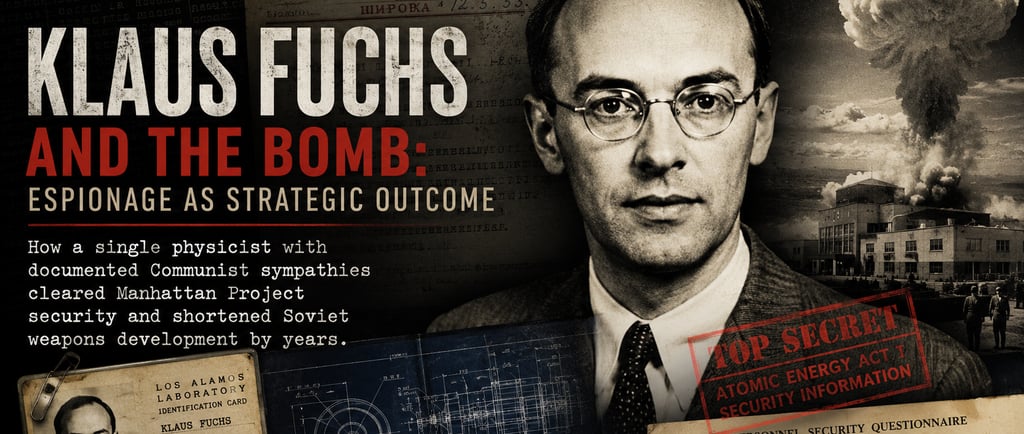
The most dangerous man inside the Manhattan Project did not look like a danger.
Klaus Fuchs was quiet. He was useful. He was brilliant in the way secret projects reward most: not dramatic, not disruptive, not hungry for attention, but mathematically exact and able to turn impossible questions into working calculations. At Los Alamos he sat inside the Theoretical Division under Hans Bethe, worked on blast waves and implosion problems, and contributed to the design logic behind the plutonium bomb. Bethe later called him one of the most valuable men in the division.
Fuchs was also a Soviet spy.
That is the shape of the case. Not a cartoon traitor slipping through a foolish system. Not a misunderstood idealist whose crime can be washed clean by motive. Fuchs mattered because he stood at the point where scientific trust, wartime urgency, refugee politics, Communist loyalty, and Anglo-American security weakness all met. He was not outside the machine. He was inside it — cleared by it, used by it, praised by it — and the damage had already moved east before anyone in British or American intelligence fully understood what had happened.
He did not give Stalin "the secret" of the atomic bomb in the childish sense. There was no single secret. Nuclear fission had been publicly understood since 1938. Physicists in Britain, Germany, the United States, and the Soviet Union understood that a bomb was possible. The hard part was never the idea. The hard part was design: metallurgy, enrichment, plutonium production, implosion timing, initiators, critical mass, and the confidence to choose one technical road over another under terrifying pressure and without the freedom to publish your mistakes.
That is where Fuchs's espionage did its work.
He shortened uncertainty. He reduced false starts. He helped Soviet scientists and Soviet security chief Lavrentiy Beria judge which American solutions had worked and which problems had already been solved. Scholarship cited by the Atomic Heritage Foundation puts the acceleration at roughly six months to two years. That range matters. It is smaller than legend and larger than comfort.
The Soviet bomb was not built by Klaus Fuchs. It was built by Soviet scientists, Soviet engineers, Soviet forced labour, and a state willing to crush any obstacle. Fuchs did not replace that machinery. He sharpened it.
The Refugee Who Became Useful
Fuchs was born in Rüsselsheim, Germany, on 29 December 1911. He studied mathematics and physics, joined the German Communist Party in 1930, and fled to Britain in 1933 after Hitler came to power. In Britain he completed advanced scientific work under men who recognised immediately what he could do. He earned a doctorate in physics from Bristol and later worked with Max Born at Edinburgh.
That biography helped him. It also obscured him.
In wartime Britain, a German anti-Nazi refugee carried a particular political legibility. He was foreign, but he had fled Hitler. He was a former Communist, but the party had not yet acquired the Cold War meaning it would carry after 1947. He was politically marked but scientifically indispensable. When the war began, he was interned first on the Isle of Man and then in Canada as an enemy alien. After Born helped secure his release, Fuchs returned to Britain in 1941 and was recruited by Rudolf Peierls into Tube Alloys — the British atomic bomb programme.
The security failure began there.
Fuchs became a British citizen in August 1942 and signed the Official Secrets Act. Shortly after entering the British atomic programme, he began passing information to Soviet intelligence. MI5's official account is precise about the sequence. In late 1941, after Germany invaded the Soviet Union, Fuchs contacted the exiled German Communist Jürgen Kuczynski and offered to provide the Russians with information on Tube Alloys. He was put in touch with Soviet military intelligence. In 1942 he was given the codename REST and transferred to Ursula Beurton — Ursula Kuczynski, also known as "Sonya" — a GRU officer. They met in Banbury, Oxfordshire, where he passed secret documents.
This was not a later corruption. Fuchs entered the Anglo-American bomb world already compromised.
His stated motive was ideological. MI5 records that he later said he believed the Soviet Union had a right to know about the atomic project. Dick White, later head of MI5, judged Fuchs's motives relatively pure compared with spies driven by money. That judgement should not soften the act. Ideological espionage can be more dangerous than paid espionage because it requires no transaction. It sustains itself on conviction. Fuchs did not sell the bomb. He gave it away because he believed no single capitalist state should control it.
That belief carried a moral pose. The consequence was strategic.
The Road Into Manhattan
The British atomic effort moved quickly in ways that mattered.
The Frisch-Peierls memorandum of 1940 — Peierls was Fuchs's own colleague and mentor — had helped demonstrate that an atomic bomb might require far less fissile material than many physicists had assumed. The MAUD Committee confirmed feasibility. Those reports accelerated American thinking at a moment when Washington was still debating whether a bomb was worth the resources.
By 1943, Britain had scientific talent but not industrial scale. The United States had the territory, the industrial base, and the war economy to turn theory into production. The Quebec Agreement of August 1943 formalised collaboration. Members of the British Mission began arriving in America. At Los Alamos, the British Mission was small but its members carried exceptional technical weight. Fuchs was among them.
He and Peierls first went to Columbia University in New York to work on gaseous diffusion, one of the methods for separating uranium-235 from uranium-238. In August 1944, Fuchs transferred to Los Alamos and joined the Theoretical Physics Division. There he worked under Bethe on problems central to the bomb's design, including the implosion mechanism that made the plutonium bomb possible.
The institutional failure that allowed him inside was not simple stupidity. It was a calculation made under wartime pressure that the project could not wait for perfect background checks, and that European refugees with communist pasts were not all the same kind of security risk.
Fuchs occupied that gap precisely. He was known. He was inside the British Mission. His scientific ability carried him through the gates. At Los Alamos he did not stand at the edge of the work. He stood close to its centre. He was quiet, socially accepted, and trusted enough by colleagues that Richard Feynman borrowed his car to visit his dying wife.
Espionage rarely announces itself as darkness. Sometimes it borrows the car.
What Fuchs Knew
The bomb that destroyed Hiroshima was a uranium gun-type weapon. The bomb that destroyed Nagasaki was a plutonium implosion weapon. The difference was not incidental. It was the technical heart of the entire programme.
A gun-type design fires one mass of fissile material into another to create a supercritical assembly. It works for uranium-235. Plutonium presented a harder problem. Reactor-produced plutonium contains impurities — including plutonium-240 — that produce spontaneous neutrons, making a gun design too likely to predetonate before critical mass is fully assembled. The answer was implosion: a precisely symmetrical inward compression of the plutonium core using shaped high explosive lenses arranged around it.
Implosion was not a slogan. It was a system of timing, geometry, materials, neutron initiation, and calculation so exact that a small error could turn a bomb into a fizzle. A working implosion bomb meant the United States could use plutonium from reactors, not only the scarce separated uranium that the gun-type weapon required. That changed the entire scale of possible production.
Fuchs worked on these problems at their core. He specialised in implosion methods, calculated approximate energy yields for the Fat Man design, and was present at the Trinity test in the New Mexico desert on 16 July 1945.
For Soviet intelligence, what he passed was not gossip. It was design confidence.
MI5 states that the information Fuchs provided Gold, combined with material from other sources, helped the Soviets make rapid progress toward what was effectively a copy of the American design. The phrase "combined with other sources" is essential to keep. Fuchs was not the only atomic spy. Theodore Hall, a nineteen-year-old physicist at Los Alamos, passed information to Soviet intelligence on his own initiative. David Greenglass, a machinist at the site, supplied material of a different technical quality. Oscar Seborer has since been identified as a further source. Los Alamos National Laboratory has acknowledged that Fuchs, Hall, Greenglass, and Seborer all committed espionage at Los Alamos.
Fuchs stood apart because of the level of his access and the depth of his understanding. Greenglass could describe. Fuchs could explain. A state racing to build a bomb needs both kinds of information, but the second kind changes confidence in a different way. It does not merely say, "This is what I saw." It says, "This is why it works."
Harry Gold and the Handoff
The courier system was ordinary in the way operational espionage usually is ordinary.
Fuchs's American contact was Harry Gold, known to him only as "Raymond." Gold had worked for Soviet intelligence since 1934. He was not a scientist. He was a Philadelphia chemist who had made himself useful as a carrier — someone who could move information from a source to a handler without either party needing to meet directly. Fuchs and Gold met in New York and Santa Fe across 1944 and 1945. Through those meetings, Fuchs passed technical material on the atomic bomb through Gold and onward to Soviet handlers.
No cinematic drama was required. The design of the plutonium bomb moved through conversations between two men who looked like nothing particular in a public street.
The Manhattan Project had concentrated knowledge inside fenced, compartmentalised places: Oak Ridge, Hanford, Los Alamos, laboratories and plants that were sometimes entire secret cities. The Soviet intelligence network dissolved those fences not by breaking gates but by turning personal access into state access. It needed the right people already inside. Fuchs was one of them.
Trinity and the Message East
On 16 July 1945, the first atomic device exploded in the New Mexico desert at a test site Oppenheimer had named Trinity. The device worked. The implosion design held. The yield was equivalent to approximately twenty kilotons of TNT. For the Americans, Trinity was proof. For the Japanese cities that followed in August, it became destruction. For the Soviet Union, it was confirmation of a race already underway with the help of stolen knowledge.
The Soviet atomic programme had begun formally in February 1943 under Igor Kurchatov, with Beria later driving the state machinery around it. During the war it was small compared with the Manhattan Project — roughly twenty physicists and limited staff, according to the Atomic Heritage Foundation. Work accelerated in 1945, especially after Hiroshima and Nagasaki forced Stalin to order a crash programme. Beria took control of the atomic effort in August 1945 with instructions to produce a bomb as fast as possible.
A state racing to build a bomb faces two distinct difficulties. The first is material: uranium, reactors, plutonium, metallurgy, precision machining, explosive lenses, timing circuits, testing infrastructure, and the industrial base to produce all of it under extreme secrecy. The second is epistemic: knowing which road is worth taking. The Americans had paid heavily for that knowledge. They had built enrichment plants before knowing which method would work best. They had confirmed that plutonium required implosion. They had tested explosive lenses and learned what configurations failed.
Fuchs passed some of that burden eastward.
The Soviet system under Beria was suspicious even of its own intelligence. Soviet scientists did not simply copy spy reports line by line. Intelligence served as a check and a guide — evidence that specific American roads had already reached success, that specific problems had already been solved. It reduced the range of possible mistakes.
That is what acceleration means in this context. Not magic. Not theft replacing science. A measurable reduction in uncertainty.
The Soviet Bomb
On 29 August 1949, the Soviet Union detonated its first nuclear device at the Semipalatinsk test site in Kazakhstan. The test was designated RDS-1 by the Soviets. The Americans, when they learned of it, called it Joe-1.
The United States did not learn of the test from a confession or a leak. It learned from the atmosphere.
On 3 September 1949, a U.S. Air Force WB-29 weather reconnaissance aircraft flying a routine patrol route from Japan to Alaska collected radioactive debris in its air filters. After further atmospheric sampling, laboratory analysis, and consultation among intelligence and scientific officials, the conclusion was unavoidable: the Soviet Union had detonated an atomic device. President Truman announced on 23 September 1949 that an atomic explosion had occurred in the USSR.
The shock was not only that Stalin had the bomb. It was the speed.
Before the test, American estimates had often placed the most probable Soviet bomb date in the early-to-mid 1950s. The National Security Archive has noted that some estimates projected mid-1953 as the most likely date. The actual test in August 1949 exposed the weakness of those projections. American intelligence had underestimated Soviet industrial progress and missed indicators of reactor-related production — including evidence of relevant chemical production in East Germany that analysts failed to read correctly.
Fuchs was not the sole reason those estimates were wrong. But his contributions were part of why Soviet progress exceeded what Washington expected.
RDS-1 resembled the American Fat Man plutonium implosion device closely enough that the relationship between the designs is not in serious dispute. Soviet espionage did not create Soviet nuclear physics. It helped give Soviet physicists a shorter and less uncertain road through the hardest technical problems of building one.
The Security Failure
The Fuchs case exposes a security failure deeper than a missed background check.
By 1949, MI5 understood that a major Soviet spy had been inside the Manhattan Project. VENONA decrypts had revealed reports of meetings between a figure codenamed REST and Gold. The material was too sensitive to use as courtroom evidence, but it was specific enough to narrow the suspects. By late 1949 investigators had focused on Fuchs.
Before that identification, he had already returned to Britain and taken a senior post at the Atomic Energy Research Establishment at Harwell — described by MI5 itself as so secret and important it was nicknamed "the holy of holies." MI5 had reviewed Fuchs's record before his Harwell appointment, including pre-war reports of Communist activity. It found nothing incriminating enough to bar him. He continued spying.
That is the failure in full sequence. He was known to have a political past. He had been interned as an enemy alien. He had worked on Tube Alloys. He had gone to Los Alamos. He returned to Britain and entered the country's premier post-war atomic research facility. The security system saw fragments and did not assemble them into a picture in time.
Security vetting under wartime conditions cannot operate with perfect hindsight. Fuchs's scientific ability was exceptional. The Allies needed exceptional minds. They also needed trust between scientists, because a bomb cannot be built under total mutual suspicion. Too much suspicion breaks the work. Too little lets a spy carry the design out by hand. Fuchs used that gap across an entire decade of access.
The Confession
VENONA could expose but not convict.
The decrypts were too sensitive to disclose in court. A prosecution based on them would have revealed to Soviet intelligence exactly which of their communications had been broken and how. MI5 therefore needed a confession. From July 1949, the service intercepted Fuchs's mail and telephone calls. Neither produced incriminating material. William Skardon, a former Special Branch officer who had become one of MI5's most skilled interrogators, was assigned to break him.
Skardon used a personal opening. Fuchs's father had accepted an academic post at the University of Leipzig in East Germany. That created a security concern Fuchs had already raised voluntarily with Harwell management. Skardon used it as a pretext for a series of meetings, gradually building Fuchs's confidence through apparent understanding and personal rapport. In December 1949 he confronted Fuchs directly with MI5's knowledge of his espionage. Fuchs first denied it.
In January 1950, he confessed.
The confession was long. It was also incomplete. He admitted spying for the Soviets since 1942, confirmed the nature of the information passed, and described his contacts. He refused to disclose certain aspects of his work. He pleaded guilty to breaching the Official Secrets Act at the Old Bailey and received the maximum available sentence: fourteen years.
The trial was almost an anti-climax after the intelligence work that had produced the confession. The courtroom resolved in minutes what had taken years of code-breaking, analysis, and patient interrogation to construct.
Fuchs served nine years. He was released in 1959 and moved to East Germany, where he joined the Institute for Nuclear Research in Rossendorf and became a prominent figure in the East German scientific establishment. He was not ruined by the state he had served. He was absorbed by it.
He had betrayed one system and been honoured by another. That is not irony. That is espionage.
What the Betrayal Changed
The first consequence was Soviet acceleration.
The honest evidence-based formulation: Fuchs's espionage, combined with other Soviet intelligence and Soviet domestic scientific effort, probably shortened the Soviet atomic bomb project by somewhere between six months and two years. That range is smaller than the myth of "the spy who gave Stalin the bomb" and larger than any comfortable dismissal.
In 1949, six months mattered. A year mattered. Two years mattered very much.
Every month of American atomic monopoly shaped early Cold War planning, coercion, confidence, and threat. The monopoly was the strategic fact underneath American foreign policy between 1945 and 1949. It underwrote the Truman Doctrine. It influenced how the United States thought about Soviet expansion in Europe. It shaped the structure of deterrence that NATO was being built to support. When the monopoly ended, Washington was forced to think differently about every assumption that had rested on it — about conventional forces in Europe, about Berlin, about the possibility of general war, about civil defence, and about the future trajectory of nuclear weapons competition.
The Soviet bomb did not make great-power war inevitable. It made total war less controllable.
The second consequence was institutional. Fuchs's exposure hardened American suspicion of nuclear sharing. After the war, Los Alamos's own history records, classified nuclear information was no longer shared with foreign countries, including Britain. British Mission scientists were denied access even to reports they had themselves contributed to. Full nuclear cooperation between the United States and Britain did not resume until the Mutual Defence Agreement of 1958. Fuchs did not create American reluctance to share atomic secrets — the McMahon Act of 1946 had already moved in that direction. His case made the argument for restriction impossible to resist.
The third consequence was investigative. Fuchs's confession opened a chain.
His testimony led directly to Harry Gold, arrested in May 1950. Gold's interrogation led to David Greenglass. Greenglass named Julius Rosenberg. That chain produced the most publicly visible atomic espionage case of the Cold War — two executions, decades of political argument, and a legal and historical dispute that Venona would later reframe but never fully close.
Fuchs was not only a spy. He was a door into a network.
Why Fuchs Was Worse Than Greenglass
The public memory of atomic espionage centres on the Rosenbergs. Their trial and execution made them symbols. Fuchs produced less theatre and more damage.
David Greenglass was a machinist at Los Alamos. His information mattered, but he did not understand the bomb as Fuchs understood it. Greenglass could pass descriptions and hand-drawn sketches of the lens mould design. Fuchs could pass design logic — the theoretical basis for why an implosion configuration worked, what calculations had confirmed it, and what problems the Americans had already overcome. The difference is not trivial. A state building a nuclear weapon needs both kinds of information. The second kind changes confidence in a way the first cannot.
Fuchs had the education to understand the value of what he carried. He had the political conviction to sustain the commitment over years. He had access at the level where design became decision — not on the periphery of the project but inside the division responsible for the bomb's theoretical architecture. He had the discipline to remain hidden long enough for the damage to be permanent.
Espionage becomes strategically significant when the stolen material changes a state's choices. Fuchs's material did exactly that. It told Moscow that implosion was not theoretical speculation but a verified, tested route. It allowed Beria's system to check Soviet progress against American results. It helped the Soviet programme avoid wasting time on inferior designs that the Americans had already ruled out.
The Soviet project still required Soviet achievement. Fuchs's crime does not diminish Kurchatov, Yuli Khariton, or the engineers who turned the design into a detonation. It proves something harder: a competent scientific establishment uses stolen knowledge well.
The Ideology Problem
Fuchs's Communism cannot be treated as incidental background. It is the explanation.
He joined the German Communist Party in 1930, when the party's primary opponent was rising German fascism and its primary promise was an organised resistance to it. He fled Hitler in 1933. He entered British science as a refugee from the regime Communism had positioned itself against. After Germany invaded the Soviet Union in June 1941, he reached out to Soviet contacts and offered what he had. MI5 records that he later described his reasoning as a belief that the Soviet Union had a right to know about the atomic project.
That motive was not madness. It was political loyalty shaped by a specific historical moment.
For a German Communist who had watched Hitler consolidate power, the Soviet Union could appear as the force that had to survive. For an anti-fascist physicist working on a weapon of unprecedented destructive capacity, American and British secrecy about that weapon could be interpreted as the foundation of future domination. Fuchs framed his betrayal as a moral corrective: no single nation should privately hold atomic knowledge while others remained ignorant and vulnerable.
The explanation does not absolve him.
He did not give atomic information to humanity. He gave it to Stalin's Soviet Union — a state whose security apparatus was run by Lavrentiy Beria, whose labour camps held millions, and whose political system operated through terror. He did not publish his findings openly in a protest against nuclear monopoly. He passed them covertly through intelligence channels to a dictatorship. The language of mankind ended in the files of a police state.
Fuchs may have believed he was preventing American nuclear domination. He was also strengthening Stalin. Both things are true simultaneously. Motive explains the road he chose. It does not clean the destination he reached.
The Bomb as State Power
The atomic bomb was never only a weapon. It was a state form.
To build it, the United States created secret cities, vast industrial plants, procurement systems, compartmentalised classification regimes, and a new institutional relationship between theoretical science and military-industrial government. The Soviet Union built its own version under different political conditions: closed cities, prison labour, coercive mobilisation, and an atomic establishment answerable to Stalin's security apparatus.
Fuchs moved knowledge from one state form to another.
He did not steal an object. He stole time, confidence, and direction. The bomb changed what states could threaten. Espionage changed how fast another state could enter that field. Fuchs's case shows the junction between those two changes: a physicist standing at a pressure point where a single mind carried information entire state apparatuses were organised to obtain.
The False Comfort of Inevitability
There is a lazy way to minimise Fuchs. It argues that the Soviet Union would have built the bomb regardless.
That is true and insufficient.
The Soviet Union had the scientific ability, the industrial capacity, and the political will to build an atomic weapon. Once fission was publicly understood and the United States had demonstrated the bomb in war, no major power with Soviet resources would ignore the technology. The question was never whether Moscow would eventually produce a bomb. The question was when, by which road, and with how much uncertainty.
Timing is history. A bomb in August 1949 is not the same as a bomb in 1952 or 1953. Strategic windows close. Policies harden around assumptions. Military plans are written to last and then are overtaken by facts that arrive sooner than the planners expected. American intelligence estimates before Joe-1 were wrong partly because analysts did not grasp the speed of Soviet industrial progress and partly because they did not know the full scale of Soviet espionage inside the Manhattan Project. The actual test forced a reassessment of everything built on the assumption of continued monopoly.
Fuchs did not create Soviet capability. He altered its timetable. That is enough weight for one man.
The Man After the Damage
After nine years in a British prison, Fuchs went to East Germany and resumed a scientific career inside the communist state whose cause he had served at the cost of his freedom.
He was not absorbed as a relic or a figure of embarrassment. He became a senior figure at the Institute for Nuclear Research at Rossendorf. He was awarded the Order of Karl Marx. He joined the Socialist Unity Party. He died in East Berlin on 28 January 1988 at the age of seventy-six — having outlived Stalin, Beria, Kurchatov, and most of the principals of the world he had helped reshape.
In Britain and America, Fuchs was remembered as a betrayal. In the German Democratic Republic, his past could be read as contribution. Neither memory is neutral. Both reveal what states value and how they account for the people who served them.
The Final Measure
Klaus Fuchs did not change history because he was dramatic. He changed it because he was useful.
Useful to Britain because he could calculate what others could not. Useful to Los Alamos because he could work at the core of the hardest theoretical problems the bomb presented. Useful to Soviet intelligence because he could translate that access into technical information Moscow needed and could not have obtained at that level by other means. His case shows the real texture of high-level espionage: not romance, not disguise, not cleverness for its own sake, but the movement of usable knowledge between systems of power.
He entered Britain as a refugee from Hitler. He entered atomic work as a gifted physicist. He entered Soviet intelligence as a convinced Communist. He entered Los Alamos as part of the British Mission. He entered history because the information he carried helped end the American atomic monopoly sooner than Washington expected and sooner than its strategic planning had assumed was possible.
The honest acceleration estimate remains six months to two years. That range may sound modest beside the myth. It was enough to change the Cold War.
On 29 August 1949, the Soviet device detonated over the Kazakh steppe at Semipalatinsk. The shock wave did not carry Fuchs's name. It did not need to. His work was already inside the timetable.
The secret had become strategy.