Narrative Historian | Author | Journalist

Kim Philby in Beirut: The MI6 Failure Before His Defection to Moscow
Explore Kim Philby’s final months in Beirut, Nicholas Elliott’s failed interrogation, the Cambridge Five scandal, and the British intelligence failure that let him defect to Moscow.
Ivo Vichev
5/26/202626 min read
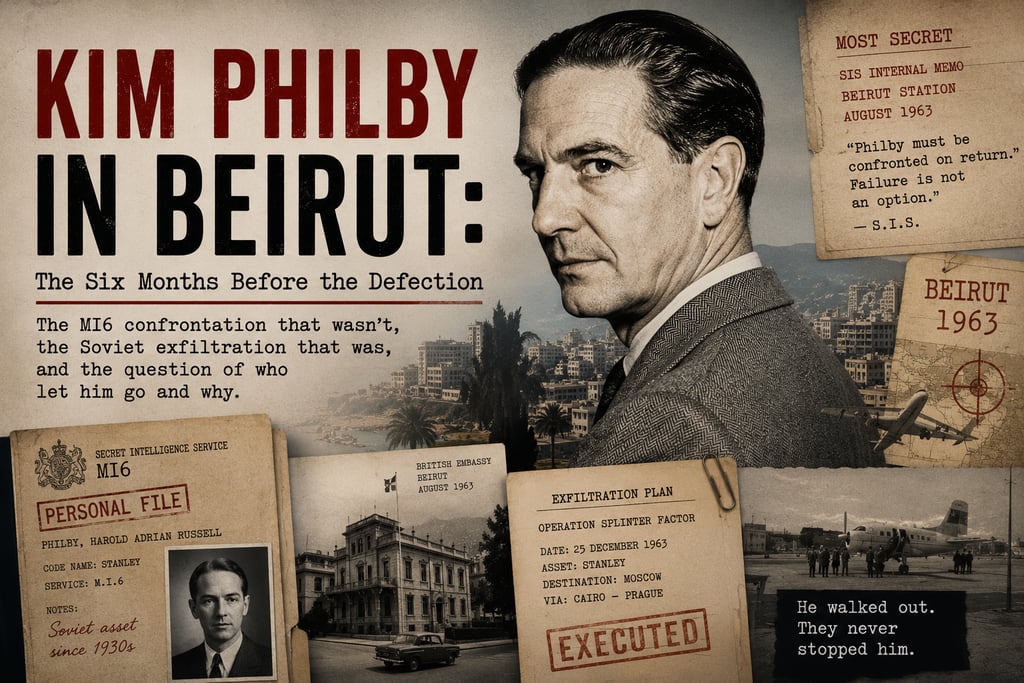
Kim Philby did not escape from a prison. He escaped from embarrassment.
By January 1963, the British state had enough to confront him. Not enough, perhaps, for the clean public trial it had failed to build for more than a decade. Enough to know. Enough to force the old friend into the room. Enough to hear him begin, at last, to admit what he had spent his adult life denying.
Nicholas Elliott flew to Beirut to extract a confession. He did not bring Philby home.
That is the centre of the story. Not simply that Philby ran to Moscow — that had become almost inevitable once the pressure finally closed around him. The harder question is why the pressure closed so gently. Why a man suspected since 1951, named by defectors, damaged by association with Burgess and Maclean, privately confronted and publicly exonerated, and finally met in Beirut with proof, still had enough space to disappear.
The answer is not clean. Philby was protected for years by class loyalty, personal friendship, institutional vanity, and the old reflex of British official life: scandal was treated not only as a danger to truth, but as a danger to the state's idea of itself. By 1963 that reflex had already failed. It had allowed a Soviet agent to live under partial suspicion, resume usefulness in the Middle East, and sit in Beirut as both journalist and intelligence contact. When the final confrontation came, the system still wanted confession without spectacle, truth without a trial, and control without custody.
Philby understood the gap.
He had lived in gaps for three decades.
The Making of a Soviet Agent
Harold Adrian Russell Philby was born in Ambala, India, on 1 January 1912, the son of Harry St John Bridger Philby — a British colonial official, Arabist, and eventual convert to Islam who had served as a political officer in Mesopotamia and Iraq and was one of the great eccentric figures of the British imperial world. St John Philby's contempt for official orthodoxy, his pleasure in subversion, and his readiness to work against the grain of the institutions that employed him left a mark on his son that is visible throughout Kim's career. The father rejected the British establishment from within it. The son destroyed it from within it.
Kim Philby went up to Trinity College, Cambridge in 1929. He read history and economics. He arrived a bright, socially confident young man from the empire's administrative class. He left in 1933 as a committed communist and a recruited Soviet agent, though neither fact was visible to anyone who mattered.
Cambridge in the early 1930s was a particular intellectual climate. The Depression had discredited liberal capitalism in the eyes of many who sat watching it collapse. Fascism was rising in Germany and Italy. The British government was pursuing appeasement. The League of Nations looked decorative. For a certain kind of politically serious young man, the Soviet Union appeared to be the only serious organised force against the direction history was taking. The Communist Party of Great Britain had members in every serious university. Its arguments were not absurd in that moment. The best answer its critics could offer was a social democracy that looked increasingly incapable of defending itself.
Philby was recruited into that world by Maurice Dobb, a Marxist economist at Cambridge. The deeper operational contact came through Arnold Deutsch, an Austrian-born Soviet intelligence officer working in Britain. Deutsch — known in Soviet files as ARNOLD — was a cultivator of unusual skill who understood that the highest-value recruits were not people already under Communist Party discipline but people with access and cover who could be steered away from open party membership and kept clean for long-term penetration work. His method was to identify ideologically committed young men before their views became publicly known, then help them perform a visible political migration away from the left — enough to gain entry to institutions that would otherwise exclude them.
Philby's Soviet codename was SÖHNCHEN: Little Son.
He went to Vienna in 1934, partly to observe the brutal suppression of socialist resistance by Dollfuss's Austro-fascist government. There he met Litzi Friedmann, an Austrian communist with intelligence connections of her own. They married. The marriage served cover. It also represented conviction. Philby was not performing leftism. He believed it deeply enough to risk his entire life on it.
By the time he returned to Britain, he had been given his assignment: enter the British establishment, rise inside it, pass everything he learned to Moscow, and tell nobody.
He began his visible political migration almost immediately. He joined the Anglo-German Fellowship, a pro-Hitler organisation that gave him respectable access to Nazi circles in the mid-1930s. He covered the Spanish Civil War as a journalist sympathetic to Franco's side. He interviewed General Franco directly. It was a performance of sustained cynicism that few people could have maintained. Most people's beliefs are visible in their company. Philby learned to choose company that contradicted his beliefs, and to appear comfortable in it.
That skill — the ability to inhabit a false self completely — was the foundation of everything that followed.
Into British Intelligence
War gave Philby his opening.
In 1940, a friend recommended him to Section D of the British Secret Intelligence Service — MI6. He was assessed, accepted, and placed. His cover had held. His performance as a conservative, Franco-sympathetic journalist had been convincing enough that nobody in the British intelligence world saw a problem. His communist past was known in broad terms. It was not treated as disqualifying. He was intelligent, well-connected, confident, and available.
He spent the early war years in various MI6 roles, rising steadily. In 1941 he was posted to Section V — counter-intelligence. He proved capable. He was given more responsibility. His judgement was respected. His manner was easy. He had the quality that British institutional culture valued most and checked least: he seemed to belong.
In 1944 he was appointed head of Section IX — the newly created anti-Soviet section of MI6.
The Soviet Union's primary adversary inside British intelligence had just given the job of running that adversary's operations to the Soviet Union's most valuable penetration agent inside British intelligence.
The appointment was not suspicious at the time. It was a recognition of ability and trust. Philby had done the work. He had built the relationships. He had shown the judgement. The system selected him because it had no idea what it was selecting.
Moscow received the appointment as an extraordinary intelligence prize. Philby now had institutional visibility into every British operation against Soviet intelligence. He could see assets, methods, operations, and the counter-intelligence thinking of the organisation that was supposed to be tracking him. He could protect Soviet operations by allowing British counter-operations to fail. He could identify people who were approaching British intelligence from the Soviet side and ensure they never arrived.
Washington and the American Wound
From 1949 to 1951, Philby served as MI6's liaison officer in Washington — the senior British intelligence representative at the CIA and FBI.
The posting was the apex of his career and the most damaging period of his work for Moscow.
In Washington, Philby sat at the junction of the entire Anglo-American intelligence relationship. He attended briefings on American signals intelligence. He was read into joint operations. He knew the names of officers and assets on both sides. He understood the shared architecture of the Western intelligence world in a way that very few people in that world did.
He passed everything he could access to Moscow.
The specific damage is difficult to calculate with precision, because intelligence damage is measured in the difference between what would have happened and what did happen — a counterfactual that the archive never makes clean. But the cases that can be traced are serious enough.
Operation VALUABLE was a joint British-American effort beginning in 1949 to insert Albanian émigré operatives into Communist Albania to collect intelligence and potentially support internal resistance. The operations failed comprehensively. Men went in and did not come back. Networks that were supposed to receive them were waiting. Some of the inserted agents were captured, tortured, and executed. Some were turned. The Albanian security services knew the operations were coming because the Soviet intelligence that ran them had been told.
Philby told them.
The number of men who died in Albania partly because Philby was in Washington cannot be stated with certainty. The connection between his position and the operational failures is documented enough that serious historians accept it. The individuals who were inserted into Albania on the understanding that their mission had been planned carefully died, in part, because one of the men who had access to their planning was a Soviet agent.
That is not abstraction. Those were men with names, families, and specific deaths.
The Konstantin Volkov Case
Before Washington. Before Albania. 1945.
Konstantin Volkov was a Soviet intelligence officer serving under diplomatic cover as Soviet Consul in Istanbul. In August 1945 he approached a British diplomat there with an extraordinary offer. He wanted to defect to the West, and in exchange for money and passage, he would provide the British with detailed information about Soviet intelligence operations — including the names of Soviet agents currently operating inside British intelligence and the British Foreign Office.
His price was twenty-seven thousand pounds and safe passage for himself and his wife.
The British consul in Istanbul, who received the approach, forwarded it to London. The matter was handled carefully, as it should have been. A sensitive defector approach from a serving Soviet intelligence officer was not something that could be resolved at the consular level. It required authorisation and a senior officer.
In London, the communication passed through the relevant MI6 channels. It arrived, among other places, on the desk of Kim Philby — head of the anti-Soviet section.
Philby read the Volkov material. He understood immediately what it meant. Volkov had described, in terms that matched Philby's position closely enough to be unmistakable to anyone who knew the facts, a senior Soviet agent inside British intelligence. He was describing Philby himself.
Philby reported the Volkov approach to Moscow.
What happened next took weeks, because Philby worked carefully to delay the British response — claiming administrative difficulties, arguing about the proper officer to send, engineering delays. When a British officer finally went to Istanbul to meet Volkov, it was too late. The Soviets had already acted. Volkov and his wife were removed from the Soviet consulate on stretchers, apparently sedated. They were flown back to the Soviet Union. They were never seen again.
They were executed. The timing, method, and final result are in no serious doubt among historians who have examined the case.
Philby was asked later, in his partial 1963 confession, about Volkov. The released transcript, reported by The Guardian in January 2025, includes his admission that he betrayed Volkov to Moscow. He is recorded as saying, in the clinical language that was his professional habit, that he had taken the appropriate action.
Volkov had tried to defect. Philby had warned the state that owned him. Volkov and his wife were taken back across a border and killed.
The British establishment's long embarrassment over Philby often reduces him to a symbol: the charming traitor, the Cambridge spy, the old boy gone wrong. Volkov cuts through that fog completely. A man tried to reach the West and bring the truth with him. Philby ensured he did not. The consequence was not abstract. Two people died because of a specific decision made by a specific man inside a specific building in London.
That is the hard floor of the Philby story.
1951 and the First Near-Miss
The beginning of the end — the first beginning of the first end — came in May 1951.
Donald Maclean was a senior British diplomat who had served in Washington during the critical period of postwar nuclear and diplomatic planning. He was also a Soviet agent. American and British counterintelligence, working partly from the VENONA decrypts, had identified a Soviet source inside the British embassy in Washington under the cover name HOMER. By 1951 the identification had narrowed to Maclean.
Maclean was due to be questioned. The date was approaching. The operation to confront him was known inside a circle that included Philby, who was still in Washington as MI6 liaison.
Philby warned Guy Burgess, who was living in his house at the time. Burgess warned Maclean. On 25 May 1951 — the Friday before Maclean was scheduled to face interrogation — Burgess and Maclean boarded a night ferry to Saint-Malo in France and disappeared. They eventually surfaced in Moscow in 1956.
Burgess's departure complicated Philby's position severely. Burgess had been living in Philby's house. Their association was known. The suspicion that Philby had been the "third man" — the warning source inside British intelligence who had enabled the escape — became immediately intense. MI5 began treating him as the primary suspect.
What followed was one of the most prolonged institutional failures in the history of Western intelligence.
Philby was recalled to London. He was interrogated by MI5 officer Helenus Milmo in November 1951 in a sustained hostile session designed to break him. Milmo was a skilled interrogator and a King's Counsel. He did not break Philby. The interrogation was hard, pointed, and well-grounded in the available evidence. Philby — who had spent twenty years maintaining a false identity under conditions of genuine danger — was better at the game than any interrogator he faced.
He admitted nothing.
He was asked to resign from MI6. He did. He received a financial settlement. He was not prosecuted.
The reason was evidentiary. There was not enough to prosecute. VENONA was too secret to use in court. Burgess and Maclean were in Moscow and unavailable as witnesses. Philby's own admissions were zero. The institutional willingness to push the case to prosecution was complicated by the public consequences of failure — of charging a man who had been publicly trusted at the highest levels and then watching the case collapse.
He was left in the gap.
The 1955 Public Clearance
In 1955, the Burgess and Maclean affair became publicly explosive again when the press began reporting that there had been a Third Man — a Soviet agent inside British intelligence who had warned them.
Marcus Lipton, a Labour MP, named Philby in Parliament. He used parliamentary privilege to ask the Foreign Secretary whether the government would now take action against the individual named as the Third Man.
On 7 November 1955, Harold Macmillan — then Foreign Secretary — rose in the House of Commons and stated that there was no evidence that Philby had betrayed the interests of the state or was responsible for warning Burgess and Maclean. Philby was cleared. Not charged, not exonerated by the evidence, but cleared — publicly, officially, by the government of the country whose secrets he had spent years passing to Moscow.
Three days later, Philby held a press conference at his mother's flat in London. He was composed, articulate, and convincing. When a journalist asked him whether he was the Third Man, he said he was not. He said it with the easy confidence of a man who had been saying untrue things to authority figures for decades.
The press conference was widely reported as a masterclass in performance. It impressed people who should have been looking for gaps in the performance.
Lipton subsequently withdrew his accusation. He apologised.
Philby received no further significant official pressure for the next seven years.
The clearance was not an act of evil. It was the product of inadequate evidence, institutional reluctance to pursue a damaging public case, and the genuine difficulty of proving espionage without the intelligence material that could not be disclosed. It was also a product of the class culture that had surrounded Philby his entire career — the assumption that a man of his background, education, and manner was entitled to the benefit of the doubt when the doubt was not yet provable.
That assumption had been wrong since 1934.
The MI5 Surveillance Files
In March 2025, previously classified MI5 surveillance notes on Philby were made public, reported by The Guardian.
The documents showed MI5 watchers — surveillance officers — following Philby through London after the Burgess and Maclean defections. He was tracked on foot, on buses, through streets and around corners. The files described his movements as consistent with those of "a clever agent." One report noted that he showed no outward sign of nervousness while under observation, but cautioned that a trained man should not be expected to show such signs.
The watchers did not break him.
That evidence — a trained man moving through the city, giving nothing away — is almost the purest possible description of what Philby was. He had built his professional survival on the ability to be watched and reveal nothing. The MI5 surveillance files show the institution trying to catch what its own culture and his own discipline combined to conceal.
The codename used in those files was PEACH.
It is an odd name for a man who spent his career stripping the flesh from British intelligence and delivering it to Moscow. But codenames are not designed for poetry. They are designed for procedure. The bureaucratic distance encoded in that word — PEACH — captures something true about how the British system treated Philby for most of his career. He was a problem on a form. A file number. A suspicion without sufficient confirmation. Not yet a criminal, always a concern.
He remained PEACH, unresolved, for years.
Beirut: The Second Intelligence Life
After the public clearance of 1955, Philby rebuilt.
He worked as a journalist and lived in London for several years, surviving on the combination of residual intelligence contacts, writing work, and the social capital that the clearance had technically restored. He was damaged but not destroyed. In 1956, he moved to Beirut to work as a correspondent for The Observer and The Economist.
The city was well chosen, though the choice was not entirely his own.
Beirut in the late 1950s was one of the most complex information environments in the world. It sat at the intersection of Lebanese domestic politics — then still operating through its sectarian balance-of-power formula — Arab nationalism, the aftermath of Suez, the early stages of the Palestinian question's regional dimension, the oil-economy interests of Western companies and governments, and the Cold War competition between Moscow and Washington for influence across the Arab world. It was a place where journalists, diplomats, intelligence officers, fixers, political exiles, arms dealers, and activists from half a dozen different causes moved through the same bars and hotels and appeared, to the casual observer, to inhabit the same world.
For Philby, it offered cover, movement, access, and distance.
It also offered re-entry into intelligence work.
Nicholas Elliott had served as MI6's Beirut station chief from 1960 to 1962. Elliott and Philby were old friends from their shared intelligence world. The Carnegie Endowment's account of Philby's Beirut years notes that Elliott helped put Philby back on the MI6 payroll as a paid agent and contact during this period. He was not reinstated as an officer. He was used as a source — a man with extensive Middle East contacts, language skills, political understanding, and access to conversations that mattered.
The man who would later fly to Beirut to confront Philby as a Soviet agent had, two years earlier, helped ensure that Philby remained useful to British intelligence.
That is the British failure's most specific and compressed form. Not a vague institutional culture. A specific friendship, a specific officer, a specific decision. Elliott helped put Philby back into the intelligence world. Elliott then had to fly to Beirut to face the consequences.
The New Evidence
What changed between 1955 and 1962 was information.
The precise source of the final evidence that confirmed Philby's guilt has not been fully disclosed in any document available to the public. The official British account, and the National Archives summary of the released MI5 files, states that in 1962 British intelligence received information that confirmed what had been suspected for eleven years.
Historians have pointed to several possible sources. Anatoli Golitsyn was a KGB officer who defected to the CIA in December 1961 and brought information about Soviet penetration of Western intelligence services. His material has been controversial among intelligence historians because of later claims that proved exaggerated and because his relationship with CI chief James Angleton became a source of paralytic paranoia inside the CIA. But whatever the assessment of Golitsyn's broader reliability, some of his specific contributions appear to have been genuine. The MI6 and CIA assessment of the Philby case in 1962 drew on material that did not exist in 1955, and defector intelligence was a primary avenue through which such material would have arrived.
A second possible source was Flora Solomon. She was a British businesswoman who had known Philby since the 1930s and was aware of his communist sympathies from that period. She is reported by several historians, including Ben Macintyre, to have spoken to MI5 contact Victor Rothschild about Philby in 1962, providing information about his pre-war beliefs and connections that helped crystallise the existing suspicion.
A third possibility involves VENONA material that had been accumulating for years but could not be used publicly or prosecutorially. By 1962, the intelligence consensus may have simply passed the threshold where the existing evidence — VENONA fragments, defector accounts, Philby's own associations, and the accumulated assessment of experienced officers — was sufficient for internal certainty even without prosecutorial proof.
What is clear is the outcome. In late 1962, the British intelligence community concluded that Philby was a Soviet agent. The decision was made to confront him. The man chosen to do so was Nicholas Elliott.
Elliott in the Room
Nicholas Elliott flew to Beirut in January 1963.
He was a product of the same world Philby had inhabited. Eton. Cambridge. Intelligence. The clubs, the friendships, the shared references, the easy authority of men who had been trained by similar institutions and had worked through similar crises. He had liked Philby. He had trusted him. He had worked alongside him and vouched for him at various points in the years when the suspicion was active. The personal betrayal was, for Elliott, not merely institutional. It was something closer to the bone.
He had been chosen partly for that reason. A cold interrogator coming from London would have had no personal purchase on Philby. Elliott could get close. He could speak to Philby in a language that a stranger could not. He could reach through the professional armour to the man who had once been, or had appeared to be, a friend.
The confrontation took place in a private room — the location described in different accounts as an apartment Elliott had arranged. Elliott laid out what British intelligence now knew. He was direct. He told Philby that the evidence was sufficient, that the question of guilt was no longer open, and that the only remaining question was whether Philby would provide a full account of his work for Moscow.
Philby did not collapse. He did not confess immediately in the way a man might who had been waiting for the burden to be lifted. He was, according to the partial accounts available from the released files and later reconstructions, careful, measured, and strategic even in that room. He acknowledged that the position he was in was serious. He asked for time to think.
Elliott, according to accounts that have been published over the years, made clear that immunity from prosecution was possible if Philby cooperated fully. The British government, or at least the relevant parts of it, appears to have authorised an offer: full disclosure in exchange for safety. No public trial. No prison. An accounting, in private, that would satisfy British intelligence's need to understand the damage without the country having to watch one of its most trusted former officers in the dock.
The offer was the system making the same mistake it had been making for years. It treated the management of embarrassment as more important than the full weight of the law.
The Partial Confession
What Philby gave Elliott was not a full confession. It was a performance of partial confession.
The National Archives released a six-page incomplete document from 1963. Reuters reported on its contents in January 2025 when the files were made public. In it, Philby described being approached in 1934 at the urging of his first wife Litzi, meeting a man he called "Otto" — almost certainly Arnold Deutsch — and agreeing to work for an organisation he later identified as the OGPU.
He confirmed that he had helped recruit Burgess and Maclean. He confirmed that he had tipped off Maclean in 1951 before Maclean could be questioned. He confirmed, in a later conversation also captured in the released material, that he had warned Moscow about Volkov.
The Guardian's reporting on the released transcript captured a line that should sit at the centre of any account of this story. Philby told Elliott that he had expected for almost twenty-eight years that conclusive proof would eventually emerge. He had been waiting, with the discipline of a man who had spent his entire adult life managing a secret, for the moment that finally arrived in that Beirut room.
That sentence destroys one of the last remaining fictions about Philby's inner life.
He was not an idealist surprised by the closing jaws of consequence. He was not a man who had somehow convinced himself that what he was doing was not what it was. He had known, from the beginning, that the secret carried a specific risk — that it might be found. He had calculated the risk. He had decided it was worth taking. He had lived inside that calculation for nearly three decades. When Elliott finally confronted him with the evidence, Philby was not shattered. He was prepared.
The confession was designed not to give the British everything they needed but to give them enough to keep the conversation open. He admitted the recruitment. He admitted the Cambridge network. He admitted Maclean. He admitted Volkov. He asked for time to provide a fuller account. He kept several matters deliberately incomplete.
The Guardian's reporting states that his declarations were, in the assessment of the intelligence officers who read them, "littered with lies."
He was doing what Soviet intelligence trained its agents to do when caught: provide enough truth to maintain credibility, withhold enough to preserve room, and use the interrogator's emotional investment in obtaining a complete picture as a tool for delay.
Elliott had come to Beirut to close a thirty-year file. Philby ensured it stayed open long enough for Moscow to act.
Between Suicide and Prosecution
The released transcript captured Philby describing his position to Elliott in a line that has since been widely quoted. He told Elliott that the choice before him was "between suicide and prosecution."
The line is dramatic. Its real value is colder.
Philby was not in custody. He was in a private room, in a city he knew well, in a country without extradition arrangements that would make his removal straightforward, talking to an old friend who had been authorised to offer him immunity. He was not describing a binary in which both options were equally available to the British state. He was describing the binary as he perceived it from inside his own position.
He was also measuring the British will to act.
If the British had truly been prepared to prosecute — if they had the full legal mechanism aligned, the evidence ready, the political will firm, and the commitment to accept the public disaster that would follow — Philby would have been in British custody before he had the chance to make the calculation he described in that room. The fact that he was still sitting across from Elliott, still negotiating, still being offered immunity rather than a cell, told him what he needed to know about the gap that remained.
He had spent thirty years reading British intelligence. He could read it accurately enough in Beirut.
The Disappearance
On 23 January 1963, Philby disappeared from Beirut.
The Guardian's reporting on the released documents says he left so quickly that he forgot his reading glasses. He sent Eleanor a letter, which British intelligence subsequently intercepted. He told her he had been called away at short notice. He left Lebanese pounds hidden inside a Latin dictionary — a mundane operational act that speaks to the training instilled across decades. He asked her to destroy the note after finding the cash.
The letter was practical, warm enough in its register to resemble a note from an absent husband, and entirely constructed. It was the last intelligence product he wrote on British soil — the last piece of information management directed at the person who had most believed he was something he was not.
Eleanor Philby was left in Beirut with a letter, a dictionary, and a marriage that had been, in its entirety, a cover story.
She did not understand immediately. She looked for him. She contacted friends. She waited. It took time for the shape of what had happened to become legible. When it did, the loss was not only a husband but a version of reality she had been living inside.
Philby had gone aboard a Soviet vessel. The ship most commonly identified in accounts is the Dolmatova, a Soviet freighter that departed Beirut for Odessa at around the time of his disappearance. The details of the embarkation have survived in various accounts with slightly different emphases, and the full operational picture — how the exfiltration was arranged, who from Soviet intelligence was involved in Beirut, whether the timing was agreed before Elliott's confrontation or decided in response to it — remains less than fully documented.
What is not in doubt is the Soviet efficiency. The confrontation had occurred. The partial confession had been given. The British had what Philby calculated they would keep quiet about rather than publicise. Moscow moved. The ship left.
Who Let Him Go
The question "who let Philby go?" is tempting and misleading in equal measure.
It implies a specific decision, a specific moment, a specific officer who opened a hand when he should have kept it closed. The reality is more diffuse and more damning.
One version of the answer says that British intelligence allowed him to leave because a public trial would have been catastrophic — worse, perhaps, than a quiet disappearance. The public accounting would have forced an examination of every failure since 1944: the appointment to head Section IX, the Washington posting, the VENONA intelligence that could not be disclosed, the Milmo interrogation that produced nothing, the public clearance in 1955, the returned usefulness in Beirut. A Philby trial would have been a trial of the British intelligence establishment's entire relationship with its own most trusted class.
A second version says the escape was incompetence: a failure to grasp that Philby would run, a failure to keep him under adequate surveillance after the confrontation, a failure to restrict his movement, a failure to coordinate between the intelligence services and the legal apparatus. Under this reading, nobody made the decision to let him go. They simply did not make the decision to hold him.
A third version, advanced by some historians and impossible to fully refute from the available record, says that some part of the British establishment deliberately created conditions in which Philby could escape. Under this reading, the exfiltration was the desired outcome — a Soviet possession in Moscow was cleaner than a British defendant in the dock, and the immunity offer was not a sincere bargain but a mechanism to keep Philby cooperative long enough for him to make the decision to leave.
The evidence does not allow a clean verdict between these versions. What can be said is firmer and more damning than any of them individually: the system created conditions in which escape was possible by treating a confirmed Soviet agent as a negotiating partner rather than a prisoner.
It had been treating him as a problem to be managed rather than a criminal to be brought to account since 1951. In Beirut, it continued that pattern to its logical end.
Moscow: The Prize and the Cage
Philby reached Moscow. He received Soviet citizenship, a flat in the Patriarch's Ponds neighbourhood, a rank equivalent to a senior KGB general, a stipend, handlers, translators, and eventually a role advising the Soviet intelligence services on Western tradecraft and personnel. He was awarded the Order of the Red Banner. A plaque later appeared at the headquarters of the SVR, Russia's foreign intelligence service, honouring his contribution.
The honour was genuine in Soviet terms. He had served Moscow for thirty years, sacrificed his life in the West, and delivered intelligence that had damaged the Anglo-American intelligence relationship, contributed to operational failures, and allowed Soviet agents to function safely while British and American counterintelligence operated on distorted foundations.
Moscow owed him.
What Moscow gave him was also, in the texture of daily life, a different kind of trap.
He was useful as a trainer and adviser. He was not a functioning officer. He did not go back into the field. He did not run agents. He did not make decisions. He drank heavily — a habit that had accompanied his Beirut years and accelerated in Moscow. He gave speeches and briefings to KGB officers. He wrote memoirs. He was occasionally displayed to sympathetic Western journalists, including an extended conversation with Sunday Times journalist Phillip Knightley, as evidence that the Soviet Union had won something worth having.
His first wife Litzi, who had introduced him to Soviet intelligence in Vienna in 1934, was in East Germany. Eleanor came to Moscow eventually and lived there with him for a period, but the marriage could not survive the full disclosure of what she had married. They separated. Philby later married a KGB officer's ex-wife, Rufina Pukhova, who remained with him until his death.
He died in Moscow on 11 May 1988. He was seventy-six years old.
He outlived most of the people he had betrayed, most of the institutions he had served, and — by three years — the state he had chosen over all others.
The Soviet Union dissolved on 25 December 1991.
Philby did not see it. That fact has an almost perfect historical cleanness.
The Cambridge Network: The Others
Philby was not alone. The damage he did was real. The damage the network around him did was also real, and the two cannot be separated.
Guy Burgess was the most theatrically self-destructive member of the Cambridge Five. He was brilliant, alcoholic, politically reckless, and constitutionally incapable of the discipline that long-term Soviet work required. He worked for Soviet intelligence while employed at the BBC, the Foreign Office, and MI6. His escape to Moscow in 1951 was, in some respects, a relief to Soviet intelligence, which had been managing his unreliability for years. In Moscow, he was unhappy. He missed London, the conversations, the pubs, and the country he had betrayed. He died in Moscow in 1963, months after Philby arrived — too soon for any sustained conversation between the two men who had lived in the same world and served the same master.
Donald Maclean was a more disciplined operator than Burgess and ultimately a more damaging one. His access during the Washington posting — to nuclear planning, diplomatic communications, and the Anglo-American relationship at its most sensitive postwar juncture — made him one of the most productive Soviet sources inside Western government of the entire Cold War period. In Moscow he built a quieter life than Burgess, took a Russian name, worked as an analyst, and eventually published academic writing on Western foreign policy that was read, without full irony, in Western academic circles. He died in Moscow in 1983.
Anthony Blunt was the fourth member of the publicly identified Cambridge Five. He had worked in MI5 during the war, where his access had been to domestic security and counterintelligence material rather than the foreign intelligence Philby controlled. He was identified as a Soviet agent in 1964 by American citizen Michael Straight, who had also been recruited by Deutsch and Burgess at Cambridge. Blunt confessed to MI5 in 1964 in exchange for immunity from prosecution. He was not publicly exposed until 1979, when Prime Minister Margaret Thatcher named him in Parliament. He had spent the intervening years as the Surveyor of the Queen's Pictures, responsible for the royal art collection — a position of cultural eminence that the British establishment had maintained while knowing what he was.
He died in 1983.
John Cairncross was the fifth member of the network, identified later. He had worked as a private secretary to Lord Hankey, who had access to the innermost levels of British government, and later at Bletchley Park, where he had access to ULTRA material — the signals intelligence from broken German Enigma communications that was among the most sensitive secrets of the war. He passed ULTRA intelligence to Moscow, which used it partly to prepare for the Battle of Kursk in July 1943 — the largest tank battle in history. The Soviet victory at Kursk, which broke the German offensive capacity on the Eastern Front, was built partly on an intelligence advantage that a British civil servant had helped provide.
He confessed to MI5 in 1952, was not prosecuted, and lived until 1995.
The Cambridge Five were not five people in parallel. They were a network: common recruitment, common method, common handler in the early period, and eventually a web of mutual awareness and operational connection that the British security services took decades to fully trace.
The Institutional Failure's Full Shape
The question that Philby's career makes unavoidable is not whether he was guilty. He was. The question is what the British establishment's long failure to act on its own suspicions reveals about the culture that produced and protected him.
The answer is uncomfortable because it does not reduce to a single failing.
MI5 suspected Philby from 1951. The VENONA material, which was real and available to senior officers, pointed in his direction with increasing force across the 1950s. The Milmo interrogation of 1951 produced suspicion that experienced officers regarded as near-certainty — only lacking the courtroom-ready evidence the legal standard required. The 1955 public clearance was a political act dressed as an evidentiary conclusion. The return to Beirut as an MI6 contact, facilitated by Elliott, was a product of institutional inertia, personal loyalty, and the residual operational usefulness of a man whose full guilt was not yet officially confirmed.
None of this was unique to Philby. It was the product of a system that had been designed, across generations, to trust certain kinds of people — and had never adequately built the mechanisms to verify that trust.
The Foreign Office, the intelligence services, the universities, the clubs, the shared schools, and the overlapping social worlds of the British upper-middle class had produced an administrative culture that treated insider judgment as a substitute for systematic security. Background checks were social rather than structural. Trust was extended to people who seemed to belong. The concept of a long-term Soviet penetration agent who had been built from within that exact culture was, at some level, genuinely difficult for the culture to process.
Philby had not exploited the gaps in the system. He was the product of the same world the system was designed to protect. He knew the passwords, the manners, the registers, and the assumptions. He knew when to be modest and when to be confident. He knew which questions not to ask. He knew how trust worked in that world because it was his world too — or appeared to be.
That was the vulnerability.
Beirut Was Not the Beginning
Beirut was the end.
The beginning was Vienna, 1934. The beginning was a young man in a city watching the suppression of working-class resistance and concluding that the British empire he had been born into was on the wrong side of history.
The beginning was Arnold Deutsch, sitting across from Harold Philby in London and describing the work that needed to be done.
The beginning was a marriage, a codename, a migration away from visible leftism, a career inside the institution that was supposed to be protecting the country from exactly what Philby was.
By the time Elliott sat with him in Beirut, more than twenty-eight years of damage had already been done. Operations had failed. People had died. Allies had been misled. The Anglo-American intelligence relationship had been permanently complicated by the knowledge that it had been penetrated at senior levels for years. The architecture of Western counterintelligence had been quietly shaped, in ways that took years to diagnose, by a man who was supposed to be one of its architects.
Beirut was where the British state finally acknowledged what it had known for over a decade.
It was not where the damage was done.
The Final Question
The question is not whether Kim Philby was guilty.
He was.
The question is what his career shows about the relationship between an institution and its own blind spots — about the way trust, class, loyalty, and the fear of institutional embarrassment can combine to protect something the institution most needs to expose.
Philby's long survival inside British intelligence was not a mystery. It was a product. The same culture that made him trusted made him dangerous. The same relationships that made him valuable made him impossible to bring to account through normal institutional channels. The same reluctance to face a public scandal that delayed action in 1951 shaped the decision to offer immunity in 1963.
He walked out of Beirut because the system that finally confronted him still could not bring itself to treat him plainly enough. It had spent years managing him as a problem rather than prosecuting him as a criminal. In the end, it offered him a deal in a private room in a port city and hoped he would stay.
He had a ship.
He had always had a ship, or its equivalent — a gap large enough to walk through, left open by the same institutional habits that had built his career in the first place.
A Soviet agent had served inside British intelligence for three decades.
When the truth finally arrived, it arrived in the voice of an old friend, in a private room, with a bargain still on the table and the door still open.
Philby took the door.