Narrative Historian | Author | Journalist

Unit 8200: From Radio Room to Cyber Operations
Explore the origins of Unit 8200, Israel's renowned intelligence unit, which began as a radio room during the tumultuous days of 1948. Discover how it evolved into a key player in cyber operations and the impact of its early days on modern Israeli security.
INTELLIGENCE & ESPIONAGE HISTORY
Ivo Vichev
6/14/202614 min read
Inside Unit 8200 and How It Started
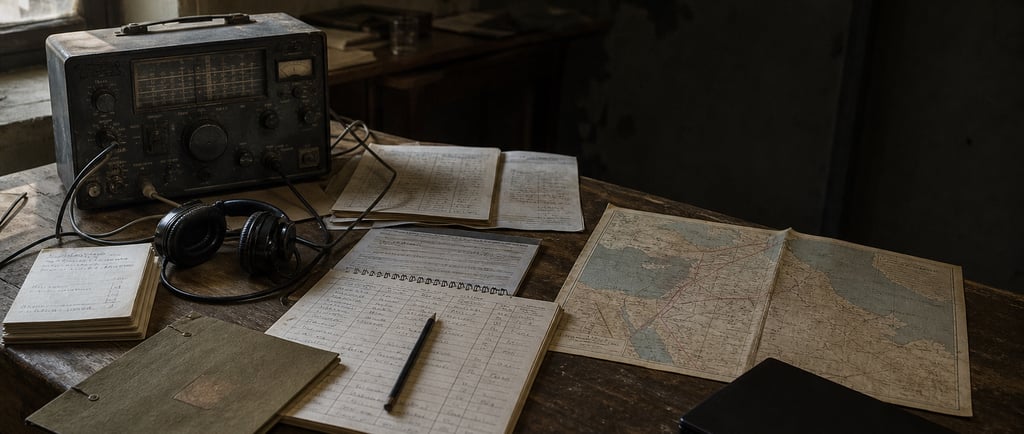
Before Unit 8200 became a name attached to cyber operations, artificial intelligence, and the private fortunes of Israeli tech founders, it was a radio room. The work was done on field receivers and salvaged equipment, by translators and codebreakers asked to make sense of static. Fame arrived decades later, and arrived partly by accident. The reason for the institution was older and harder. The state that built it believed surprise could be fatal.
That belief was not theoretical in 1948. Israel was declared into existence on the fourteenth of May and at war within hours. Its borders, in the settled European sense, barely existed. They were armistice lines, exposed roads, hills above settlements, refugee camps still being raised under tarpaulin. A hostile army could reach a Jewish town in a morning, sometimes in an hour. In several sectors the new state had hours, not weeks, to understand what was happening to it. The first generation of military officers learned to read maps that were also liabilities, and to think about time the way other countries thought about depth.
Information, in that context, became a kind of territory. Where the state lacked depth it tried to manufacture warning, and where it lacked numbers it tried to manufacture precision. The institution that would later be called Unit 8200 was one of the instruments built for that purpose. It was an answer to vulnerability, and the people who shaped it knew exactly what kind of country they were trying to keep alive.
The public version of this story usually begins much later. It begins with cyber start-ups, with elite recruitment programmes, with veterans walking out of military service into Tel Aviv venture capital meetings. All of that has happened. The version is also incomplete. It mistakes the polished surface of the institution for its origin. The deeper history starts in signals intelligence — interception, codebreaking, translation, and the slow discipline of turning fragments into warning.
The unit had pre-state ancestors. Inside the Haganah, the underground Jewish defence force of the British Mandate, signals and code work were gathered into a small intelligence formation known as Shin Mem 2 — Hebrew shorthand for "intelligence service, branch two". Its operators were often refugees from European universities and military services, men and women who had taught themselves wireless and cryptography in basements and farm sheds across the Yishuv. They worked alongside the broader internal intelligence service known as SHAI, in conditions of permanent illegality. The British authorities tolerated the Yishuv's economic and educational institutions and treated its intelligence services as criminal. Operators worked under cover names and moved equipment by hand at night.
After independence, the IDF folded that inheritance into a new military apparatus. Aman, the Military Intelligence Directorate, took its modern form in the early 1950s. The signals element was reorganised more than once. It was Unit 515. Then Unit 848. Eventually Unit 8200. The names changed because the mission expanded. A listening post became a national system.
The early work was unglamorous and relentless. Operators sat at sets and listened to Arabic radio traffic from Cairo, Damascus, Amman, and the smaller military commands of the Arab League states. Linguists translated. Analysts tried to separate routine chatter from military movement. Technicians kept ageing equipment alive through summers in which transmitter valves failed at predictable intervals. Cryptanalysts hunted for weakness in codes that were sometimes military, sometimes commercial, and sometimes a mix of the two. Commanders wanted certainty, and intelligence almost never gives certainty. It gives fragments and patterns. The skill lay in knowing which fragment mattered and how quickly to say so.
That second question — how quickly — shaped everything else. In a larger country, intelligence could move through layers of staff and committee, with assessments refined over weeks. In Israel the pressure was different. A warning had to reach the people who could use it before the window closed. An intercept might matter to a general in the Negev, an air force commander in the north, a patrol on the Lebanese line, or the political leadership in Tel Aviv. Intelligence that arrived after the fact had become evidence, and evidence was what you wrote after the funerals.
The unit's place inside Aman also shaped its character. Mossad, formed in 1949, became the foreign service, working agents and operations outside the state's borders. Shin Bet, the internal security service, monitored threats inside Israel and, after 1967, in the occupied territories. Unit 8200 belonged to the army. Its work fed war planning, battlefield awareness, and strategic warning. It lived where language, technology, and command decisions met, and it answered up the IDF chain rather than across to the civilian intelligence community. That military framing shaped what the unit was for and what it was asked to deliver.
Power, in the worldview the unit grew out of, travelled through communication. A radio intercept could become a military fact within hours. A telephone call could become a political one. A small change in enemy communications discipline could become a warning, sometimes the only warning available. In a state built under constant pressure, the line between intelligence and operations stayed narrow. Commanders did not have the patience for the analytical decorum of larger services, and the unit's culture absorbed that impatience. Analysts were expected to write short, write fast, and stake a position.
The unit also grew alongside a country building itself in real time. Ministries, an army, an immigrant absorption system, industries, and intelligence agencies were under construction at once. Equipment was short. Trained personnel were short. Money was short. The advantages were unusual. A multilingual immigrant population brought native speakers of Arabic, German, Russian, Polish, Romanian, and Yiddish. A strong technical culture had survived inside the Jewish refugee community, much of it carried out of central Europe by people who had lost everything else. The political leadership treated intelligence as a survival question. David Ben-Gurion, the country's first prime minister, kept intelligence files in his own office and read raw cables.
Signals intelligence had a particular value inside that environment. A human agent needed access, often years of careful cultivation. A reconnaissance aircraft needed airspace and risked being shot down. A signal could be caught from a distance, given the right equipment, the right people, and enough patience. Communications could of course be coded, disguised, fragmentary, or designed to mislead. The Arab-Israeli conflict ran on communication networks, military and political, and so it ran across a field the unit could enter. By the mid-1950s, listening posts in the Negev and along the northern frontier were producing daily intercept summaries that flowed up to the General Staff each morning.
The decades after independence pushed the logic further. Israel fought conventional wars, border conflicts, reprisal raids, and intelligence operations across a region whose political map kept shifting. Egypt, Syria, Jordan, Lebanon, Iraq, Palestinian organisations, and later non-state armed movements all became part of the listening environment. The unit needed Arabic linguists who could read between formal address and operational reality, military analysts who could distinguish a unit's training cycle from its mobilisation cycle, and cryptanalysts willing to spend months on a cipher for one decisive intercept. Pattern was the message. Silence could matter as much as traffic. A familiar unit communicating in an unfamiliar way could be the first sign of mobilisation.
Then came 1967, and with 1967 the unit's first famous triumph and its first hidden trap.
The Six-Day War of June 1967 was an intelligence success in the operational sense. The IDF struck the Egyptian air force on the ground in the opening hours and read the Egyptian command's situation reports as they were sent. One celebrated intercept caught a conversation between Gamal Abdel Nasser and King Hussein of Jordan, coordinating a story to mask the scale of the Egyptian defeat. Israeli signals intelligence picked up the call, the substance was passed to the leadership, and the wider Arab military narrative collapsed in the days that followed. Across six days, the country's intelligence services watched the war from inside the enemy's communications. By the time the ceasefire took hold, Israel held the Sinai, the West Bank, East Jerusalem, and the Golan Heights, and the intelligence establishment held something equally consequential. It held a story about its own competence.
That story would carry the system into 1973 and break against the canal.
The Yom Kippur War became the central trauma of Israeli intelligence history. Egypt and Syria opened their coordinated attack at two in the afternoon on the sixth of October 1973, while most of the country was at synagogue. The Egyptian Second and Third Armies crossed the Suez Canal under cover of artillery preparation and water-cannon assault on the Israeli sand embankment. Syrian armour rolled into the Golan. The forward Israeli lines were thinly held, partly because Aman had been judging the build-up on the other side as exercise rather than preparation.
Israel possessed real intelligence capabilities going into that morning. It had sources, intercepts, analysis, and warning signs. A Mossad asset close to the Egyptian leadership, the businessman Ashraf Marwan, had passed warning on the night of the fifth of October. The cabinet held an emergency meeting at dawn on the sixth. Reservists were partly mobilised. The collection was there. The failure came in the reading.
The dominant assumption inside Aman — known afterwards, almost grimly, as ha-konseptzia, "the conception" — held that Egypt would not attack without long-range strike capability it did not yet possess, and that Syria would not attack without Egypt. The doctrine had hardened into something between a working theory and an article of faith. When evidence pushed against it through the summer and autumn of 1973, the doctrine held. The head of Aman responsible for the assessment, Major General Eli Zeira, dismissed the warnings as deception linked to a large Egyptian exercise codenamed Tahrir 41. The exercise was real. It was also the cover.
The cost ran for nineteen days. More than two and a half thousand Israeli soldiers were killed before the ceasefire took hold. The Israeli political class lost a portion of the moral capital it had carried out of 1967. The intelligence establishment lost something less measurable and more important. It lost the assumption that its own assessments could be trusted because it had run them.
The Agranat Commission, set up in November 1973 under the Chief Justice of the Supreme Court, became the founding document of modern Israeli intelligence reform. Its interim report, released in April 1974, was harsh on Aman and on Zeira personally. Zeira was removed. The Director of Military Intelligence's monopoly on national assessments was broken, with Mossad and the foreign ministry assigned roles in producing independent estimates. The doctrine of structured dissent — ipcha mistabra, "the opposite is reasonable" — was institutionalised. An analyst within Aman was now required to write the case against the prevailing assessment, in writing, and have it read upward. The reform was procedural. Cultural change took longer.
Unit 8200 grew up in the shadow of that ruling. Its informality, its problem-solving habit, its willingness to push analysis upward fast were a response to a system that had once been institutionally certain and institutionally wrong. The lesson written into the unit's working life was simple. The wall between what you have heard and what you have understood is thicker than it looks. Move quickly between them, and challenge your own reading before the enemy does it for you.
The renaming to Unit 8200 belongs inside that broader process of reform and expansion. The number itself is deliberately empty. Military secrecy hides more than it reveals, and a four-digit designation is a useful mask. Behind it stood a growing institution responsible for communications intelligence, cryptanalysis, electronic collection, and eventually the digital transformation of military intelligence as a whole. By the late 1970s the unit had its main headquarters at the Glilot Junction north of Tel Aviv, with major listening stations across the country, including a large site at Urim in the Negev that was publicly described in the French press only in 2010, after a Le Monde investigation. Other sites operated and continue to operate without public description.
The shift from older signals work to modern cyber operations did not happen in a single moment. It unfolded as the world's communications systems changed. Armies moved from radio traffic and fixed lines into computerised command systems. Governments digitised their records. Banks, airports, ministries, and utilities became dependent on networks they did not fully understand and did not entirely own. Mobile phones multiplied. The internet turned daily human behaviour into data. The basic intelligence question stayed where it had been. The terrain became unrecognisable.
Unit 8200 was structurally prepared for the change because it had always lived in the technical shadow of communication. The old discipline of interception became the newer discipline of access — getting onto a network, getting under its defences, sitting inside its routing. The old discipline of codebreaking became cryptanalysis at scale, exploitation of implementation flaws, and the steady industrial work of decrypting traffic captured in volume. The old discipline of traffic analysis became metadata analysis, network mapping, and pattern recognition over data volumes that no previous generation of analysts could have processed. The radio room became a cyber command floor, and the codebreaker's pencil became something closer to a piece of malware. The work remained recognisable. The artefacts changed completely.
By the late twentieth and early twenty-first centuries Unit 8200 had become one of the central pillars of Israeli military intelligence. Public descriptions usually compare it to the American NSA or the British GCHQ. The comparison gets the shape of the work right and the institutional setting wrong. The NSA and GCHQ are national intelligence agencies of large states, embedded in long-running professional services with civilian leadership and substantial career bureaucracies. Unit 8200 is a military unit inside a small country with compulsory service, an unusually dense reserve system, and a much closer connection between military service and civilian technology than any comparable democracy.
That structural difference produced an unusual recruitment system. Israel could screen young people before their careers had begun. Mathematically gifted teenagers, strong linguists, puzzle-solvers, coders, and analytically unusual recruits could be identified and moved into intelligence service while their counterparts elsewhere were still in undergraduate degrees. The elite technical programme known as Talpiot, run jointly between the IDF and the Hebrew University in Jerusalem, fed graduates into 8200 and into adjacent units such as 9900, the geospatial intelligence formation, and 81, the operational technology unit. Recruits were given real responsibility early because the system needed them, and a culture grew in which an eighteen-year-old corporal could find herself running an analytical line that, in another country, would have been held by a colonel.
Service inside the unit involved unusual stresses. The work was tedious and high-stakes at the same time. Analysts watched the same channels for months and might intervene in another person's life with a single keystroke. Linguists translated material that ranged from the mundane to the intimate and the cruel. The institution's secrecy made it difficult to talk about what one was doing, including with family, and the long working hours were combined with the ordinary pressures of compulsory military service in a country that took its army seriously. Burnout was common. Pride in the work was also common, sometimes in the same conscript on the same day.
The same recruitment system became one of the engines of the Israeli technology sector. Veterans of Unit 8200 left with technical skills, operational confidence, a network of trusted peers, and the habit of solving difficult problems under time pressure. In civilian life those habits translated into cybersecurity companies, data firms, defence technology, and start-ups across most of the sector. Check Point, Palo Alto Networks, CyberArk, Imperva, NICE, Verint, and the controversial spyware vendor NSO Group all drew founders or senior engineers from the unit. The "Unit 8200 to start-up founder" pipeline became one of the most studied features of the Israeli technology economy. It was the civilian afterlife of a state intelligence system, and it was watched closely by other countries that wondered how to copy it.
The pipeline also produced operations that travelled well beyond Israel's borders. The Stuxnet worm, discovered in 2010 and used to sabotage centrifuges at the Iranian nuclear enrichment facility at Natanz, was widely attributed by Western journalists and former officials to a joint American-Israeli operation, with Unit 8200 reported as the Israeli partner. The reporting was extensive and unofficial. No state involved confirmed authorship. The episode established the public idea of Israeli cyber capability and gave a generation of young 8200 veterans a quiet professional reputation that they themselves could not openly claim. The NSO Group's Pegasus spyware, used by foreign governments against journalists, dissidents, and political opponents, made the story uglier. Investigations by Citizen Lab in Toronto, by Amnesty International, and by the Pegasus Project consortium of news organisations documented Pegasus's use against people who were neither soldiers nor militants. NSO denied wrongdoing and pointed to its licensing controls. The reputational damage to the broader 8200 ecosystem was real and travelled with the technology.
That afterlife carries a moral shadow the unit's celebratory press treatment rarely confronts directly. Signals intelligence is never innocent. It involves listening to people who do not know they are being heard, and the consent the law typically demands for surveillance does not apply to enemies. The category of enemy, however, is institutional. It is decided by the state. In Israel's case the question is inseparable from the Palestinian one. Unit 8200 has been credited with preventing attacks across decades of suicide bombing and rocket fire, and it has been accused of enabling wide surveillance of Palestinians in Gaza and the West Bank, including targeting work that has fed military operations and intelligence work that has supported administrative coercion. Both descriptions belong to the same institution. The capabilities that can stop a bombing can also build an architecture of control. The data systems that protect soldiers can also reduce civilian life to risk categories on a screen.
In September 2014, forty-three reservists of Unit 8200 published a public letter in Yedioth Ahronoth refusing to continue their reserve service. The signatories included veterans who had spent their conscript years inside the unit. The letter named specific practices. The use of intercepted private information to coerce Palestinians into collaboration. The collection of intimate material — sexual orientation, health problems, family debt — for the purpose of leverage. The targeting of populations as a long-running administrative tool rather than a wartime measure. The letter was extraordinary because of its source. The signatories were the system.
The army responded with public criticism and quiet pressure. The reservists were largely shielded from formal sanction, in part because the unit's chain of command preferred not to fight publicly on the ground the letter had chosen. The political establishment dismissed the signatories as a fringe. The text remained, however, on the record. Researchers, journalists, and human rights organisations have since returned to it as one of the clearest internal accounts of what mass signals intelligence inside an asymmetric conflict actually looks like at the operator level. Unit 8200 has not produced a comparable public document since.
The unit's relationship to Israeli democracy is therefore complicated by design. Intelligence agencies ask the public to trust them, and most of their work cannot be publicly tested. Successes stay secret. Failures appear only when they become catastrophic. After the seventh of October 2023, the reputation of the Israeli intelligence establishment took its heaviest blow since 1973. A state that had invested heavily in surveillance, signals collection, and digital monitoring of Gaza failed to prevent a coordinated cross-border attack that killed roughly twelve hundred people and triggered the war that followed.
Reporting in the months after the attack uncovered a pattern that echoed the failures of 1973. Female lookouts on the Gaza border — the tatzpitaniyot, whose job was watching surveillance feeds — had been flagging unusual Hamas activity for months. Their warnings reportedly did not move up the chain. A senior 8200 analyst had circulated, in mid-2023, a Hamas attack plan now widely referred to in Israeli reporting as "Jericho Wall", which described the structure of the October operation with disquieting accuracy. The document was assessed at higher levels as aspirational rather than operational. Egyptian intelligence reportedly passed a separate warning shortly before the attack. The institutional response was that Hamas lacked the capability and the will to execute what the warning described.
The old lesson of the Agranat Commission returned in a different shape. Collection is not the same thing as understanding. Technological superiority does not abolish institutional certainty, and institutional certainty is what intelligence failures usually run on. The Israeli system of 2023, far more capable than the Israeli system of 1973, had failed in a structurally similar way. The conception had changed. The architecture of the failure had not.
That failure does not erase Unit 8200's importance. It makes the story harder to tell honestly. The history of the unit is a record of adaptation, overconfidence, reform, achievement, secrecy, and renewed failure. It is also a record of the country around it. Israel built signals intelligence because it feared surprise. It expanded the unit because war rewarded those who could hear first. It transformed the unit because communication itself moved from radio waves into digital networks. The unit became internationally visible because its veterans carried military intelligence culture into a civilian technology economy that was already global. Each move was a response to pressure, and each one left a trace that the next pressure had to absorb.
The underlying logic stayed remarkably stable across all of it. Power hides inside communication. If you can hear the message, you may understand the intention. If you can break the code, you may see the plan. If you can map the network, you may know the organisation. If you can enter the system, you may change the battlefield before a shot is fired. The technologies changed. The strategic intuition that drove the institution did not.
That is why Unit 8200 cannot be separated from the larger history of the Israeli state. Zionism built farms, parties, settlements, and a national language. It also built security organs designed for a hostile environment, and it treated information as a strategic weapon from the start. Unit 8200 became one of the most important of those organs because it worked in the invisible space before battle: the space of preparation, deception, communication, and warning. That space has only grown since 1948. The unit grew with it.
The story begins there, in a small exposed country in the spring of 1948, listening across hostile borders and trying to decide whether the next sound in the static was routine traffic or the opening of a war.
The institution kept changing its name — Shin Mem 2, Unit 515, Unit 848, Unit 8200 — and its reach kept expanding. The instinct underneath stayed the same. Hear early. Read correctly. Move before the enemy's intention becomes irreversible. The tools shifted from receivers to networks, from antennas to data centres, from intercepted calls to oceans of metadata. The radio room became the cyber command floor. The legend came afterwards. The necessity came first, and it has yet to leave.