Narrative Historian | Author | Journalist

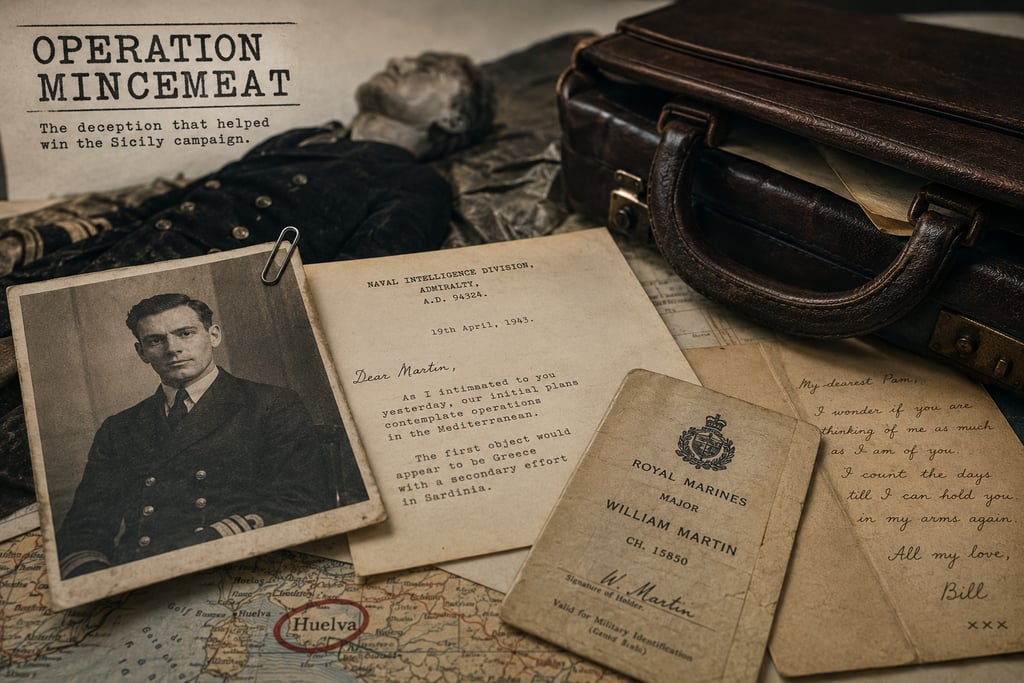
Operation Mincemeat used a corpse, false papers and Spanish channels to mislead German command before Sicily. The real question is what it changed.
Inside Operation Mincemeat: The Corpse, the Forgery, and the German Response
Dive into narratives that challenge the usual tales, revealing hidden layers and forgotten voices through rich storytelling and meticulous research.
INTELLIGENCE & ESPIONAGE HISTORY
Ivo Vichev
5/11/202616 min read
Write your text here...Operation Mincemeat worked because the lie arrived inside a body.
Not as a rumour passed through a frightened informant. Not as a coded message left for German intelligence to find too easily. Not as a diplomatic whisper carried through a neutral capital by someone already suspected of being useful. A body. A dead officer with wet clothes, identity papers, keys, receipts, personal letters, a photograph of the woman he was meant to marry, and a briefcase holding the kind of official correspondence that looked too careless to be invented.
That was the genius of it. British intelligence did not only forge documents. It forged a life around them.
The man who washed towards the Spanish coast in April 1943 was not Major William Martin of the Royal Marines. Major Martin did not exist. The body was that of Glyndwr Michael, a Welshman who had died in London after ingesting rat poison. In death, he was taken into one of the strangest and most effective deception operations of the Second World War. His corpse was dressed, documented, loaded with a false private history, carried by submarine, released into the sea, and sent towards a neutral country known to be porous to German intelligence.
The purpose was precise. The Allies were preparing to invade Sicily. The Germans knew Sicily was the obvious target. Geography said it. Strategy said it. The island sat in the centre of the Mediterranean, close to Tunisia, close to the routes into Italy, close to everything the Allies needed next. The problem was not to make Sicily invisible. It was too visible for that. The problem was to make the obvious target look like bait.
Operation Mincemeat belonged to the larger deception effort before Operation Husky, the Allied invasion of Sicily in July 1943. The British understood that a flat denial would not work. No serious German planner would believe Sicily had no place in Allied thinking. So the false story had to be more subtle. Sicily would remain in the picture, but in the wrong role. Greece and Sardinia would appear to be the real targets. Sicily would appear as cover, a feint, the place the Allies wanted German command to worry about while the true blow fell elsewhere.
The lie succeeded because it did not fight German expectations directly. It used them.
Hitler was already anxious about the Balkans. German war industry depended on resources from that region. The Balkans also carried political and strategic weight in his mind far beyond the clean logic of a map. An Allied landing in Greece would threaten Germany’s southern flank and reopen a theatre thick with old fear, occupation, partisan war and raw materials. Sardinia, too, could be made plausible. It sat west of Italy and could threaten the central Mediterranean. Sicily was obvious, but obvious targets can be made to look like decoys when an enemy already fears something more elaborate.
Good deception does not create belief from nothing. It enters an existing fear and gives it paperwork.
That was the work done by the forged letters placed on the corpse. The planners did not simply write, “We are invading Greece and Sardinia.” That would have been crude. The documents had to carry the false meaning indirectly, through the habits of British military correspondence. The lie had to look as if it had leaked from a larger truth. It needed the texture of bureaucracy, personal trust, impatience, side issues, military inconvenience and half-buried assumption.
A formal invasion plan would have been suspicious. No officer would carry such a document loosely across hostile waters unless the story around him was too perfect, and perfect stories invite suspicion. So the deception used private official letters. They were the sort of papers a senior officer might carry because they were not labelled as operational plans, yet still revealed more than they intended. Their power lay in appearing incidental. The Germans were not meant to feel they had been handed the answer. They were meant to feel they had discovered it.
The British forged not only the letters but the dead man’s ordinariness. Major William Martin had to have lived before he died. He needed the debris of a real existence. Pocket litter became intelligence architecture. His wallet, receipts, ticket stubs, personal correspondence, bank material and romantic traces all existed to answer the questions a suspicious reader might ask without appearing to answer them. The personal life mattered because the official lie needed a human container.
A body without a life would have looked planted. A body with too clean a life would have looked worse. Martin had to be believable in small, untidy ways. He needed signs of debt, affection, minor carelessness, professional duty and private attachment. He needed to look like a man whose death had interrupted a future.
This is where Operation Mincemeat becomes more than a clever trick. It becomes a study in the material culture of credibility. A spy story often imagines deception as the dramatic falsehood, the secret code, the hidden room, the glamorous double life. Mincemeat depended on bus tickets and love letters. It depended on details so ordinary that they seemed beneath invention. The dull object did the serious work.
The men who shaped the operation, Ewen Montagu and Charles Cholmondeley, worked inside the machinery of British wartime deception. They were not improvising in isolation. Their idea drew on earlier thinking about using a corpse with false papers, and it passed through the structures of British intelligence and the Twenty Committee, the body that oversaw double-cross and deception work. The operation also carried the flavour of a Britain that had become exceptionally good at using enemy intelligence against itself. By 1943, British deception was not merely lying. It was system work. It studied channels, habits, reporting chains, enemy anxieties and the appetite of commanders for information that confirmed what they already feared.
Spain was essential. Officially neutral, it was not sealed away from German influence. German agents operated there, especially in ports and diplomatic circles. Huelva, on the southern coast, gave the British a place where the body could plausibly come ashore and where the documents could pass through Spanish hands into German ones. The deception required a channel that could be trusted to behave badly. Spain had to look neutral enough for the discovery to feel accidental, and compromised enough for the papers to be copied before they were returned.
That balance was delicate. If the body appeared in a place too openly controlled by German intelligence, the operation might look like a plant. If it appeared somewhere too cleanly Allied, the papers might never reach the Germans. Huelva offered the middle ground. It had sea, current, distance, Spanish officials, German interest and British diplomatic presence. The geography served the deception because the politics served it too.
The corpse was carried by submarine and released off the Spanish coast. On 30 April 1943, it was found near Huelva. From that point, the operation depended on other people doing what the British hoped they would do while believing they were acting on their own initiative.
The Spanish authorities recovered the body and the documents. The British performed concern. They requested the return of the briefcase and papers with the right degree of urgency. Too little concern would suggest the documents did not matter. Too much would risk looking theatrical. The anxiety had to be calibrated. It had to show that the papers were important without making the trap visible.
This was another strength of the operation. Mincemeat did not end when the body reached Spain. The performance continued. British officials had to behave as if they had suffered an embarrassing accident. They had to create the impression of a government trying to recover sensitive material before the damage spread. That impression was part of the bait. The Germans were meant to believe not only the documents, but British fear of their loss.
The documents were eventually returned. British examination showed they had been opened. The deception had moved through the intended channel. The question then became the only question that mattered: had the Germans believed it?
The answer came through intelligence. German communications showed that the planted material had been taken seriously. A message decrypted through Ultra confirmed that the false information had reached the right people and that they appeared to be acting on it. Churchill received the famous report that Mincemeat had been swallowed. The phrase has survived because it catches the operation’s strange mixture of absurdity and consequence. The joke was grotesque. The result was military.
But the important issue is not whether German officers read the documents. It is what changed after they read them.
This is where the story is often weakened by exaggeration. Operation Mincemeat did not win Sicily by itself. No corpse won a campaign. Sicily was taken by ships, aircraft, landing craft, infantry, armour, artillery, engineers, logistics, command decisions, Italian weakness, German calculation and Allied force. The invasion began on 10 July 1943 with a vast amphibious assault. More than 150,000 troops came ashore in the opening phase, supported by thousands of ships and aircraft. The campaign was real fighting, not a magician’s reveal.
Mincemeat mattered because it helped shape the enemy’s allocation of fear.
German command did not strip Sicily bare. The island was defended, and the fighting cost lives. German units resisted hard enough to evacuate large numbers to the Italian mainland before Sicily fell in August. The Allied campaign was faster and less costly than some planners feared, but that outcome cannot be honestly assigned to one deception operation alone. War does not permit that kind of clean accounting.
The real measure of Mincemeat is more disciplined. Did the deception reinforce German belief that Greece, Sardinia and the Balkans were likely targets? Did it help keep German attention and resources away from Sicily at a crucial moment? Did it influence command response in a way favourable to the Allied invasion? On those questions, the operation was a success.
German reaction showed that the false story entered the decision-making structure. Hitler and German command remained deeply concerned about Greece and Sardinia. Reinforcements and attention were directed away from the true target. The lie did not need to empty Sicily of defenders. It needed to keep the German high command from concentrating fully on Sicily before the invasion. That is a lower claim than “a corpse won a campaign,” but it is a stronger historical claim because it can bear weight.
Operation Mincemeat also worked because it sat inside a wider deception frame. Operation Barclay, the broader Allied deception plan, was designed to suggest that the eastern Mediterranean and the Balkans were the likely direction of attack. False formations, misleading signals, dummy movements, map and currency preparations, and controlled intelligence channels all contributed to the picture. Mincemeat was not a lone trick in an empty field. It was a vivid piece of evidence placed into a deception environment already prepared to receive it.
That context matters. A single false document can be dismissed if it contradicts everything else. A single body can be doubted if it arrives without supporting noise. Mincemeat worked because it confirmed a story the Allies were already feeding through other channels. The corpse gave the lie intimacy. Operation Barclay gave it atmosphere.
The Germans believed partly because they wanted, or were prepared, to believe. That is not the same as stupidity. Intelligence failure often comes from rational processing inside a distorted frame. German command knew the Allies would move into southern Europe after North Africa. It knew Sicily was obvious. It also knew the Allies used deception. It had reason to consider Greece and Sardinia. It had strategic fears that made the false documents plausible. Mincemeat succeeded not because German intelligence simply failed to think, but because the planted evidence fitted a pattern German commanders already considered possible.
This is one of the most important lessons of the operation. Deception is strongest when it does not ask the enemy to become foolish. It asks the enemy to become more certain of a mistake already forming.
The body made that mistake feel discovered rather than supplied. That distinction was vital. If British intelligence had sent a double agent with a neat claim that Greece was the target, German handlers might have weighed the source, checked the timing, and suspected manipulation. If British wireless traffic had made the false plan too obvious, it might have been treated as deliberate noise. But a drowned courier with private letters, recovered by neutral authorities and copied by German access in Spain, felt different. It felt stolen from circumstance.
The Germans were not simply reading British documents. They were reading documents they believed Britain had tried and failed to protect.
The personal details around Major Martin did the same work at a smaller scale. A photograph of a fiancée, letters from a father, evidence of an ordinary life: these things were not sentimental decoration. They were camouflage. They made the body harder to reduce to a device. The more completely Martin seemed to have lived, the less likely the papers seemed to have been planted. His fictional life protected the false military information more effectively than any seal or classification marking could have done.
The cruelty of that construction should not be ignored. Glyndwr Michael had lived a marginal life and died alone enough to be usable. British intelligence needed a body with no family likely to intervene and no wounds that would contradict the story of death at sea. His anonymity made the operation possible. In life he had little power. In death he was given a false name, a false rank, a false fiancée and a military purpose he had never chosen.
There is no need to become melodramatic about that. War uses bodies. It uses living ones in greater numbers and with greater brutality. But the human fact still matters. The man who carried the lie was not the man named in the lie. The success of the operation depended on erasing one life and replacing it with another.
The grave in Huelva bore the name William Martin for decades. Later recognition restored Glyndwr Michael to the story. That restoration matters because deception history has a habit of admiring cleverness until the human cost disappears. Mincemeat was clever. It was also an operation built on a dead poor man’s body, turned into an instrument of statecraft.
The planners themselves worked under wartime pressure, not in the comfort of later moral distance. In 1943 the war had not been won. North Africa had only recently been secured. The invasion of Sicily was the next step towards Italy and the pressure on Nazi Europe from the south. Every German division held away from Sicily mattered. Every hour of enemy uncertainty mattered. Every reduction in Allied casualties mattered. In that context, the use of a corpse to mislead German command was not a parlour trick. It was part of the brutal arithmetic of war.
Still, the operation’s reputation has sometimes outgrown its evidence. Popular memory likes the clean sentence: a dead man fooled Hitler and changed the course of the war. The truth is better because it is less neat. A dead man helped persuade German intelligence that a false Allied plan was real. That belief reinforced existing German anxieties and contributed to command decisions that kept attention and resources divided before Sicily. The invasion then succeeded through force, planning and fighting. Deception helped shape the battlefield before the first landings. It did not replace the battle.
Measured properly, that is enough.
The invasion of Sicily did not unfold without difficulty. Weather, airborne confusion, beachhead problems, command rivalry and Axis resistance all shaped the campaign. British and American forces had to fight across difficult terrain against defenders who did not simply collapse. The Germans conducted a disciplined evacuation to the Italian mainland, preserving forces that would fight again up the peninsula. Sicily was not a bloodless Allied stroll made possible by a corpse.
But German uncertainty before the landings helped. The enemy had not concentrated every possible resource on Sicily. Hitler’s fear of Greece and the Balkans continued to matter. Sardinia and Corsica remained in the German defensive imagination. That was the space Mincemeat widened. It did not remove danger. It displaced part of it.
The operation also exposed something about command under pressure. Leaders rarely make decisions from pure information. They make decisions from information filtered through fear, prior belief, strategic obsession, institutional habit and the reports they want to trust. Hitler’s anxiety over the Balkans made the false documents more powerful. German intelligence did not receive the Mincemeat papers as blank-minded readers. They received them inside a command culture already inclined to see certain dangers.
The British understood that. They did not need to know every German thought. They needed to know enough about German fear.
This is why the briefcase mattered so much. It carried more than paper. It carried a version of the war the Germans were prepared to accept. Greece, Sardinia, Sicily as feint: the arrangement was plausible because it gave German command a more complex pattern than the obvious one. Clever commanders are often vulnerable to complicated mistakes. They distrust the simple answer because they assume the enemy must be disguising something. Mincemeat took advantage of that habit. It made the obvious answer look like the surface of a deeper plan.
The most effective deception often flatters the enemy’s intelligence. It says: you are too sharp to be fooled by Sicily. You have seen past the obvious. You have found the hidden design.
That flattery was buried inside military paperwork and a dead officer’s pockets. No one had to say it aloud.
The operation’s afterlife has turned Montagu and Cholmondeley into near-mythic figures of British wartime ingenuity. There is some justice in that. The planning was careful, imaginative and disciplined. But the myth can become too cosy. It can make wartime deception feel like an Oxford puzzle solved over drinks by eccentric geniuses. The reality was more severe. This was intelligence work tied to amphibious warfare, to the opening of a new front, to the lives of soldiers who would land on defended beaches, and to the struggle to force Italy out of the war.
The stakes were not comic because the method was strange.
Operation Mincemeat also reminds us that intelligence success is often indirect. The best operation may not destroy anything by itself. It may not produce a photograph of an explosion, a captured city or a signed surrender. It changes the conditions under which force is used. It moves a unit elsewhere. It delays a reinforcement. It confirms a false assumption. It makes an enemy commander hesitate in the wrong direction. It adds weight to one fear and removes weight from another.
That is hard to measure cleanly. It is also how deception often matters.
The German response is therefore the centre of the story. Without it, Mincemeat is only a bizarre plan. With it, the operation becomes military history. The corpse, the forged letters, the false identity and the Spanish channel all mattered because they entered German command consciousness and altered the distribution of concern before Sicily. The operation should be judged there, not in the theatre of its own cleverness.
Mincemeat’s success also depended on restraint. The British did not overplay the lie. They did not load Major Martin with too much evidence. They did not make the documents too perfect. They did not choose a channel so direct that it screamed manipulation. They allowed the Germans the pleasure of discovery. They trusted the enemy to complete the operation by believing it.
There is a hard discipline in that. Deception fails when the deceiver becomes too eager to be believed. The falsehood grows fat. Every clue points in the same direction. Every document says too much. Every accident becomes too convenient. Mincemeat avoided that by burying the main claim inside texture. The lie was not shouted. It was allowed to leak.
The sea gave the story its final credibility. A crashed aircraft, a courier lost over water, a body drifting ashore with papers still attached to its briefcase: these details belonged to the violent accident of war. Aircraft were lost. Men drowned. Documents travelled with officers. Neutral coasts became places where accidents crossed into intelligence channels. The situation was strange, but not impossible. In wartime, impossible things happened every day.
That is another reason the operation worked. It sat close enough to reality to borrow its authority.
The irony is that the false Major Martin became more historically visible than Glyndwr Michael ever had been in life. The invented officer entered books, films, official histories and public memory. The real man had to be recovered from beneath the cover identity created for him. It is a small example of how state operations can overwrite private lives. Intelligence work often leaves paper trails around false names while the real people beneath them remain faint.
Yet Michael’s body carried one of the war’s most consequential deceptions. That fact should be held without sentimentality and without erasure. He did not choose the mission. The mission used him. Through that use, Allied planners helped misdirect German command before a major campaign. History often moves through such discomfort: a poor man’s lonely death becomes material for an operation that may have saved soldiers he never knew.
The Sicily campaign opened the way to Italy. It contributed to the fall of Mussolini. It forced Germany to fight on another front in southern Europe. It did not end the war quickly. Italy became a long, hard campaign of mountains, rivers, fortified lines, mud, ruined towns and costly advances. The Mediterranean road to victory was not clean. But Sicily mattered. It broke the Axis hold on a central island, exposed Fascist Italy’s weakness, and pulled the war onto Italian soil.
Mincemeat belongs to that larger movement. Its role was not to win the Mediterranean by trickery. Its role was to help open the door with less resistance than might otherwise have been waiting behind it.
That is a more serious achievement than the legend allows. Legends simplify because they want a single object to carry the whole result. The corpse won the campaign. The forged letter fooled Hitler. The briefcase changed the war. These phrases are memorable and partly true in the way headlines are partly true. They identify the symbol and lose the mechanism.
The mechanism is better.
A dead body was turned into a courier. A false officer was given a life. Documents were written to appear revealing without looking planted. Spain was chosen because neutrality there had holes in it. British officials performed anxiety to draw attention to the papers. German intelligence gained access. German command absorbed the false picture. Existing fears about Greece, Sardinia and the Balkans were reinforced. Sicily remained defended but not as fully as it might have been. Allied forces landed on 10 July 1943 into a strategic environment that deception had helped shape.
That is the chain. Not magic. Mechanism.
Operation Mincemeat remains compelling because it joins the grotesque and the bureaucratic. A corpse in the sea. A briefcase. A love letter. A forged military note. A Spanish port. A German agent. A decrypt. A prime minister told the fish had swallowed the bait. It has all the furniture of improbable fiction, yet its success rested on the dry logic of staff work and enemy assessment.
The operation also shows the advantage of understanding an adversary as a mind, not only as a force. Armies can be counted. Ships can be photographed. Airfields can be bombed. But fear must be read. Hitler’s fear of the Balkans could not be destroyed by artillery. It could be fed. German suspicion that the Allies might strike somewhere less obvious than Sicily could not be commanded from London. It could be guided with evidence placed where German intelligence thought it had found it.
This was the true artistry of Mincemeat. It made the enemy participate in his own deception.
The corpse did not persuade Germany by itself. The Germans persuaded themselves with help. They opened the papers, connected them to existing anxieties, elevated their significance, and acted within the frame the Allies wanted reinforced. The British supplied the bait. German command supplied the appetite.
In that sense, the operation’s famous absurdity hides its sober lesson. Deception is not mainly about inventing a lie. It is about knowing where the enemy’s judgment is already vulnerable. The body, the briefcase and the forgery were instruments. The target was not a beach or a port. The target was German confidence.
Operation Mincemeat helped win advantage before the battle began. That is what good intelligence does when it works. It changes the terms of danger before soldiers enter it.
The body came ashore in Spain as a dead officer with secrets.
He was neither officer nor bearer of secrets. He was a false life built around a real corpse, carrying a false plan designed to reveal a false truth to men already inclined to fear it.
The Germans read the papers.
That was not the victory.
The victory was that they believed the wrong thing at the right time.