Narrative Historian | Author | Journalist

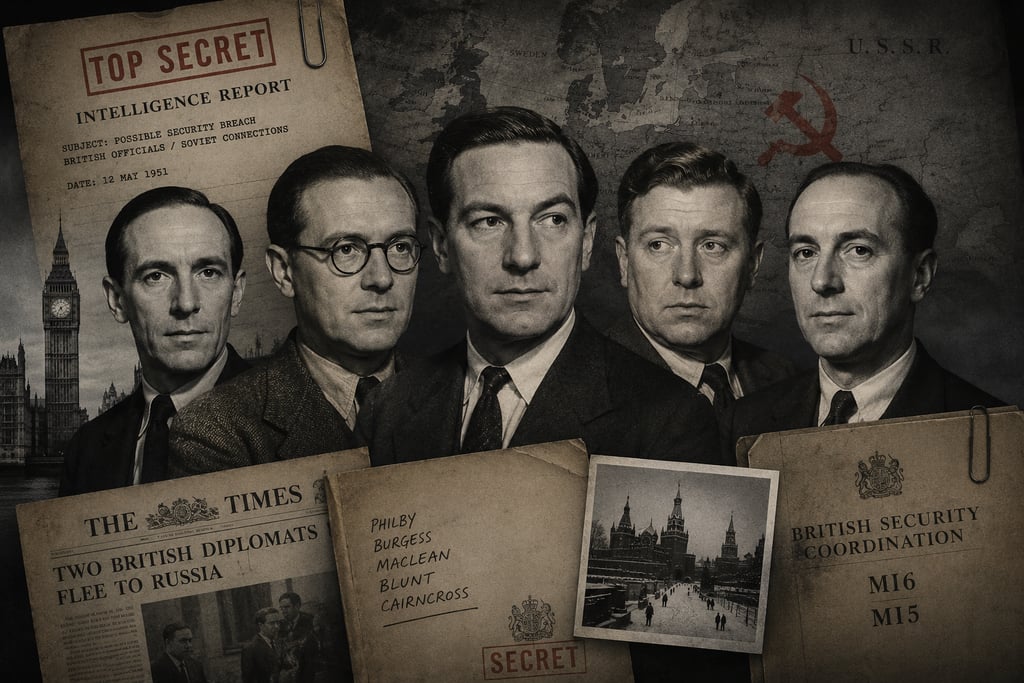
How Britain’s most damaging Soviet spy ring exposed the class blindness inside MI5, MI6, and the British establishment.
The Cambridge Five and the Cost of Class Loyalty
How Britain’s most damaging Soviet spy ring exposed the class blindness inside MI5, MI6, and the British establishment.
INTELLIGENCE & ESPIONAGE HISTORY
Ivo Vichev
5/8/202416 min read
Britain did not fail to see the Cambridge spies because they were invisible. It failed because they were familiar.
They had the right schools behind them, the right voices, the right rooms, the right kind of carelessness. They knew how to move through a system that trusted style before evidence. They did not have to batter their way into the British state. They entered through its manners.
That was the wound the Cambridge Five left behind. Not simply that Kim Philby, Guy Burgess, Donald Maclean, Anthony Blunt and John Cairncross gave secrets to Moscow. Not simply that Soviet intelligence had placed agents near the centre of British diplomacy, intelligence and wartime administration. The deeper injury was that Britain’s own ruling culture had helped protect them. It had taught its institutions to recognise danger as something foreign, rough-edged, ideological, socially awkward, insufficiently vouched for. It had not taught them to suspect the clever man at lunch, the old Cambridge acquaintance, the diplomat with the correct vowels, the art historian with royal access, the intelligence officer whose treachery wore the clothes of belonging.
The Soviet services understood this weakness with brutal clarity. A visible Communist could be watched. A working-class agitator could be filed, followed, excluded. A foreigner could be interrogated by accent alone. But a Cambridge man with friends in the right rooms could pass through doors that were never properly guarded, because the guard was often social before it was procedural.
The Cambridge Five were not only spies. They were proof that class can become a security system, and that a security system built on class can be turned inside out.
The accepted names are now familiar: Philby, Burgess, Maclean, Blunt and Cairncross. Together they became known as the Cambridge Five, though the phrase gives them a false neatness. They were not a formal committee of treason. They did not move through British life as one perfectly disciplined machine. Their recruitment, usefulness and exposure came through overlapping circles, friendships, ideological commitments, evasions and accidents. Their lives were untidy. Their damage was not.
Philby reached deepest into British intelligence. Burgess moved with a mixture of brilliance, charm and destructive carelessness. Maclean entered the Foreign Office and gained access to material that mattered far beyond London. Blunt carried his betrayal behind the polish of culture, scholarship and royal service. Cairncross, less socially effortless than the others, complicates the class story without overturning it. He was not simply another polished son of the old English ruling class, but he still moved through the same machinery of education, bureaucracy and state access. The Soviet achievement was not that it found five identical men. It was that it found different men who could all be made useful inside a system Britain had not learned to doubt.
The scandal did not arrive as one clean revelation. It came in stages, which made it more corrosive. Burgess and Maclean fled to the Soviet Union in 1951. Philby survived suspicion, denial and official embarrassment until his own defection in 1963. Blunt confessed in 1964 and remained publicly protected until 1979. Cairncross’s place in the story emerged more slowly, through confession, files, memoir and later historical reconstruction. Each exposure reopened the same question. How had men so close to the centre been trusted for so long?
Cambridge in the 1930s was not an innocent academic backdrop. It was part of a Europe under strain. The First World War had left behind a civilisation that no longer trusted itself. The Depression had made capitalism look brittle. Fascism was not a rumour but a marching force. Mussolini had taken power in Italy. Hitler had taken Germany. Spain was becoming the rehearsal ground for a larger European catastrophe. To young men who wanted certainty, discipline and moral drama, Communism offered an answer with the force of revelation.
That answer required blindness. Stalin’s Soviet Union was already a state of coercion, terror, famine, surveillance and execution. The purges were not a secret whispered only in hostile embassies. The forced transformation of Soviet society had left bodies behind it. But ideology has a way of moving the inconvenient fact into the background when the believer wants a larger moral permission. For some Western sympathisers, the Soviet Union was not judged by what it was doing. It was judged by what they needed it to represent.
For the Cambridge recruits, Communism gave rebellion a grand shape. They could despise the British establishment while continuing to use the advantages it had given them. They could present themselves, at least to themselves, as servants of history rather than as servants of a foreign intelligence power. They could imagine treason as anti-fascist duty, then later as loyalty to the side they believed history had chosen.
This was one of the quiet obscenities of the affair. The men who turned against the British state did not surrender the comforts of the world they condemned. They used them. They used the schools, the contacts, the ease, the assumption of seriousness. They used the fact that a man from the right rooms could be explained away for longer than another man would have survived.
Soviet intelligence did not invent British class trust. It exploited it.
The method required patience. A recruit who remained visibly Communist would be of limited use. He could speak at meetings, write pamphlets, make noise, attract attention, and eventually be marked. The valuable recruit had to disappear back into respectability. He had to break obvious political ties, soften the surface, cultivate career prospects, and move towards the places where secrets were made, stored, interpreted or passed upward. The public radical had to become the private instrument.
That was the deeper logic behind the Cambridge operation. It did not depend on one stolen document or one dramatic act. It depended on life trajectories. The Soviet services wanted men who could become useful over years. Men who could enter the Foreign Office, wartime ministries, intelligence services, code-breaking circles, embassies and advisory positions. Men who would be trusted not because they had proved trustworthy, but because they came wrapped in the language of trust.
Britain’s official security machinery was not absent. Files existed. Suspicions existed. Questions were asked. Officers worried, watched, interviewed and sometimes understood more than the institution could bear to act upon. But the deeper machinery of trust was older than the paperwork. It worked through school, university, club, accent, friendship, family connection, recommendation, dinner table and shared contempt for those outside the circle. It worked through the assumption that some men might be foolish, indiscreet, drunk, eccentric, sexually careless, politically juvenile or emotionally chaotic, but still somehow sound.
The word “sound” did a great deal of damage in British life. It was never only a judgment of competence. It was a judgment of type. A sound man could be relied upon because he belonged to a recognisable world. He knew the rules even when he broke them. He could be criticised without being treated as dangerous. He could be forgiven because unforgiveness would implicate too many of the people who had vouched for him.
Philby understood that world. More importantly, he made that world believe it understood him.
Harold Adrian Russell Philby, known as Kim, was not the most flamboyant of the group. He did not need to be. His power lay in his ability to occupy the role expected of him. He was charming, competent, amusing enough, serious enough, clubbable enough, and protected by the human weakness that makes friendship a poor instrument of counter-intelligence. He moved into British intelligence and then into its confidence. His treason was not conducted from the margins of British power. It sat inside the room.
Philby’s career remains the central terror of the Cambridge Five because he was not merely passing gossip. He was positioned inside the system that was meant to defend Britain from precisely the sort of penetration he represented. He learned how British intelligence thought, what it suspected, what it missed, where it planned, and who it trusted. He could pass documents, but documents were only part of the value. He could pass habits. He could pass assumptions. He could warn Moscow not simply of what Britain knew, but of how Britain knew it.
The betrayal of Konstantin Volkov shows the human cost of that access. Volkov, a Soviet intelligence officer in Istanbul, attempted in 1945 to defect to the West and offered information about Soviet agents inside British institutions. The information could have exposed the penetration earlier. Philby was in a position to intervene. Volkov was abducted, returned to Moscow and executed. In that episode the abstraction of espionage becomes a body. A man tried to escape the system he served. The system was warned. The man disappeared into it.
Philby’s later conduct deepened the humiliation. After Burgess and Maclean fled in 1951, suspicion fell on him as the possible “third man.” Suspicion alone did not finish him. He resigned from MI6 but survived the immediate ruin that should have followed. In 1955 he denied the allegations publicly. The establishment, already wounded, still had not fully severed itself from the man whose betrayal had been growing inside it. When he defected to Moscow in 1963, the scandal became irreversible. Britain had not only produced a Soviet spy. It had allowed him to stand before the world and deny what the state had failed to prove.
There is a tendency to turn Philby into a figure of dark glamour. That is the wrong response. Glamour is part of the damage. He was not a romantic double agent moving through a clean chessboard of Cold War intrigue. He was a traitor whose usefulness depended on the trust of colleagues, friends and allied services. He used friendship as cover. He accepted confidence as raw material. He turned the intimacy of secret work into a supply line for Moscow.
Nicholas Elliott’s confrontation with him in Beirut in 1963 carries that bitterness because it was not a meeting between strangers. It was a confrontation inside a broken friendship and a broken service culture. Philby had been treated well. He had been liked. He had been one of them. That was exactly why he had been dangerous.
Burgess was dangerous in a different way. Guy Burgess should have been harder to excuse. His recklessness was visible. He drank, talked, quarrelled, charmed, offended and disrupted. He was brilliant enough to be forgiven and disorderly enough to expose the absurdity of that forgiveness. In another social register, the same conduct might have marked a man as unstable, compromised or unfit for sensitive work. In Burgess, it became personality.
His career moved through the BBC, the Foreign Office and intelligence-adjacent circles, but his real importance lay partly in access and partly in connection. Burgess knew people. He moved through rooms where influence circulated before it became official language. He understood gossip as a political instrument. He was exactly the sort of man a class system could both recognise and misread: too familiar to be treated as a threat, too connected to be easily discarded, too clever to be dismissed, too socially embedded to be confronted with the severity another man might have faced.
His flight with Donald Maclean in 1951 made private suspicion public. The two men did not merely vanish. They tore open the surface. Their defection told Britain and its allies that Soviet penetration was not a theoretical danger. It had sat inside the Foreign Office and the diplomatic world. It had touched the intimate machinery of post-war policy.
Maclean’s case was less flamboyant and, for that reason, in some ways colder. He had entered the Foreign Office, where access came dressed as routine. The diplomatic file, the cable, the briefing, the conversation in Washington, the assessment of allied intentions: these were the instruments of state power after 1945. Britain was no longer the imperial force it had been before the war, but it still sat inside the high councils of the Western alliance. It still handled information Moscow wanted. Maclean was placed where such information passed.
His value was not theatrical. It was bureaucratic and strategic. He did not need to seem dramatic. Diplomacy produces secrets in ordinary form: minutes, memoranda, reports, positions, anxieties, drafts, conversations rendered into official prose. The spy inside such a system does not need to steal a crown jewel every day. He needs sustained access. He needs time. He needs the confidence of colleagues who believe that paperwork itself is a form of order.
When Maclean came under pressure, Philby warned him through Burgess. The warning allowed the escape. That single movement reveals the larger structure. One insider protecting another. One compromised trust network serving a foreign power. One friendship line becoming an evacuation route.
The Burgess-Maclean flight should have shattered every lazy assumption. It did not. It forced action, embarrassment and inquiry, but institutions rarely surrender their self-image at once. They adjust around injury. They explain. They contain. They protect what can still be protected. Philby remained under suspicion but not destroyed. Blunt remained hidden. Cairncross was not turned into a full public reckoning. The state knew enough to be frightened, but not enough, or not willing enough, to make the whole wound visible.
Anthony Blunt’s case revealed the second scandal: not espionage itself, but the management of embarrassment after espionage had been discovered.
Blunt had a different surface from Burgess. He was polished, scholarly, restrained. He inhabited the world of art history, museums, royal collections and cultivated taste. During the war he had worked for MI5. Later he became Surveyor of the Queen’s Pictures. His position placed him close not only to culture but to the symbolic centre of the British state. He was not just a man who had betrayed secrets. He was a man whose exposure would make the establishment look foolish in its most protected rooms.
He confessed in 1964 and received immunity from prosecution. The decision had an intelligence logic. A confession could produce information. A trial could expose methods, embarrass agencies, damage relationships and perhaps produce less than it cost. States make such calculations. Intelligence services often prefer knowledge to theatre. But the moral residue remains. Blunt kept his position, his social standing and his knighthood for years after his confession. The public did not learn the truth until Margaret Thatcher named him in the House of Commons in 1979.
That long concealment mattered because it repeated the original disease in another form. The same system that had been slow to suspect its own kind was now slow to expose one of its own to public judgment. The motive had changed. The pattern had not. Containment came before candour.
The palace dimension made the matter sharper. Blunt’s role as Surveyor of the Queen’s Pictures attached the scandal to monarchy, discretion and the old British instinct that some things were best handled quietly by serious men behind closed doors. The public explanation could wait. The institution had to be spared shock, scandal and untidy consequence. The state that had been penetrated by social trust now used secrecy to protect itself from the cost of admitting how far that trust had failed.
Blunt was eventually stripped of his knighthood. He was not prosecuted. By then the damage had already changed shape. It was no longer only the damage done by the secrets he had passed. It was the damage done by the state’s refusal to tell the truth when truth had become a public obligation.
Cairncross is often treated as the awkward fifth man, and awkwardness is useful here because it prevents the story from becoming too simple. John Cairncross was Scottish, the son of an ironmonger and a schoolteacher, and not a seamless product of the English upper class. He studied at Glasgow, the Sorbonne and Trinity College, Cambridge, and then entered the civil service. He lacked the effortless polish of Philby, Burgess, Maclean and Blunt. He was not the same social creature.
But the central issue was not aristocracy in the narrow sense. It was access. Cairncross gained access through education, examination and bureaucratic ability. He passed through the Foreign Office, the Treasury, the Cabinet Office and Bletchley Park. At Bletchley he had access to decrypted German communications. He passed material to the Soviets, including information on German movements on the Eastern Front. Later accounts have linked that intelligence to Soviet preparations before Kursk.
His defence, maintained in various forms, was that he had helped the Soviet Union defeat Nazi Germany and had not harmed Britain. That argument is revealing because it shows how ideology reorders obligation. Britain and the Soviet Union were allies after Hitler’s invasion of the USSR in 1941. The Red Army bore a terrible share of the war against Nazi Germany. None of that gave a British official the right to decide privately which secrets a foreign power should receive. Alliance did not erase sovereignty. Anti-fascism did not convert espionage into public service.
Cairncross complicates the class argument, but he also strengthens the larger point. Soviet intelligence did not rely on one social type. It relied on routes into power. Sometimes the route was old-boy ease. Sometimes it was intellectual brilliance and civil service success. Sometimes it was friendship. Sometimes ideology. Sometimes vanity. Sometimes resentment. The British failure was not only that it trusted aristocratic polish. It was that it mistook institutional belonging for loyalty across several forms.
The Cambridge Five caused damage that cannot be honestly reduced to a single clean number. That is one reason bad history often mishandles them. It wants a figure, a total, a ledger. Espionage does not always leave that kind of accounting. A copied document may alter an operation. A warning may save a network. A diplomatic paper may change how an adversary negotiates. A betrayed source may vanish before he can speak. A compromised service may lose an ally’s confidence for reasons never fully written down.
Some damage was direct. Documents and assessments passed to Moscow. Diplomatic secrets exposed. British and allied thinking made visible to the Soviet state. Wartime and post-war material channelled into an intelligence system built to exploit it.
Some damage was operational. Philby’s betrayal of Volkov remains one of the clearest examples because the human chain is visible. A potential defector carried information about Soviet moles. Philby’s position gave him the means to warn the side he secretly served. Volkov was taken back and killed. In that moment betrayal was not theoretical. It had a name.
Some damage was strategic. The United States had to ask how much it could trust British intelligence. This was not an abstract question of national pride. Intelligence sharing depends on confidence. If one partner’s service is penetrated, the other partner’s secrets are also at risk. The Cambridge scandal therefore weakened Britain not only by giving information to Moscow but by making Britain look unsafe to its friends.
Some damage was psychological. The British state had to confront the failure of its own assumptions. That may sound softer than stolen files, but it mattered. Institutions run on trust. When trust collapses, every relationship becomes harder. Every past decision becomes suspect. Every missed warning becomes part of the indictment.
The deepest damage was moral and institutional. The Cambridge Five showed that Britain’s ruling culture had confused recognition with evidence. The men were trusted because they seemed like men who should be trusted. That is not a security principle. It is a social habit dressed as judgment.
Class loyalty works most dangerously when it does not announce itself. It does not say, “This man is safe because he is one of us.” It says, “He may be difficult, but he is sound.” It says, “He was foolish when young.” It says, “He is not that sort.” It says, “I know his people.” It says, “There must be another explanation.” It says, “We should be careful before ruining a man.” On the surface, these sound like fairness, caution, decency and restraint. Sometimes they are. In the Cambridge case, too often they became cover.
The outsider is required to produce proof of loyalty. The insider is granted it in advance. That imbalance is the opening through which betrayal walks.
This does not mean that every member of the British establishment was naïve or corrupt. It does not mean that MI5 or MI6 were staffed only by fools. The reality is harder and more useful. Many able people failed because they were working inside a culture whose deepest assumptions had not been made visible to itself. Procedures existed, but culture softened them. Suspicion existed, but friendship complicated it. Evidence was pursued, but embarrassment shaped what could be admitted. The institution could imagine danger. It struggled to imagine danger in the mirror.
The Soviet services were not omniscient. They made errors, lost agents, misread politics, destroyed people who had served them, and often drowned intelligence in ideological expectation. But in the Cambridge operation they saw something essential. They saw that Britain’s elite institutions were porous in a specific way. They saw that the right recruit could use British confidence against Britain itself.
The scandal also exposes the limits of intelligence as a culture of cleverness. British intelligence had no shortage of clever men. The Cambridge spies themselves were clever. Their pursuers were often clever. Their friends were clever. The failure was not a lack of intelligence in the narrow sense. It was a failure of judgment under social pressure. Cleverness can make such failures worse because it produces better explanations for delay.
A clever institution can explain why it has not acted. It can distinguish suspicion from proof. It can protect a source, avoid a scandal, preserve an operation, calm an ally, manage a minister, delay a confrontation, and call the delay prudence. Sometimes that discipline is necessary. Sometimes it becomes evasion with better vocabulary.
The Cambridge Five lived in that space. They benefited from the difference between knowing enough to worry and proving enough to act. They benefited from the fact that counter-intelligence inside elite networks is emotionally difficult. To suspect an outsider is procedure. To suspect a friend is violence against one’s own world.
This is why the scandal still holds attention long after the Cold War world that produced it has vanished. It is not only a story about Communism, Stalin, MI5, MI6, Cambridge or the KGB. It is a story about institutions that cannot examine the assumptions on which their trust depends. Every state has those assumptions. Every intelligence service has some version of the trusted circle. Every bureaucracy has people who pass through scrutiny because scrutiny feels unnecessary when applied to them.
The form changes. The old school tie may matter less than it once did. The accent may no longer open the same doors. The club may have been replaced by the network, the consultancy, the elite university, the political staff, the security clearance community, the technology firm, the ideological faction or the closed professional caste. But the mechanism survives. Every system creates insiders. Every insider class is tempted to mistake fluency for loyalty.
The Cambridge Five are therefore not relics of an antique Britain. They are an old warning in a specific British form.
Philby, Burgess, Maclean, Blunt and Cairncross did not merely steal secrets. They revealed a defect in the structure that guarded those secrets. They showed that a state can be strong in procedure and weak in imagination. It can watch enemies abroad while failing to examine the loyalties of men at home. It can build files on radicals while missing the radical who has learned to look respectable. It can demand discipline from the margins while excusing disorder at the centre.
The British establishment eventually absorbed the scandal into history, drama, memoir and myth. Philby became the charming traitor. Burgess the flamboyant wreck. Maclean the haunted diplomat. Blunt the cold art historian. Cairncross the disputed fifth man. Their lives became material for novels, television, biographies and national self-examination. That cultural afterlife has sometimes made them seem more elegant than they were.
There was nothing elegant about the consequence. Operations were compromised. Sources were endangered. Allied confidence was shaken. Public truth was delayed. A state that prided itself on discretion found that discretion could rot into concealment. A class that prided itself on service found that service could be imitated by men serving someone else.
The real lesson of the Cambridge Five is not that Britain should have feared Communists more. It is sharper than that. Britain should have feared its own comfort. It should have understood that danger does not always arrive speaking with a foreign accent or carrying a crude ideology in public view. Sometimes it arrives from Cambridge with good introductions. Sometimes it drinks with the men it betrays. Sometimes it knows the club rules. Sometimes it has already been forgiven before the evidence is read.
The old establishment treated loyalty as something almost atmospheric, something absorbed through school, service, family, manners and shared inheritance. Soviet intelligence treated that belief as an operational opportunity. Moscow did not need to invent a disguise for these men. Britain had already supplied one.
That is why the Cambridge Five remain Britain’s most damaging intelligence scandal. Not because no other breach has ever mattered. Not because every detail of their work can be measured with mathematical precision. But because their betrayal exposed a weakness at the point where power most trusted itself.
The spies gave Moscow secrets.
The establishment gave them time.