Narrative Historian | Author | Journalist

The Berlin Airlift: How Logistics Broke Stalin’s Berlin Blockade
Discover how the Berlin Airlift used 277,000 flights, three air corridors, and relentless logistics to break Stalin’s blockade and keep West Berlin alive.
COLD WAR
Ivo Vichev
5/28/202617 min read
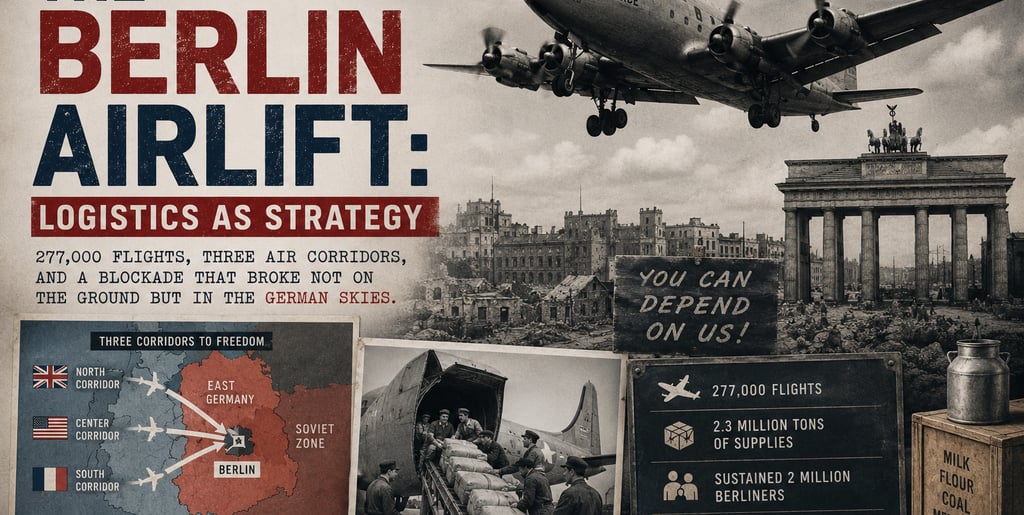
Berlin did not break the blockade by force. It broke it by schedule.
On 24 June 1948, Soviet forces closed every road, rail, canal, and power line connecting the Western sectors of Berlin to the outside world. The city sat more than one hundred miles inside the Soviet occupation zone, geographically exposed and militarily indefensible against the Red Army surrounding it. American, British, and French troops were present, but not in numbers that could fight their way through to a relief column. A ground convoy risked war. Withdrawal meant surrendering the position. Negotiation meant conceding that Soviet pressure could rewrite the occupation settlement whenever Moscow chose to apply it.
The answer came through the air — not as a gesture, not as a sentimental rescue mission dressed in humanitarian clothing, but as a sustained act of political and logistical will that turned aircraft into instruments of state power. Flour, coal, powdered milk, salt, potatoes, medicine, fuel, machine parts, and newsprint became the means by which the Western position in Berlin was held. Each landing told Moscow the same thing: this city would not be abandoned.
The blockade was lifted on 12 May 1949, after roughly 277,000 flights had delivered approximately 2.3 million tons of supplies into a city of two million people through three narrow air corridors and three Berlin airfields. At the height of the operation, on 16 April 1949 — the "Easter Parade" — 1,398 flights delivered more than 12,940 short tons in twenty-four hours. One supply aircraft landed every sixty-two seconds.
That was the moment the blockade had already lost. Not at the negotiating table. Not on the roads. In the sky above Tempelhof, Gatow, and Tegel.
The City Inside the Soviet Zone
Berlin was not supposed to become the Cold War's first great test of will. Geography and prestige conspired to make it one.
At the war's end, Germany was divided into four occupation zones administered by the United States, Britain, France, and the Soviet Union. Berlin, though located entirely within the Soviet zone, was itself divided among all four powers — a deliberate structure that made the Western presence there both symbolically significant and militarily precarious. Two and a half million Berliners lived in the Western sectors, surrounded by Soviet-controlled territory, moving through a city that still carried the physical and moral wreckage of the war: ruined housing, uncertain food supplies, disrupted electricity, black markets, and the administrative awkwardness of a defeated population governed by four former enemies who were rapidly ceasing to be allies.
The city's vulnerability made it valuable, in the particular Cold War logic where exposed positions carried the heaviest political meaning. If the Western powers held Berlin under Soviet pressure, it proved they would not retreat from every contested position simply because holding it was difficult. If they left, the signal would travel across Europe before the news had reached Washington. Every NATO-aligned government watching the crisis understood that American and British credibility was not only at stake in Berlin but was the thing the crisis was actually testing.
The immediate trigger for the blockade was currency reform. In June 1948 the Western powers introduced the Deutschmark into their zones and then into West Berlin, deepening the division between the Eastern and Western economic systems and signalling the likely shape of the West German state they were preparing to create. The Soviets withdrew from the Allied Control Council in March, began tightening access restrictions across April and May, and on 19 June sealed the roads, railways, and waterways entirely. Only the air corridors remained open, protected by the 1945 and 1946 air agreements that had left three specific air routes available for Allied use between the Western zones and Berlin.
That legal detail was the foundation of everything that followed.
A truck convoy could be stopped at a Soviet checkpoint and treated as a military challenge requiring a response. An aircraft flying food through an agreed corridor under existing treaty arrangements placed the burden of escalation entirely on the Soviet side — because shooting it down would not be stopping an armoured thrust but attacking an unarmed supply flight operating under established international agreement. The Western powers could not force the roads. They could use the sky without forcing anything. Strategy began with that distinction.
The First Calculation
The question that opened the airlift was not optimistic. It was: could a modern city actually be supplied by air?
The first honest answer should have been no. West Berlin's two million residents needed not only food but heating fuel, electricity generation, industrial supplies, medical materials, and enough basic commerce to prevent the city's economy from collapsing into dependence on whatever the Soviet side was offering. Aircraft in 1948 carried sacks, crates, barrels, and coal dust. They were not container ships. Every ton had to be flown in at enormous operational cost, unloaded under pressure, distributed through a city whose infrastructure was still damaged from the war, and consumed or stored fast enough to clear the airfields for the next wave.
The early tonnage target alone — 4,500 tons per day, raised to 5,000 as winter approached — gave the scale of the problem without yet resolving it. Of that total, coal formed the largest single category, and coal was not mercy cargo. Food kept people alive. Coal kept the city functioning: heated homes, powered utilities, ran what industry remained, and gave Berliners the possibility of surviving a Berlin winter without accepting Soviet supply on Soviet terms. It was awkward cargo — heavy, dirty, corrosive to aircraft, hard to load quickly — and it was inescapable. The humanitarian story of the airlift runs on flour and milk. The strategic story runs on coal.
Operation Vittles, the American effort, began on 26 June 1948, with the British Operation Plainfare following two days later. The beginnings were fragile: varying aircraft types, incomplete procedures, limited ground handling capacity, and Berlin's constrained airfields creating friction at every level. Alongside the supply flights, Washington moved B-29 bombers to British bases — a signal deliberately separated from the airlift in register but inseparable from it in meaning. The supply flights said the West would stay and feed Berlin. The bombers said the West understood that the crisis existed inside a larger balance of power that could not be ignored.
Both messages had to be sent. Neither could be sent alone.
From Improvisation to Machine
The airlift became decisive the moment it stopped behaving like an emergency.
General William H. Tunner had learned the operational logic of sustained air logistics in the China-Burma-India theatre, where the Allies had maintained a supply route over the Himalayan "Hump" under conditions that made most aviation experts doubtful. Appointed to command the Combined Airlift Task Force in October 1948, with British Air Commodore John Merer as his deputy at Wiesbaden, Tunner approached Berlin not as a rescue mission but as an industrial flow problem requiring industrial solutions. His contribution was not courage. It was discipline of a particular and unglamorous kind.
Aircraft had to arrive at intervals air traffic controllers could actually manage without fatal compression. Loading and unloading had to be standardised to the point where variation became an anomaly rather than a feature. Crews had to stop burning time on the ground. If a pilot missed an approach — through weather, through fatigue, through simple timing failure — he did not circle and clog the approach pattern while others stacked behind him. He returned to his base, cleared the corridor, and came back on the next scheduled slot. Maintenance, refuelling, cargo handling, and crew rotation became parts of a single interlocking schedule rather than separate activities that happened to share an airfield.
The Air Mobility Command records the specific procedural architecture Tunner imposed: inbound and outbound traffic separated by altitude, distress altitudes held clear, block systems adjusted as the tempo increased, and a deliberate preference for C-54 Skymasters over larger experimental aircraft because the C-54's smaller load was more than offset by its compatibility with the rhythm Tunner was building. The rhythm was not a side effect. It was the weapon. An aircraft every few minutes, arriving through fog or rain or night with the regularity of a factory shift, was not only transport — it was a visible, measurable, daily refusal to be intimidated, and it was visible to everyone: to the people of Berlin watching from rubble heaps and windows, to Soviet observers who could count landings as easily as any Western newspaper, and to Western politicians who needed to show that commitment was not merely rhetorical.
The Three Corridors
The corridors were twenty miles wide, stretching from the Western zones of Germany to Berlin through Soviet-controlled airspace. They made the operation possible. They also concentrated it into predictable channels where weather, navigation, Soviet harassment, and the compounding pressure of sustained high-tempo operations could all find the system's weak points simultaneously.
Three corridors handling the entire flow of supply meant that the spacing between aircraft mattered as much as any individual load, that a disruption at one airfield sent consequences backward through the system toward bases in western Germany, and that Soviet harassment — buzzing aircraft, interfering with radio signals, conducting exercises in adjacent airspace, raising administrative objections — could accumulate into pressure without constituting the kind of overt attack that would force a Western military response. The corridors were protected by treaty. They were not protected from friction.
The political geometry of those corridors was what made the airlift something other than a conventional supply operation. A ground convoy challenged Soviet checkpoints directly, creating a physical confrontation the Soviet side could escalate or de-escalate on its own terms. The airlift inverted that structure. It was the Soviets who had to decide whether to shoot down unarmed supply aircraft operating in agreed airspace — whether to turn administrative pressure into open aggression with the full weight of Western and international opinion bearing on the decision. Every aircraft that landed without being intercepted was a small Soviet concession, repeated thousands of times.
The corridors were not just routes. They were the instrument by which Western restraint became Western advantage.
The Airfields
A logistics system breaks at its most constrained point, and in Berlin the constraint was often concrete.
Tempelhof, in the American sector, became the visual centre of the airlift in public memory and in the imagination of everyone who watched it. The approaches were brutal. Aircraft came in low over city streets, over apartment buildings, over children standing on rubble heaps with their necks craned upward. The airport's location in the middle of the city made it operationally useful and perennially dangerous — every approach was a navigation problem and a crowd management problem at once. Gatow served the British sector with more space and fewer obstacles. Neither was enough.
Tegel, in the French sector, had to be created essentially from nothing, and its construction stands as one of the airlift's least dramatised achievements. Roughly 19,000 workers — the majority of them Berliners — built a functional airfield in three months, finishing in November 1948. They cleared rubble, laid surfaces, worked in cold and dust and the compressed urgency of people who understood that the runway they were building was the ground beneath the aircraft that was feeding them. The construction of Tegel was not engineering support for the airlift. It was political resistance poured into concrete, and the scale of it — 19,000 people working through the autumn of a blockaded city's worst year — describes the human engine inside the logistical one.
The Alliance Museum's account of the airlift notes that the operation transformed the Western powers in Berlin from occupying authorities into protecting powers in the eyes of many West Berliners. That transformation was not produced by speeches or posters. It was produced by runway capacity, coal deliveries, and the sight of a city building its own connection to the aircraft that kept it alive.
Coal
The airlift's public image runs on flour, powdered milk, and candy dropped by parachute. Its operational reality ran mostly on coal, and coal was nothing like those things.
Coal clogged aircraft, coated crews, broke the sacks it was carried in, and slowed unloading unless ground teams had been drilled to the point where hesitation became a reportable event. It was dense, unromantic cargo that wore down equipment and exhausted workers with particular efficiency. American deliveries alone accounted for more than 1.4 million short tons, with British deliveries recorded separately; across the operation, coal consumed a larger share of the airlift's capacity than any other single category of cargo.
The reason was strategic as much as humanitarian. A city that runs out of food will starve, and starvation is slow, visible, and politically forcing. A city that runs out of heating fuel and power will freeze and go dark through a European winter, and the people of such a city will eventually accept supply from whoever offers it on whatever terms are attached. The blockade's best prospect of success was not the dramatic one — Berliners rioting in the streets, Western governments losing their nerve — but the slow one: attrition, cold, darkness, and the daily arithmetic of Soviet supply available in the east versus nothing guaranteed in the west. Coal denied that arithmetic. Every sack unloaded at Tempelhof or Gatow or Tegel was one fewer argument for Soviet terms, one fewer degree of leverage, one more day of the Western position intact.
The British and Commonwealth Operation
The airlift is most often told as an American story, partly because Operation Vittles supplied the largest share of total tonnage and partly because the C-54 Skymaster became the iconic aircraft of the operation in photographs and newsreels. The telling is incomplete.
Britain began Operation Plainfare alongside the Americans on 28 June 1948, drawing on RAF transport capacity and on a network of civilian charter companies — twenty-five in total — contracted to expand the British effort. The AlliesMuseum records British aircraft carrying approximately 23 percent of total freight tonnage while handling the lion's share of passenger movement, including officials, specialists, medical cases, and families whose lives could not be expressed as cargo weight but who nonetheless needed to move. Oil and aviation fuel, in particular, were categories where British chartered operations carried a disproportionate share.
Beyond the British national contribution, the airlift drew personnel from Australia, Canada, New Zealand, and South Africa operating within RAF structures, making the operation genuinely multinational in its human composition even when the aircraft carried American or British roundels. That breadth mattered politically because it showed that the Western position in Berlin was being sustained not by a single flag but by a coalition — something Stalin had worked to fracture and had conspicuously failed to fracture. The alliance held not because its members agreed on everything but because Soviet pressure on an exposed position had given them enough in common to act together.
France's direct flying contribution was smaller, six aircraft at the outset. Its contribution on the ground was essential: the French sector provided the land, the authority, and the administrative support for Tegel's construction, without which the airlift could not have reached the throughput it eventually achieved.
The Easter Parade
On 16 April 1949, the Combined Airlift Task Force delivered 12,940 short tons into Berlin on 1,398 flights, averaging one aircraft landing every sixty-two seconds across a full twenty-four hours.
That record was not a stunt designed for the newspapers. It was a demonstration of what the system had become, and its significance lay not in the numbers themselves but in what the numbers proved about the operation's relationship to the problem it was solving. At the beginning of the blockade, the Soviet calculation had been reasonable: supplying a city of two million people indefinitely by air was not something anyone had done before, the scale was genuinely unprecedented, and the pressures — weather, maintenance, attrition, political will — would sooner or later force either a military confrontation or a quiet Western withdrawal from the position.
By spring 1949 that calculation had been overtaken by the evidence. The AlliesMuseum records that on some days during that period the airlift was delivering more goods into Berlin than had arrived by road, water, and rail combined before the blockade began. The system was not surviving. It was exceeding its baseline. The blockade had been designed to demonstrate that West Berlin could not function without Soviet permission, and the airlift had demonstrated the opposite — that Soviet pressure could be made functionally irrelevant by disciplined organisation sustained over time.
Moscow could no longer wait for collapse. There was no collapse coming.
The People Below
Aircraft mattered because people were waiting below them, and those people were not passive recipients of an airlift someone else had decided to run.
West Berlin in 1948 was still visibly a bombed city. Housing was short, industry fragile, food uncertain, infrastructure damaged. Many of its residents had moved through bombardment, Soviet assault in 1945, occupation, defeat, denazification, hunger, political reorganisation, and the slow early process of a divided country trying to reconstitute something like normal civic life from rubble and loss. The blockade was not their first emergency. It was one more pressure added to a stack that had been accumulating for years.
The Soviet side made a specific offer to West Berliners: register in the eastern sector, collect supplies there, feed your family from a Soviet distribution system rather than wait for Western aircraft. It was not simple generosity. It was leverage dressed as provision. Hunger can do political sorting more efficiently than most forms of coercion. If enough West Berliners accepted Soviet supply, the Western authorities' claim to represent the city's interests became thinner. If the city's elected government was destabilised from below by an exhausted, cold, and hungry population, the blockade could win without a single Soviet soldier moving into the Western sectors.
In September 1948, 300,000 West Berliners gathered at the Reichstag to oppose any possibility that the Allies might halt the airlift and cede the city to Soviet control. That demonstration was also a strategic act, though it did not present itself as one. It told Western governments that the population they were sustaining intended to be sustained — that civilian endurance was not in doubt, and that the operation had political ground beneath it. The State Department records that the rally's scale helped convince Washington and London to continue both the airlift and the Deutschmark in the city, reinforcing commitments that were still being debated internally at that stage.
The airlift worked because tonnage and civilian will were not separate variables. Each made the other viable.
Gail Halvorsen and the Limits of the Candy Story
No account of the Berlin Airlift should omit Gail Halvorsen. No account should let him consume it either.
Halvorsen was an American pilot who began dropping small parachutes carrying sweets for Berlin children near the approaches to Tempelhof. The operation expanded, became known as Little Vittles, and produced one of the most enduring images of the entire crisis: a child in a bombed city watching something small and sweet descend from an aircraft. It gave the airlift a human register that tonnage figures could not provide. It showed a city's children as more than a supply problem.
The danger is the softening. Halvorsen's candy drops were real and genuinely humane. They were not the mechanism by which the blockade was defeated. That mechanism was Tunner's scheduling, coal deliveries, runway construction at Tegel, crew rotation systems, maintenance cycles, and the weather flying discipline of thousands of people who never became famous for it. The candy drops matter in the history because they show how humanitarian action and strategic operation were not separate things during the airlift — they amplified each other. But a story told mainly through Halvorsen's parachutes is a story in which logistics has been made decorative, and logistics was the whole point.
A child receiving chocolate could remember protection. A power station receiving coal could keep the lights on through January. Both things were true, and the second was primary.
The Soviet Problem
The blockade created a trap for the side that imposed it.
If it forced the Allies out, Moscow won. If the Allies attempted a ground breakthrough and war followed, Moscow could claim provocation and control the escalation narrative. If the airlift failed through exhaustion or weather or political nerve, the Soviet side could present terms. But if the airlift succeeded — if the operation proved durable across a full winter, if tonnage kept rising, if Berlin endured — the blockade became a public failure of Soviet coercive power repeated in the sky every hour. Unlike a failed diplomatic manoeuvre or a quietly reversed political position, this failure was being counted and published and broadcast in real time.
By spring 1949 that was precisely the situation. The operation had not only survived winter, the hardest period for air operations, but had strengthened during it. The Easter Parade's numbers confirmed what the trend lines had been showing for weeks. There was no operational plateau below the city's requirements, no sign of Western fatigue, no indication that the political will to continue was weakening. Meanwhile the blockade's collateral effects — Western cohesion visibly strengthened, public sympathy for Berlin deepened, the process of creating NATO accelerated rather than delayed — were running in exactly the wrong direction for Moscow. The Western powers created NATO in April 1949. The Federal Republic of Germany was established in May, shortly after the blockade ended. The German Democratic Republic followed in October. The division the blockade had been designed to prevent was made permanent, in part, by the crisis itself.
On 12 May 1949, the Soviet Union lifted the blockade.
After the Roads Reopened
The airlift did not stop when the roads opened. It continued for another four months, into late September 1949, and the continuation was not inertia.
Trust had been broken. Berlin's reserves were not sufficient to make the city secure against a renewed closure. The Allied position depended not only on keeping the city supplied but on making clear that Soviet access-switching would not work as a mechanism of coercion — that West Berlin's survival could not be turned on and off at Soviet convenience by reopening or closing the land routes. Flying for months after the blockade ended turned logistical capability into structural insurance, demonstrating that the corridor capacity that had sustained the city through eleven months of blockade would remain available regardless of what happened on the ground.
The final American airlift mission departed Rhein-Main on 30 September 1949. Its cargo was coal. The last load was the same material that had carried the operation from humanitarian emergency into strategic instrument, and its ordinariness was fitting. The airlift was not concluded with ceremony. It ended because the machine had finished its job, and the machine's job had always been to be so consistent that the blockade could not outlast it.
The Cost
Remembered as bloodless because it avoided open war, the airlift was not costless.
Aircraft crashed. Crews died in conditions created by the operational tempo, the weather, and the compressed approach patterns of overworked airfields. The AlliesMuseum records at least seventy-eight deaths in aircraft accidents, with those names engraved on the Airlift Memorial at Tempelhof. The Air Mobility Command's accounting is wider, recording thirty-two American deaths and thirty-nine British deaths across RAF, Army, Australian, civilian, and contract categories.
The discrepancy between those figures reflects different methods of counting rather than a dispute about the facts, but neither number should be lost inside the operational statistics. Men flew repeated approaches through instrument conditions into crowded corridors where the spacing between aircraft was tight enough that a late turn or a misread instrument could turn a supply mission into wreckage. Ground crews worked to keep aircraft moving through temperatures and schedules that did not accommodate error. Berliners unloaded cargo in coal dust and cold. Air traffic controllers held the sky apart through procedure alone, without the margins that peacetime operations built into the system as standard.
Logistics is often treated as the bloodless alternative to combat. It is less violent. It is not safe.
What the Airlift Proved
The Berlin Airlift proved several things simultaneously, some of them well understood and some still underappreciated.
It proved that air transport could sustain a political position under sustained coercive pressure — that aircraft could supply an urban population at strategic scale, not merely garrison a military outpost. Before Berlin, airlift had supplied armies. The Smithsonian National Air and Space Museum describes the delivery of 2.3 million tons solely by air as unprecedented in history, and the description holds. No comparable operation had been attempted.
It proved that industrial regularity could defeat coercion more effectively than dramatic countermoves. The blockade was a bold strategic act. The answer was repetitive, methodical, and unsexy — flights, maintenance cycles, loading schedules, corridor discipline, weather approaches — and its very consistency was what made it impossible for the Soviet side to wait out. Moscow had calculated that Western will would fracture under sustained pressure. The airlift's regularity showed that will and system had been fused into something more durable than either alone.
It proved that humanitarian action and strategic purpose are not mutually exclusive. The people of West Berlin genuinely needed what the airlift delivered. It genuinely saved them from dependence on Soviet supply and Soviet terms. The operation's moral weight was real, not manufactured — and that weight amplified its political effect rather than contradicting it. Western governments did not have to pretend the operation was more than supply. The supply itself was the argument.
Perhaps most durably, it proved that restraint could be stronger than escalation. A ground challenge to the blockade might have opened a war for which the Western powers were not prepared. Withdrawal would have confirmed Soviet pressure as effective. The airlift found a third position: firm, visible, legal, difficult to attack directly, and impossible to stop by the means available without triggering consequences far worse than accepting the airlift's success. That third position — between war and submission — was the diplomatic achievement the operation represented, and it established a model for Cold War management of exposed positions that would be drawn on for decades.
The Final Measure
The blockade was built on the assumption that geography was decisive — that a city more than one hundred miles inside Soviet-controlled territory, accessible only by roads and railways that could be cut, was ultimately indefensible without a military confrontation the Western powers would not risk.
The airlift dismantled that assumption piece by piece and then held the pieces up for the world to count.
Three corridors became lifelines running above the Soviet zone. Three airfields received the aircraft that the corridors fed. Every load of coal, every sack of flour, every ton delivered through fog or rain or the compressive weight of a Berlin winter was a measured refusal to accept the logic on which the blockade rested. The Western powers did not have to defeat the Red Army to hold the city. They had to make the blockade's premise false — to demonstrate that Berlin could be supplied without Soviet permission, and that Soviet pressure could not make that demonstration stop.
At the beginning the question was whether air power could feed a city. By spring 1949 the question had been answered so thoroughly that the original doubt seemed almost quaint. Air power had not only fed a city but had held a political frontier without crossing into war, turned logistical capability into diplomatic instrument, and shown that the most effective response to coercion was sometimes not confrontation but sustained, unglamorous, precisely managed endurance.
The blockade ended because the West had made it irrelevant. Not by breaking it. By flying past it, every few minutes, until there was nothing left for it to do.