Narrative Historian | Author | Journalist

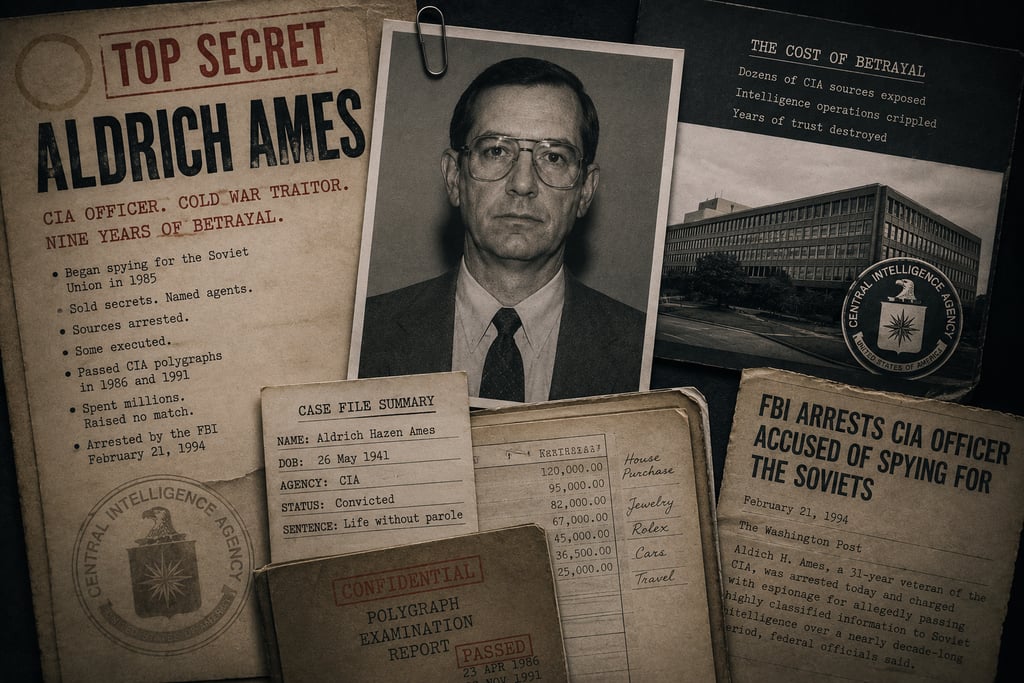
Aldrich Ames spied for Moscow for nine years. The CIA missed the warnings: money, access, failed scrutiny and polygraphs that comforted more than they protected.
Aldrich Ames: How the CIA Missed a Mole for Nine Years
Aldrich Ames was not hidden by brilliance. He was hidden by habit. He worked inside the CIA for more than three decades. He knew the building, the people, the language, the protective rituals. He knew how suspicion moved and how it stalled. He knew the difference between a security rule and a security culture. He knew that the Agency could be severe in theory and forgiving in practice, especially towards one of its own.
INTELLIGENCE & ESPIONAGE HISTORY
Ivo Vichev
5/11/202611 min read
That was the wound he opened. Ames did not penetrate the CIA from outside. He was not a foreign officer slipped into American intelligence under a false name. He was already inside the machinery that handled Soviet operations. He had access to names, files, methods, meetings, cables, assessments, identities and weaknesses. His job placed him near the very material Moscow most wanted. When he began selling secrets in 1985, he did not need to break through the wall. He was standing behind it.
The damage was immediate and human. Sources inside the Soviet system began to disappear. Agents who had risked their lives for the United States were arrested, imprisoned, interrogated or executed. Networks went silent. Years of recruitment work collapsed. The CIA, trained to read hostile services, had to confront something more humiliating: the enemy had been reading the CIA through one of its own officers.
Ames was arrested by the FBI on 21 February 1994. By then he had been spying for the Soviet Union and later Russia for almost nine years. He had passed the identities of Western sources, compromised operations and received millions of dollars. The FBI identifies him as a 31-year CIA veteran who had been spying since 1985. The Associated Press, reporting after his death in federal prison in January 2026, described him as admitting he had been paid $2.5 million by Moscow and exposing Russian and Eastern European officials who were spying for the United States or Britain. Some of those betrayals led to executions.
The clean version of the Ames case says that the CIA missed him because he passed polygraphs and explained his sudden wealth badly but plausibly. That is true, but too small. The deeper failure was not one missed clue. It was a system that kept receiving warnings and translating them into something less dangerous.
The paper trail was there. His finances changed. His spending pattern changed. His access matched the timing of compromised Soviet operations. His polygraph examinations were weaker than their final results suggested. His professional record had warning signs. His personal life had warning signs. His explanations should have been treated as evidence requiring verification, not as answers requiring politeness.
The CIA did not miss Ames because there was nothing to see. It missed him because it did not hold the pieces together with enough force.
Ames began his betrayal in April 1985. He walked into the Soviet Embassy in Washington and offered information. That image has lost some of its shock through repetition, but it should not. A serving CIA officer, assigned to work connected to Soviet operations, voluntarily entered the embassy of the adversary and sold access that others had trusted him to protect. There was no elaborate ideological conversion scene necessary. There was no grand theory of history. Ames wanted money. His life had become expensive, disordered and financially pressured. Moscow was willing to pay.
Money is often treated as the least interesting motive in espionage because it lacks drama. It should not be dismissed for that reason. Money is direct. It creates pressure, dependence and repetition. A man who sells one secret for money does not only receive payment. He creates the need for another payment, another meeting, another concealment, another lie. The act becomes a structure. After the first betrayal, the next one is easier to imagine and harder to avoid.
Ames gave the Soviets names. That was the central crime. Not vague policy discussion. Not ideological analysis. Names. Human beings operating under conditions where discovery could mean death. The file becomes a person at the moment it reaches the hostile service. The cable becomes an arrest. The asset list becomes an execution list.
This is the part of intelligence history that cannot be softened by professional language. “Compromise” is the word agencies use. It is accurate, but it can become too clean. In the Ames case, compromise meant that Soviet and Eastern European sources who had trusted American intelligence were exposed to the state they had betrayed. Some were executed. Others were imprisoned or destroyed professionally and personally. Their handlers survived to write reports. Many of the sources did not.
The CIA saw the losses before it saw Ames.
In 1985 and 1986, Soviet sources began disappearing. From the American side, the pattern was frightening but not immediately self-explanatory. A source can be lost because of a mole, but also because of surveillance, bad tradecraft, communications compromise, coincidence, enemy investigation, betrayal by another service, or technical failure. Counterintelligence is a discipline of uncertainty. The first explanation is not always the true one.
That uncertainty became part of the problem. The CIA and FBI had to determine whether the losses came from a penetration inside American intelligence, a communications breach, a technical compromise, or some other failure. The possibilities were real. They had to be examined. But the existence of alternatives can become a refuge. A mole is the most difficult explanation because it turns suspicion inward. It means looking at colleagues, careers, offices, access lists and old assumptions. It means admitting that the enemy may not have defeated your system from outside. He may have rented a room inside it.
Ames benefited from that reluctance. So did the institutional habit of separating facts into compartments. One office knew one part. Another office knew another. A supervisor remembered a weakness. A financial officer could see something else. A polygraph examiner saw charts. A counterintelligence investigator saw access patterns. The danger sat between the compartments.
His spending should have forced attention earlier.
Ames and his wife, Rosario, began living in a way that did not match his salary. The most famous marker was the house in Arlington, Virginia, bought with hundreds of thousands of dollars in cash. There were expensive cars, high credit card bills, luxury purchases, travel and lifestyle changes. The explanation offered was Rosario’s family money. It was not impossible on its face. That was its usefulness. A bad cover story does not have to be perfect. It only has to survive the first social impulse not to press too hard.
The spending mattered because espionage for money leaves financial weather. It changes a life. It pays debts, buys houses, alters habits, creates visible excess. In the Ames case, money was not a hidden ideological whisper. It was there in property, accounts and behaviour. The CIA eventually understood that the financial pattern was central, but late. The Senate Intelligence Committee’s assessment of the case criticised the failure to identify when Ames’s finances changed and correlate that change with other events.
That was the paper trail. Not one receipt. A pattern.
The Agency’s handling of that pattern revealed a deeper weakness. Financial scrutiny was not treated with the aggression the case required. Ames’s lifestyle was strange enough to deserve harder verification. His explanation was accepted or insufficiently tested for too long. The possibility that Rosario’s family could explain some wealth appears to have softened suspicion where it should have sharpened inquiry. Good counterintelligence does not ask whether a story is socially comfortable. It asks whether the story is documented, proportionate and consistent with the timeline.
Ames’s professional record also deserved less indulgence. He was not a flawless officer whose brilliance made suspicion unimaginable. He had performance problems, drinking issues and uneven assignments. He was not some untouchable genius moving above ordinary rules. That makes the failure harder to excuse, not easier. The CIA did not miss him because every part of his life appeared controlled. It missed him despite the mess.
Mess can disguise danger because institutions grow used to managing it. A weak performer is explained as weak. A drinker is explained as a drinker. A difficult colleague is explained as difficult. Bureaucracies often prefer known categories. They file behaviour under personality when they should ask whether personality has become operational risk.
Ames’s access remained devastating. During his Rome assignment, he had access to sensitive Soviet and Eastern European operations. The Senate assessment notes that, as a branch chief in Rome, he had access to the true identities of CIA agents, details of planned agent meetings and intelligence reports from those agents. After his arrest, the FBI confirmed that during his Rome tour he had provided extensive data to the KGB on Soviet and Eastern European officials cooperating with the CIA.
That is the nightmare version of bureaucratic normality. A man with mediocre warning signs still held extraordinary access. The machine kept giving him material because his position said he should have it.
The polygraphs remain one of the most damaging parts of the story because they show how a security ritual can become a substitute for judgment. Ames took CIA polygraphs in 1986 and 1991 while he was spying. He passed. The word “passed” still carries authority in public language, as if a machine had cleared him. The record is more troubling.
The Senate assessment, drawing on the CIA Inspector General report and FBI review, states that the FBI later examined Ames’s 1986 polygraph charts and found deception indicated in response to the “pitch” issue that was never resolved, even though the CIA examiner passed him. The FBI also believed significant deceptive responses were detectable on questions dealing with unauthorised disclosure of classified material, with no further testing or explanations noted in Ames’s polygraph file.
This is not a story of a perfect liar defeating a perfect test. It is a story of a flawed process producing institutional comfort.
The CIA Inspector General’s review found that the Ames case should not be seen simply as a chart-interpretation problem. Several examiners said the 1986 and 1991 examinations were invalid because the examiner in each case failed to establish the proper psychological atmosphere. Ames himself later said he had not received technical training from the KGB to beat the polygraph. The advice he remembered was simpler: relax, do not worry, you have nothing to fear.
That advice was enough.
The point is not that polygraphs are useless in every setting. The point is that the Ames case showed the danger of treating a security tool as a moral instrument. A polygraph does not know loyalty. It measures physiological responses inside a human and procedural setting. It can be misused, misread, softened by examiner assumptions or shaped by the atmosphere of the room. If the person being tested is familiar, cooperative, bright, direct, or able to appear so, the test can become part of the theatre of reassurance.
Ames passed the ritual and continued the betrayal.
The institutional question is not only why he passed. It is why passing mattered so much when other facts should have kept the case alive. A polygraph result should have been one piece in the file. Instead, it helped reduce pressure. The machine did not clear him in any absolute sense. The institution allowed itself to feel cleared.
That distinction matters across intelligence history. States often build procedures to manage fear. Forms, checks, interviews, clearances, reinvestigations, polygraphs, access lists and compartmented systems all have value. But procedures can become dangerous when they are treated as proof that the institution is serious. A serious-looking process can still fail if the people inside it do not connect the evidence.
Ames’s betrayal continued through the late 1980s and into the early 1990s. The Soviet Union itself began to collapse. The Cold War order that had shaped his career was breaking apart. The enemy state he had served changed name and structure, but the damage did not stop simply because the map changed. Intelligence relationships, files and consequences survived the ideological architecture that had created them.
By the early 1990s, the hunt for a mole had become more focused. Investigators narrowed access lists and began looking harder at individuals who could have compromised the lost cases. Ames appeared among priority suspects. By then the money trail became harder to ignore. His bank deposits, spending and lifestyle were examined with the seriousness they should have received earlier. Surveillance followed. The FBI eventually took the lead in the final investigation.
The arrest in February 1994 ended the operation, but not the embarrassment. Ames pleaded guilty to espionage and tax evasion and received a life sentence without parole. Rosario Ames also pleaded guilty for her role. The legal case closed faster than the institutional reckoning. The CIA still had to answer why one of the most damaging moles in American intelligence history had survived inside its own house for nine years.
The answer was not one failure. It was layered failure.
There was a failure of financial scrutiny. The spending pattern should have been treated as a major counterintelligence lead earlier and with more force.
There was a failure of access discipline. Ames held and retained access to material that made him devastatingly useful to Moscow.
There was a failure of polygraph practice and polygraph culture. The examinations did not produce the security outcome the Agency believed it was buying from them.
There was a failure of internal communication. The investigation did not connect every available warning with enough speed and discipline.
There was a failure of imagination. The CIA took too long to believe that the man damaging its Soviet operations could be a career officer sitting inside its own system.
That last failure is the hardest to measure and often the most important. Counterintelligence is not only a technical function. It is an assault on institutional comfort. It asks an organisation to imagine betrayal by someone who knows its language, shares its corridors, attends its meetings, understands its habits and can predict its defences. Every institution resists that kind of suspicion because it corrodes trust. Intelligence services need trust to function. They also need the capacity to distrust intelligently. Ames survived in the space between those needs.
His case also damaged the moral self-image of intelligence work. CIA officers recruit people to betray their own states. They ask them to risk prison, exile or execution. They build relationships across fear and secrecy. They promise, explicitly or implicitly, that the service receiving those risks will protect them as far as possible. Ames broke that compact. He did not only betray the United States as a state. He betrayed individuals who had already crossed a lethal line for the CIA.
That is why the language of “damage to operations” is insufficient. Operations are made of people. A compromised operation can mean a lost file, a closed channel, a failed recruitment or a murdered source. In the Ames case, the human consequence was not incidental. It was the centre.
Ames later tried to minimise the strategic importance of what he had done. That, too, is familiar. Traitors often seek a scale that makes their betrayal smaller. They tell themselves that states are cynical, that espionage is routine, that everyone lies, that no one is innocent, that their act was only one move in a dirty game. There is enough truth in the ugliness of intelligence work to make the excuse sound more serious than it is. But causation is not justification. The fact that espionage exists does not dissolve responsibility for betrayal. The fact that states run agents does not excuse selling those agents to the power that can kill them.
The Ames case stands beside other great penetration scandals because it exposes an old counterintelligence truth. The mole does not need to defeat the whole system every day. He only needs the system to misread the right signs at the right moments. He needs the warning to be explained away, the money to be treated as awkward rather than damning, the polygraph to soothe suspicion, the supervisor to avoid escalation, the investigator to chase other theories, the institution to hesitate before accusing itself.
Nine years is not one missed moment. Nine years is a structure of missed moments.
The CIA after Ames had to reform. Financial disclosure, counterintelligence coordination, CIA-FBI cooperation and internal security practices came under pressure. The case became a reference point for later debates about polygraphs, insider threats and the culture of American intelligence. Reforms mattered, but reform after catastrophe always carries the same bitter fact: the evidence became undeniable only after the dead and imprisoned had already paid the price.
Ames died in federal custody in January 2026, aged 84. His death did not change the case. It only closed the body around a record that had been fixed for decades. He remains one of the most damaging intelligence traitors in American history because his betrayal struck at the point where intelligence services are most vulnerable: the trust between handler and source, colleague and colleague, institution and servant.
The paper trail outlived him. The embassy visit. The payments. The house. The bank records. The warnings. The polygraph files. The compromised sources. The delayed suspicion. The arrest photographs. The guilty plea. The inspector general’s findings. The Senate assessment. Each piece answers the same question from a different angle.
How did the CIA miss him?
It missed him because espionage did not arrive wearing an enemy face. It arrived as a tired, flawed, familiar officer with access, debts, explanations and a badge. It arrived through the ordinary channels of institutional life. It arrived through a man who knew that the system could be strict in policy and slow in recognition.
Ames sold names to Moscow.
The CIA’s failure was that it took too long to read the receipt.